










Gulshan Polyols Limited targets HSBC loan exit by February
Key highlights
- Gulshan Polyols Limited expects to repay its HSBC loan by February, with two instalments described as Rs 10.2 crore remaining.
- Management expects about Rs 90 crore of SBI borrowing to remain in February after the HSBC repayment.
- Gulshan Polyols plans a Rs 120 crore Muzaffarnagar sorbitol and MDP/NDC project with about Rs 100 crore of proposed bank funding.
- Management indicated long-term debt of around Rs 125 crore by March 2027.
powered by IRIS
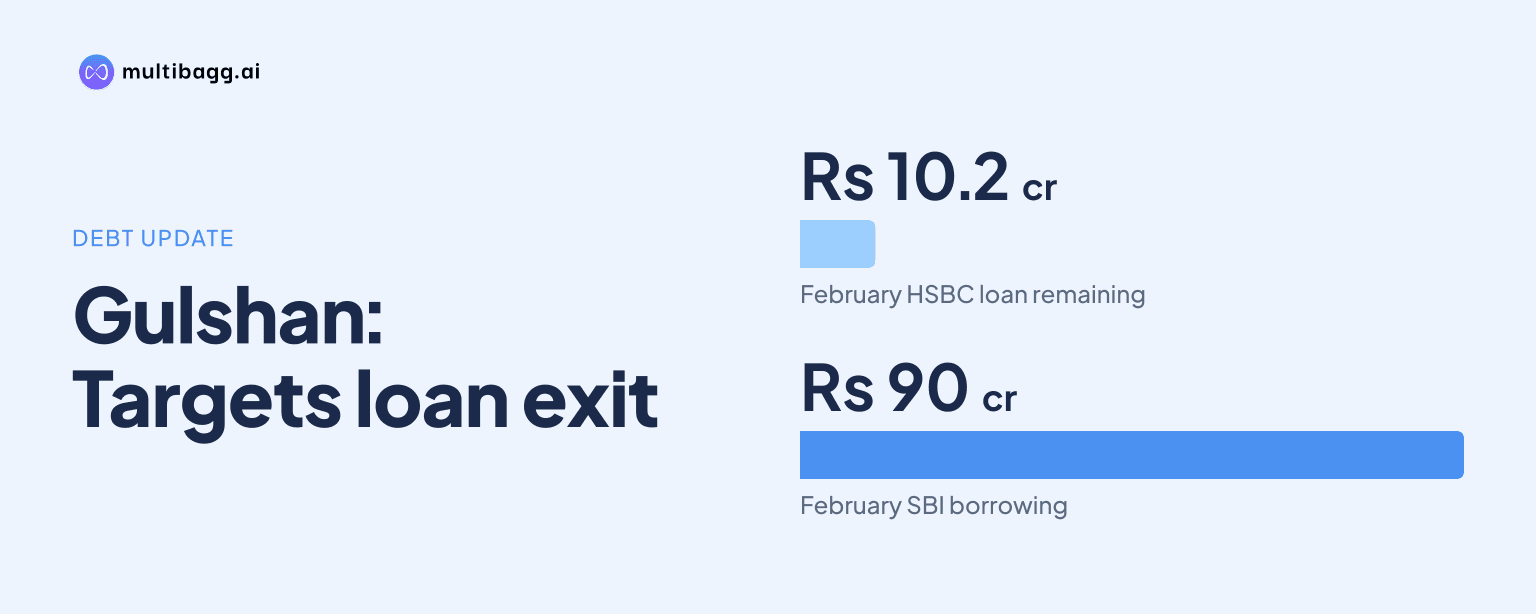
Gulshan Polyols Limited expects to repay its HSBC loan by February, with two instalments described as Rs 10.2 crore remaining, while seeking about Rs 100 crore of bank funding for a Rs 120 crore Muzaffarnagar expansion. Gulshan Polyols said it would draw the proposed new loan in instalments as project spending requires it.
Know Gulshan Polyols inside out
Results, valuation, peers and who's buying, in one view.
When will Gulshan Polyols repay its HSBC loan?
Gulshan Polyols said it expects to be debt-free from HSBC by February after paying two remaining instalments described as Rs 10.2 crore. Rajiv Gupta said the company would then have only State Bank of India, or SBI, debt remaining, estimated at about Rs 90 crore in February.
Management said the SBI borrowing stood at Rs 103 crore at the time of the call and had about 4.5 years remaining, with quarterly instalments. This means the planned February action concerns the exit from HSBC rather than the removal of all bank borrowings.
Gupta described reported long-term debt as Rs 123 crore, split between facilities of Rs 22 crore and Rs 103 crore. Those cited components total Rs 125 crore, creating a Rs 2 crore difference from the stated total; the call did not explain that difference or provide interest rates for either facility.
How will Gulshan Polyols finance Muzaffarnagar expansion?
Gulshan Polyols plans a Rs 120 crore Muzaffarnagar project for sorbitol and MDP/NDC production, with 80% intended to be financed by a bank. Gupta put the expected bank-funded amount at around Rs 100 crore and said the proposal had already been moved to the bank.
Management expects a sanction letter in another two to three quarters, rather than reporting that funding has already been approved. The proposed Rs 100 crore sanction is therefore a financing plan, not an existing drawn balance or a completed lending arrangement.
Gulshan Polyols does not plan to draw the whole proposed loan at once. Gupta said the company would utilise the sanction over the next nine months, drawing instalments only when project requirements arise, which links borrowings to the pace of capital expenditure.
When an analyst asked whether long-term debt could reach Rs 200 crore by March 2027, Gupta said management expected it to be around Rs 125 crore. That outlook reflects the planned HSBC repayment and phased funding for the Rs 120 crore project, subject to loan sanction and project spending timing.
What is Gulshan Polyols building at Muzaffarnagar?
Gulshan Polyols is developing sorbitol and MDP/NDC capacity at Muzaffarnagar within the Rs 120 crore project. Management also discussed an onsite green hydrogen plant because the site does not have a nearby caustic soda producer that can provide hydrogen by pipeline.
Aditi Pasari said other sorbitol producers buy hydrogen in the open market at costs about 20% to 25% higher. She said the onsite green-hydrogen arrangement was a new experiment for Gulshan Polyols and that management hoped it would support cost optimisation, without disclosing a quantified savings target.
The company contrasted Muzaffarnagar with its Bharuch operation, where hydrogen comes through pipelines from DCM and UPL, located about 50 to 100 metres from the plant. Management said the Bharuch supply costs less than satellite hydrogen or open-market procurement, but did not disclose the Muzaffarnagar hydrogen unit's cost, capacity or commissioning date.
Got a follow-up? Ask IRIS
What other capital spending is Gulshan Polyols undertaking?
Gulshan Polyols said capital work in progress, or CWIP, of about Rs 15 crore is spread across Muzaffarnagar, Bharuch and Borgaon. Gupta said Muzaffarnagar accounts for most of this work, while Bharuch and Borgaon receive regular spending to maintain production capacity and efficiency.
The company also received a Rs 5 crore capital subsidy from Assam under the North East Industrial Development Scheme policy. Management said it reduced the subsidy from the relevant capital item on the balance sheet, so it did not affect the profit and loss account in the quarter discussed.
Alongside the sorbitol project, Gulshan Polyols is working to debottleneck ethanol facilities. Pasari said management expects to execute about 22 crore litres by the end of ESY 2026-27 and is assessing how to raise that volume to 24 crore to 25 crore litres; no capital cost was given for this work.
How does ethanol affect Gulshan Polyols’ funding plans?
Gulshan Polyols expects ethanol to remain a major revenue contributor, with management hoping it will account for about 65% to 70% of revenue in coming years. An analyst said ethanol contributed roughly 70% of revenue in the first half referenced on the call, and management agreed that it should remain the company's growth engine.
Feedstock costs could affect the cash generation supporting the wider capital plan. Management said maize-based ethanol can remain sustainable at maize prices up to Rs 26 to Rs 27 per kilogram, but becomes unattractive above that range; it said maize prices had risen from Rs 20 to Rs 21 per kilogram to Rs 30 to Rs 31 per kilogram.
Management said it would focus for the next one to three months on ethanol made from damaged food grains and Food Corporation of India rice, using tender flexibility. It guided for full-year ethanol-segment earnings before interest, tax, depreciation and amortisation, or EBITDA, margin of about 11% to 12%, while saying the second half could be 1 to 2 percentage points lower than earlier levels.
Conclusion
Gulshan Polyols is planning two offsetting financing moves: repayment of the HSBC loan by February and phased borrowing for its Rs 120 crore Muzaffarnagar sorbitol and MDP/NDC project. Management's indication of about Rs 125 crore of long-term debt by March 2027 suggests it expects the new sanctioned facility to be drawn gradually rather than to cause an immediate step-up in debt.
The next disclosed milestones are the expected bank sanction in another two to three quarters and utilisation of the proposed Rs 100 crore facility over nine months. Investors can also watch whether ethanol output reaches management's 22 crore litre target by the end of ESY 2026-27 and whether feedstock switching contains the margin pressure management expects in the second half.