










Gulshan Polyols plans Rs 100-120 crore for derivatives capacity
Key highlights
- Gulshan Polyols plans to invest approximately Rs 100-120 crore in two Muzaffarnagar grain-processing projects.
- The sorbitol project adds 30,000 metric tonnes per annum, taking total capacity to 110,000 metric tonnes per annum.
- Management targets May 2027 commissioning and Rs 200-250 crore of annual revenue at optimal operations.
- Q2 FY27 grain-processing revenue rose 24% to Rs 166 crore, while EBITDA was Rs 2.45 crore.
powered by IRIS
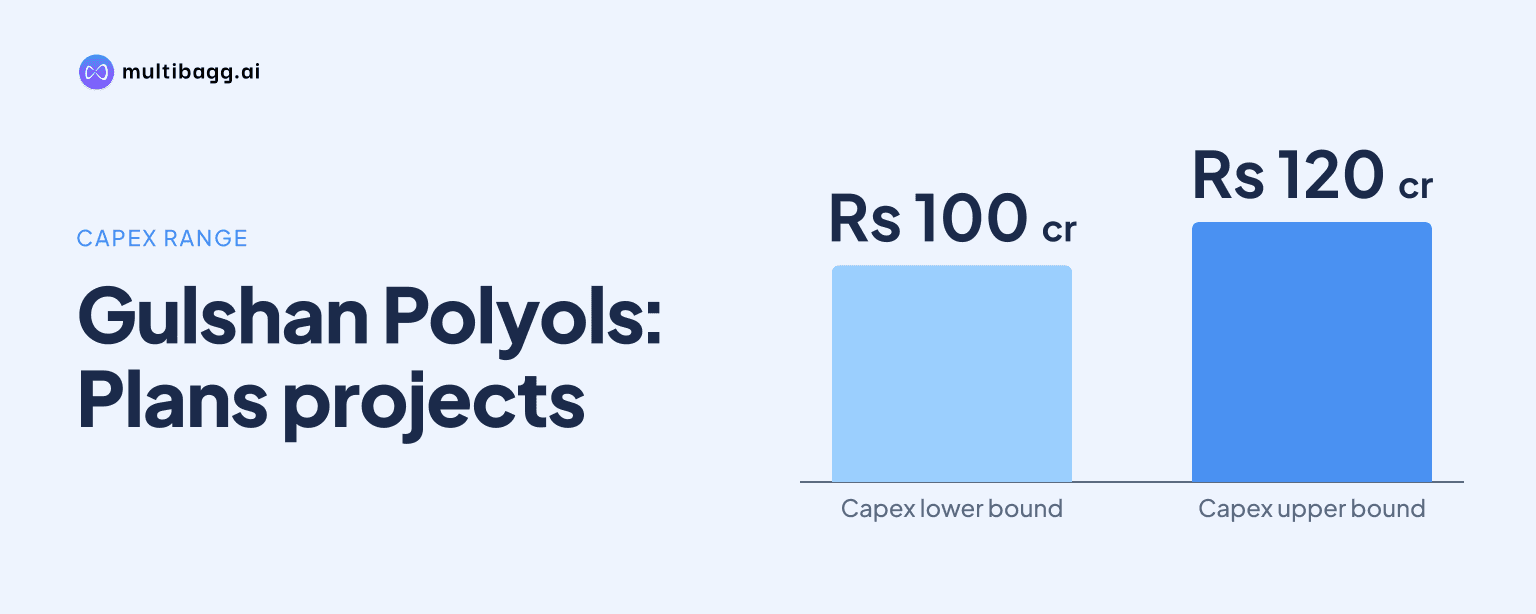
At its November 13, 2026, second-quarter financial year 2027 (Q2 FY27) call, Gulshan Polyols Limited said it would invest Rs 100-120 crore in sorbitol and maltodextrin powder/non-dairy creamer capacity, targeting Rs 200-250 crore of annual revenue at optimal operations and an earnings before interest, tax, depreciation and amortisation (EBITDA) margin of about 10%.
Know Gulshan Polyols inside out
Results, valuation, peers and who's buying, in one view.
What is Gulshan Polyols building at Muzaffarnagar?
Gulshan Polyols is adding a 30,000-metric-tonne-per-annum sorbitol plant and expanding maltodextrin powder capacity to 30,000 metric tonnes per annum at Muzaffarnagar. The sorbitol addition will take total sorbitol capacity to 110,000 metric tonnes per annum, while the second facility will be able to manufacture maltodextrin powder or non-dairy creamer from the same plant.
Maltodextrin powder capacity is currently 5,000 metric tonnes per annum, so the planned 30,000-metric-tonne capacity is a six-fold increase. Management described non-dairy creamer as a higher-value-added product and said the flexible plant would allow Gulshan Polyols to produce either product according to market requirements.
The sorbitol expansion changes Gulshan Polyols' manufacturing coverage because its existing sorbitol facility is in Gujarat and the new plant will be in Uttar Pradesh. Management said the Muzaffarnagar location would bring it closer to North and Northeast Indian consumption markets where the Gujarat footprint had limited its ability to compete effectively.
Both projects sit in grain processing, rather than ethanol, which management identified as the principal driver of growth and earnings. In Q2 FY27, grain processing reported Rs 166 crore of revenue, up 24% year on year, while EBITDA declined to Rs 2.45 crore from Rs 3.7 crore in the corresponding quarter.
How much will Gulshan Polyols spend and how will it fund it?
Gulshan Polyols expects the two Muzaffarnagar projects to require combined investment of approximately Rs 100-120 crore, funded through internal accruals and long-term debt. Management did not provide a separate capital-expenditure allocation for the sorbitol plant and the flexible maltodextrin powder/non-dairy creamer facility during the November 13, 2026 call.
The funding plan follows a reduction in reported debt. Total debt was about Rs 233 crore in Q2 FY27, compared with Rs 312 crore in financial year 2026 (FY26), while cash flow from operations was Rs 119 crore in the first half (H1) of FY27 and was mostly used for debt repayment.
Management said the major investment phase in ethanol was largely behind it, with the stated focus moving to asset utilisation, operating cash flow, working-capital management and leverage. It characterised the Muzaffarnagar expenditure as selective expansion in existing manufacturing areas, rather than entry into a new business line.
The planned outlay follows higher consolidated profitability in H1 FY27. EBITDA increased 97% to Rs 159 crore from Rs 81 crore in H1 FY26, EBITDA margin rose to 12.7% from 7.1%, and profit after tax increased to Rs 92 crore from Rs 29 crore.
Got a follow-up? Ask IRIS
When will Gulshan Polyols' new capacity begin contributing revenue?
Gulshan Polyols targets commissioning both Muzaffarnagar projects in May 2027 and expects a gradual ramp-up over the following two to three years. Management indicated initial-year revenue potential of approximately Rs 120-130 crore, subject to commissioning and market absorption.
At optimal operating levels, management expects the two plants together to generate annual revenue of about Rs 200-250 crore, depending on prevailing market prices. It also indicated EBITDA margin of around 10% for the combined capacity, which is a management target rather than a reported result.
The May 2027 commissioning target falls late in FY27, so the first full-year contribution depends on execution and the pace of customer absorption after start-up. Management is targeting consolidated revenue of Rs 2,800-3,000 crore in financial year 2028 (FY28), compared with approximately Rs 2,600 crore in FY27.
Gulshan Polyols' FY27 revenue plan includes Rs 1,700-1,800 crore from ethanol, approximately Rs 800 crore from grain processing and around Rs 100 crore from mineral processing. The Rs 200-250 crore capacity target is therefore a potential addition within grain processing, although management did not state how much would be incremental to existing product sales.
Why is Gulshan Polyols increasing downstream grain-processing capacity?
Gulshan Polyols said the projects support its move toward higher-value downstream derivatives, particularly sorbitol and maltodextrin powder. Management cited more than 25 years of sorbitol manufacturing experience and an existing export franchise as the foundation for the 30,000-metric-tonne-per-annum capacity addition.
The Q2 FY27 segment comparison provides context for that plan. Ethanol generated Rs 427 crore of revenue and Rs 62.5 crore of EBITDA, producing a 14.6% EBITDA margin compared with 8.5% in the corresponding quarter a year earlier; grain processing generated Rs 166 crore of revenue and Rs 2.45 crore of EBITDA, with margin falling to 1.5% from 2.8%.
Gulshan Polyols also disclosed a separate sorbitol-related arrangement with Zero Footprint Industry Limited. Under a build-own-operate model, Zero Footprint Industry Limited will establish and operate a 6-megawatt green-hydrogen plant at Gulshan Polyols' sorbitol facility under a long-term contract valued at Rs 300 crore.
Management said hydrogen is a major input for sorbitol production and estimated that the arrangement could save almost 20% compared with buying hydrogen on the open market. The green-hydrogen project is separate from the Rs 100-120 crore Muzaffarnagar budget and is expected to reduce carbon emissions by approximately 15,000 tonnes annually, although management did not provide a commissioning date.
Conclusion
Gulshan Polyols is allocating Rs 100-120 crore to enlarge sorbitol production and establish flexible maltodextrin powder/non-dairy creamer capacity. The plan follows Q2 FY27 grain-processing revenue growth of 24% to Rs 166 crore, but a decline in segment EBITDA to Rs 2.45 crore, while ethanol remained the larger earnings contributor at Rs 62.5 crore of EBITDA.
The next disclosed milestone is the May 2027 commissioning target for both projects. Management's initial-year revenue expectation of Rs 120-130 crore, its two-to-three-year ramp-up plan and the FY28 consolidated revenue target of Rs 2,800-3,000 crore will depend on execution and prevailing market conditions.