










Gulshan Polyols says maize above Rs 27/kg hurts ethanol margins
Key highlights
- Gulshan Polyols said maize above Rs 26-Rs 27 per kg makes ethanol production unviable.
- Maize was quoted at Rs 30-Rs 32 per kg, compared with Rs 20-Rs 21 per kg when Gulshan Polyols built inventory.
- The latest 19.7 crore-litre ethanol allocation comprises 65% maize, 25% FCI rice and 10% DFG rice.
- Management cited first-half EBITDA of about 12%-13% and expects pressure in Q3 and possibly Q4.
powered by IRIS
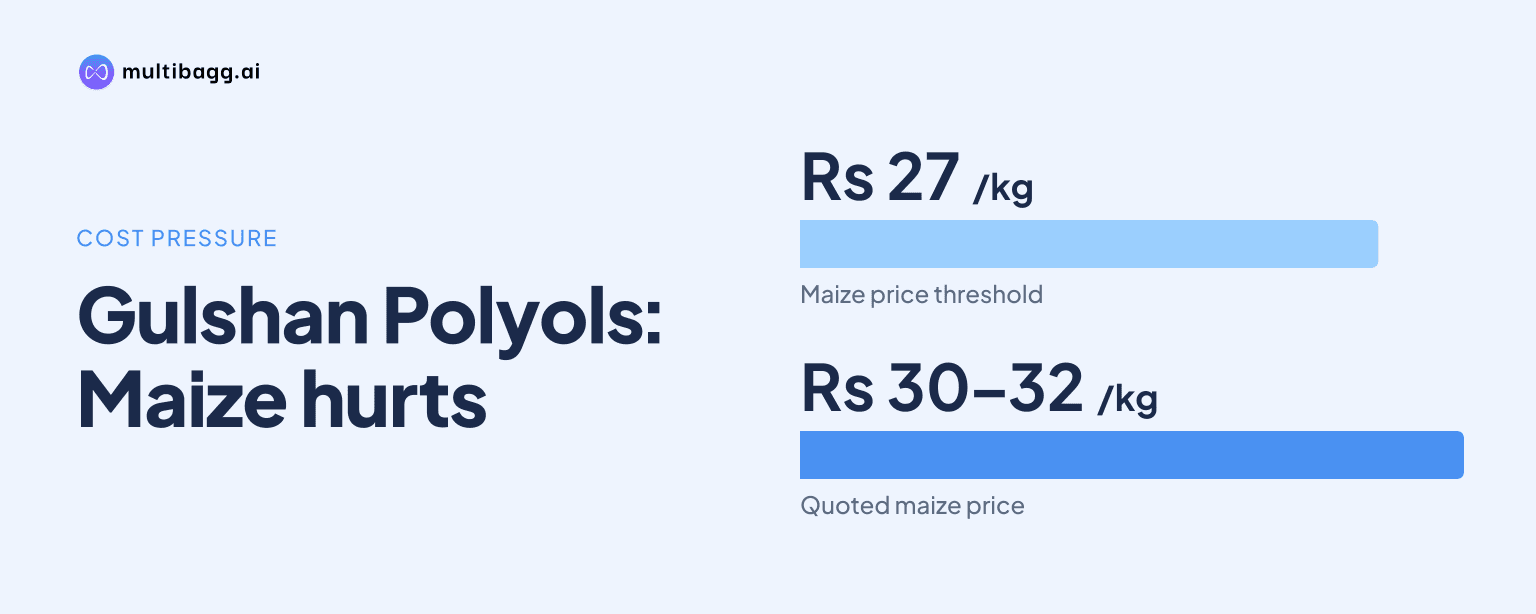
In the call, Gulshan Polyols Limited said ethanol production becomes unviable when maize exceeds Rs 26-Rs 27 per kg, while market prices of Rs 30-Rs 32 per kg point to margin pressure in Q3. Management said first-half earnings before interest, tax, depreciation and amortisation (EBITDA) of about 12%-13% provides some cushion.
Know Gulshan Polyols inside out
Results, valuation, peers and who's buying, in one view.
At what maize price does Gulshan Polyols' ethanol production become unviable?
Gulshan Polyols said maize priced above Rs 26-Rs 27 per kg makes ethanol production unviable under current procurement economics. Management said the business can continue generating positive EBITDA while maize remains at or below that range, but declined to specify EBITDA per litre because feedstock costs and profitability change daily.
The stated threshold is below the Rs 30-Rs 32 per kg market price cited by management during the call. Gulshan Polyols described that level as an all-time high for maize in India, compared with Rs 20-Rs 21 per kg when it had previously procured inventory. The increase of Rs 9-Rs 12 per kg from the earlier purchasing range is the central risk to ethanol profitability.
Management attributed the supply concern partly to an El Niño year and lower rainfall, and said maize prices would remain a concern for the next two to three months. Industry representatives from ethanol and starch businesses have sought a reduction in maize import duty to allow imports, but Gulshan Polyols disclosed no government decision, import approval or revised ethanol procurement price.
How much of Gulshan Polyols' ethanol allocation uses maize?
Gulshan Polyols' latest ethanol allocation of 19.7 crore litres comprises 25% Food Corporation of India (FCI) rice, 10% damaged food grains (DFG) rice and a 65% balance of maize. The maize share matters because the prevailing Rs 30-Rs 32 per kg price is above the company's stated Rs 26-Rs 27 per kg viability range.
Gulshan Polyols said there is no technical bottleneck in changing among maize, FCI rice and DFG rice, and the production switch takes two to three hours. It can ask oil marketing companies (OMCs) to replace maize with DFG when maize economics are unfavourable, although management did not quantify how much of the 19.7 crore-litre allocation OMCs might permit to be changed.
Management retained full-year EBITDA guidance of about 11%-12% for the ethanol segment despite the high maize price. That is a full-year target rather than a forecast for Q3 alone, meaning it incorporates the better first-half outcome as well as the prospect of lower profitability when higher-cost feedstock is used.
How much margin pressure does Gulshan Polyols expect in Q3 and Q4?
Gulshan Polyols expects margin pressure in Q3, with management also saying Q4 could be affected if elevated maize costs persist. Rajiv Gupta said EBITDA margins could be one to two percentage points lower than guidance, while adding that the company aims to protect profitability through its grain inventory and flexibility to use FCI rice or DFG rice.
Management cited EBITDA of around 12%-13% for the first six months as a cushion for the remaining six months. It said it hoped to maintain EBITDA in a 9%-11% range and remain better than the 10% EBITDA it cited for the last financial year, FY26. These were management expectations rather than reported Q3 or Q4 margin results.
The exposure extends beyond the ethanol unit because grain is also a raw material for grain processing. An analyst said ethanol contributed roughly 70% of revenue in H1 and H1 FY26, and management said it hoped the contribution would remain around 65%-70% in coming years. Management's response indicates that ethanol will remain the principal revenue driver even as feedstock costs influence group margins.
Got a follow-up? Ask IRIS
Why did Gulshan Polyols build grain inventory before maize prices rose?
Gulshan Polyols said inventory increased by roughly Rs 60 crore in the quarter because it bought grain in advance for future ethanol and grain-processing production. Management said it anticipated tighter maize availability and procured raw material earlier to maintain production and help retain profitability as prices moved higher.
The inventory was accumulated when maize was around Rs 20-Rs 21 per kg, compared with the Rs 30-Rs 31 per kg level management cited while discussing the stock build-up. This earlier procurement can defer some exposure to spot maize costs, but Gulshan Polyols said it will need additional raw material to meet demand, leaving future buying vulnerable if prices remain above Rs 26-Rs 27 per kg.
Management said the stock position should help limit, rather than eliminate, the effect of higher grain costs. It said margins would not be as high as the Q1 benchmark and would be affected going forward, but expected the impact not to be large because of the inventory and feedstock-switching option. No inventory duration or maize quantity was disclosed.
What other plans could diversify Gulshan Polyols' earnings mix?
Gulshan Polyols is expanding its Muzaffarnagar facility to reduce starch production and add sorbitol, non-dairy creamer and maltodextrin powder. Management targets Rs 200 crore-Rs 250 crore of revenue from the project with EBITDA margin of about 10%-11%, as it seeks to move away from starch, where it said industry overcapacity has prevented recovery of variable costs.
The project has a total cost of Rs 120 crore, with about Rs 100 crore expected to be funded through bank debt and Rs 20 crore from internal accruals. Management said peak revenue could reach Rs 250 crore and optimal utilisation could take two to three years. It suggested an annual mix of 20,000 tonnes of maltodextrin powder and 10,000 tonnes of non-dairy creamer, subject to market demand.
Management cited a selling price of almost Rs 150 per kg for non-dairy creamer, compared with about Rs 50 per kg for maltodextrin. Separately, Gulshan Polyols expects to execute about 22 crore litres of ethanol orders by the end of ESY 2026-27 and is working to debottleneck plants to raise execution to 24 crore-25 crore litres. Those plans retain ethanol as the growth engine while adding products intended to reduce reliance on starch.
Conclusion
Gulshan Polyols has identified Rs 26-Rs 27 per kg as its practical maize-cost limit for ethanol, yet cited current maize prices of Rs 30-Rs 32 per kg. With maize making up 65% of the latest 19.7 crore-litre allocation, management expects lower margins in Q3 and possibly Q4, although first-half EBITDA of about 12%-13%, grain inventory and feedstock flexibility are intended to moderate the impact.
The next measures to watch are maize prices over the two to three months identified by management, OMC decisions on requests to substitute DFG or FCI rice for maize, and margins against the 11%-12% full-year ethanol EBITDA target. Gulshan Polyols' execution of about 22 crore litres by ESY 2026-27 and its plan to reach 24 crore-25 crore litres will also depend on successful debottlenecking and feedstock availability.