










Happiest Minds adds five clients while $1 million accounts stay 52
Key highlights
- Happiest Minds had 311 active customers in Q2 FY27, up from 306 in Q1 FY27.
- Happiest Minds reported 52 million-dollar customers for the third consecutive quarter.
- Average revenue per active customer increased to $875,000 in Q2 FY27 from $866,000 in Q1 FY27.
- Happiest Minds' top 20 customers accounted for 58.7% of revenue.
powered by IRIS
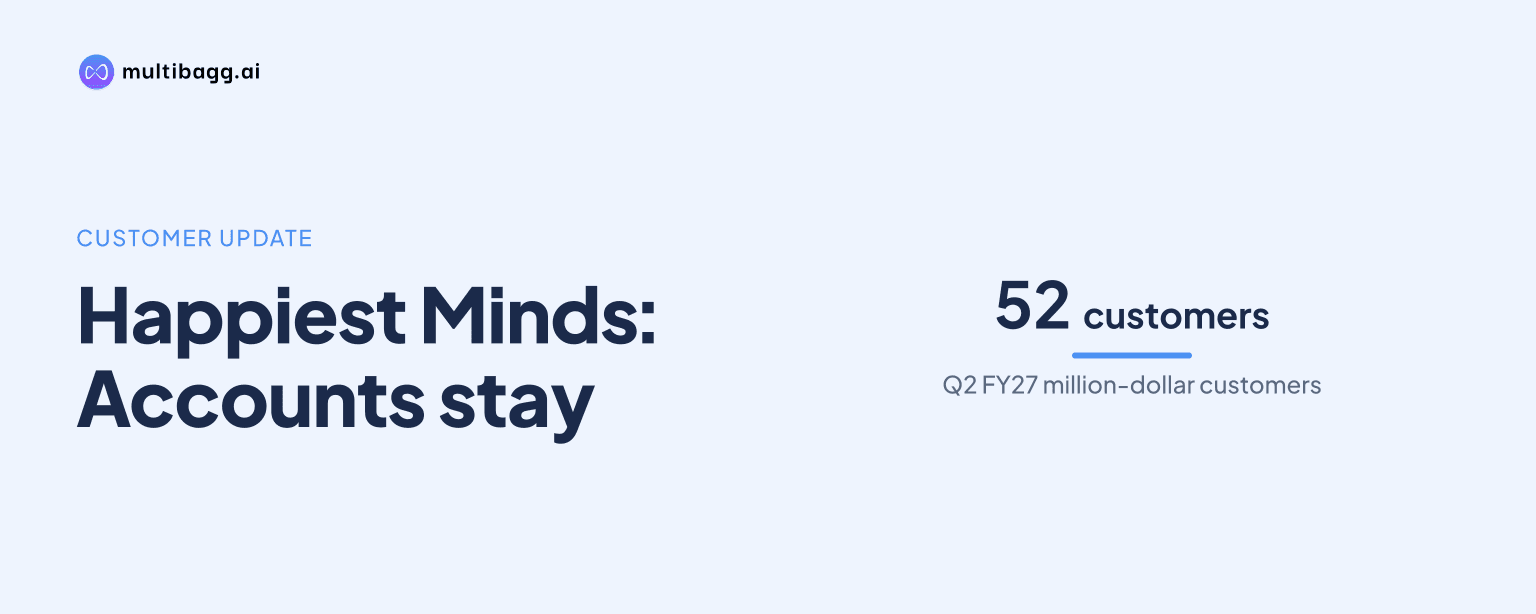
Happiest Minds added five active customers in Q2 FY27, taking its total to 311, but customers generating at least $1 million remained at 52 for a third consecutive quarter. The result shows that the quarterly expansion in active customers did not increase the reported number of large revenue accounts.
Know Happiest Minds Technologies inside out
Results, valuation, peers and who's buying, in one view.
How many customers did Happiest Minds add in Q2 FY27?
Happiest Minds added five active customers in Q2 FY27, increasing the total to 311 from 306 in Q1 FY27. The Q2 FY27 count was also above the 306 active customers reported at FY26, while the million-dollar customer total stayed at 52 in each of those periods.
The active-customer base rose from 250 in FY24 to 281 in FY25 and 306 in FY26. This means Happiest Minds had 61 more active customers in Q2 FY27 than in FY24, although the five-customer sequential increase was smaller than the 25-customer increase between FY25 and FY26.
The customer-count comparison separates expansion of the overall base from growth in larger accounts. Happiest Minds did not identify the five additions in Q2 FY27 or provide their individual revenue contribution, so the presentation does not show whether they were new accounts or changes in the active-customer base.
How did Happiest Minds' million-dollar customer bands change?
Happiest Minds' million-dollar customer total stayed at 52 in Q2 FY27 because increases in two revenue bands were numerically offset by a decline in another band. The $1 million to $3 million group increased to 31 customers from 29, while the $5 million to $10 million group rose to eight from seven.
The $3 million to $5 million band fell to nine customers in Q2 FY27 from 12 in Q1 FY27. Customers generating more than $10 million held at four, leaving the total count of customers generating at least $1 million unchanged at 52.
The Q2 FY27 total remained below the 58 million-dollar customers reported in both Q2 FY26 and Q3 FY26. It had fallen to 52 in Q4 FY26 and was unchanged through Q1 FY27 and Q2 FY27, while the composition moved further toward the $1 million to $3 million range.
Got a follow-up? Ask IRIS
What happened to revenue per active customer in Q2 FY27?
Happiest Minds reported average revenue per active customer of $875,000 in Q2 FY27, compared with $866,000 in Q1 FY27. The $9,000 sequential increase occurred as active customers rose by five, but the Q2 FY27 average was below the FY25 level of $917,000.
Average revenue per active customer increased from $794,000 in FY24 to $917,000 in FY25 before declining to $864,000 in FY26. The Q2 FY27 figure was $11,000 above FY26 and $42,000 below FY25; the presentation does not link this measure to the revenue of individual new customers.
Customer-age data show that relationships of zero to five years contributed 58% of revenue in FY26, up from 56% in FY25 and 52% in FY24. Customers with relationships exceeding five years contributed 42% in FY26, compared with 44% in FY25 and 48% in FY24.
How concentrated was Happiest Minds' customer revenue?
Happiest Minds reported that its top five customers accounted for 28.7% of revenue, its top 10 accounted for 42.4%, and its top 20 accounted for 58.7%. Based on those figures, customers outside the top 20 contributed 41.3% of revenue.
The difference between the top-five and top-10 measures was 13.7 percentage points, representing the contribution from customers ranked sixth to 10th. The presentation does not disclose the share of revenue generated specifically by the 52 million-dollar customers.
Happiest Minds also reported 95 billion-dollar corporations among its customers in Q2 FY27, up from 92 in Q1 FY27 and 91 in FY26. This is a measure of customer-company size rather than the revenue Happiest Minds receives from those accounts, so it is distinct from the 52 million-dollar customer count.
Revenue mix also changed by contract model in Q2 FY27. Fixed-price work represented 31.7% of revenue, up from 30.8% in Q1 FY27 and 26.5% in FY26, while time-and-material work declined to 68.3% from 69.2% and 73.5%, respectively.
Conclusion
Happiest Minds expanded its active-customer base to 311 in Q2 FY27 while its million-dollar customer count remained at 52. The quarter included higher average revenue per active customer of $875,000 and additions in the $1 million to $3 million and $5 million to $10 million bands, but these did not outweigh the decline in the $3 million to $5 million cohort.
What remains unresolved is whether the five additional active customers can progress into higher revenue bands, because the presentation does not identify their revenue contribution. The next reported customer metrics will show whether the $3 million to $5 million group, which declined by three customers in Q2 FY27, recovers and whether the total can move above 52.