










Hexaware banking outpaces growth as GSE cuts curb financial services
Key highlights
- Hexaware banking grew 6.6% sequentially and 13.5% year on year in Q3CY26.
- Financial services grew 3.0% sequentially, but GSE-client cost cuts are expected to continue affecting Q4CY26.
- Technology products and platforms grew 7.2% sequentially and 9.7% year on year in Q3CY26.
- Hexaware narrowed its CY26 adjusted EBIT margin range to 13.0% to 13.5%.
powered by IRIS
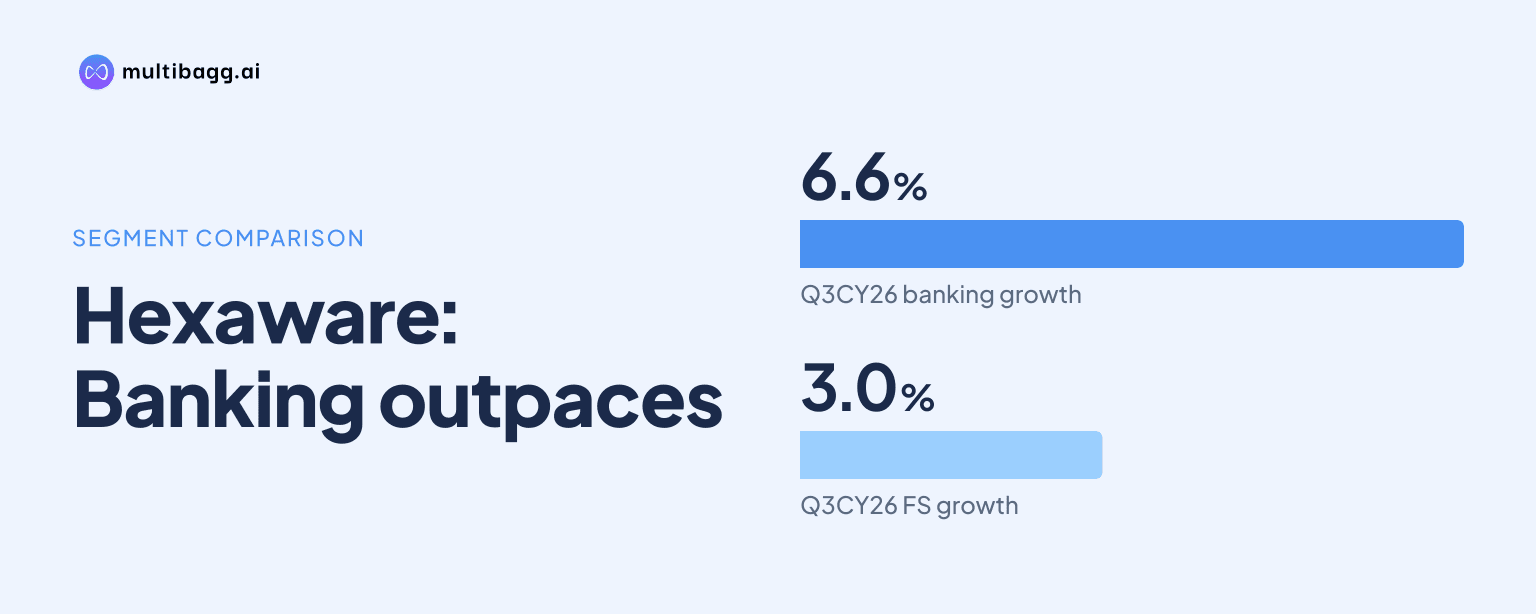
Hexaware’s banking vertical grew 6.6% sequentially and 13.5% year on year in Q3CY26, outpacing total revenue growth of 1.6%, while financial services increased 3.0% sequentially as a GSE client’s cost-optimization programme constrained spending. Management said the headwind affected Q3CY26 and would continue into Q4CY26.
Know Hexaware Technologies inside out
Results, valuation, peers and who's buying, in one view.
How fast did Hexaware’s banking business grow?
Hexaware’s banking business grew 6.6% sequentially in Q3CY26, against 1.6% sequential growth for company revenue, and grew 13.5% year on year. Management said banking had delivered secular growth over the past few quarters and expected the final quarter to be strong for the vertical on a full-year basis.
Banking’s year-on-year increase also exceeded Hexaware’s 4.3% reported revenue growth in Q3CY26. Management attributed banking’s growth to all three geographies, making it broader than the client-specific pressure within financial services. The transcript does not disclose banking revenue, its largest customers or the contribution from each geography.
The company’s Q3CY26 revenue was below management’s expectations because of softness at one GSE client and slower-than-anticipated progress in selected large deals. In constant-currency terms, total revenue grew 1.7% sequentially and 4.5% year on year, compared with reported growth of 1.6% and 4.3%, respectively. Management said volume and better seasonality supported quarterly dollar revenue, partly offset by lower licence revenue.
Why is Hexaware’s financial services growth under pressure?
Hexaware’s financial services business was constrained by a cost-optimization exercise at one GSE client, although the vertical still grew 3.0% sequentially and 2.4% year on year in Q3CY26. Management said Hexaware retained market share at that customer and was not losing business to a competitor, but the client’s lower spending reduced the vertical’s growth.
The two GSE accounts followed different paths in Q3CY26. One client gained traction after a vendor-consolidation exercise completed during the year. The other had benefited from a consolidation exercise in the prior year but is now reducing costs. Management said the second client’s programme affected Q3CY26, will continue to affect Q4CY26, and means financial services should grow for the full year below the company average.
The issue has particular significance in the Americas, where management identified financial services as the largest vertical. Americas revenue rose 1.5% sequentially and 1.1% year on year in Q3CY26, with the GSE softness affecting regional performance. Europe grew 3.1% sequentially and 12.8% year on year on account ramp-ups, while Asia Pacific recorded 20% year-on-year growth led by financial services, banking, and manufacturing and consumer.
Got a follow-up? Ask IRIS
How did other Hexaware verticals perform in Q3CY26?
Hexaware’s technology products and platforms business was the fastest-growing reported vertical in Q3CY26, rising 7.2% sequentially and 9.7% year on year from a smaller base. The company began reporting the vertical separately in the current year. A cited win involved an outcome-based pricing model for an artificial-intelligence customer-experience engagement with a smart-home and property-technology platform.
Manufacturing and consumer grew 1.8% sequentially and 3.0% year on year as earlier deal closures began converting into revenue. Management said growth was spread across accounts, subsectors and geographies, with contributions from existing clients and new logos. Q3CY26 was the fifth consecutive quarter of year-on-year growth for the vertical.
Healthcare and insurance fell 0.4% sequentially but rose 6.3% year on year in Q3CY26, as lower asset revenue outweighed volume and calendar benefits. Management said European ramp-ups supported the underlying business and expected healthcare and insurance to be one of the company’s largest full-year growth contributors. Professional services was broadly stable sequentially after a stronger previous quarter at its largest client, while travel and transportation declined 3.5% sequentially and 8.5% year on year.
What does Hexaware expect in Q4CY26?
Hexaware is not providing a Q4CY26 revenue outlook because its new chief executive is reviewing client commitments, pipeline quality, forecasting assumptions and the sales-to-revenue realization process. Management nevertheless said Q4CY26 should follow its usual seasonal pattern, in which furloughs and fewer working days lead to a sequential revenue decline. The GSE-client headwind and delayed progress in selected large deals are also expected to continue.
Over the next 90 days, management plans to review target markets, service offerings, large-deal execution, go-to-market operations, delivery and investment choices. It said it would share a strategic plan after that assessment is complete. During the current year, Hexaware also moved its hunting sales team from a quota-based to a commission-based incentive plan, which management said it expects to support deal velocity.
Management narrowed its CY26 adjusted earnings before interest and tax margin range to 13.0% to 13.5%, after reporting a 13.6% margin for the year to date through Q3CY26. It expects Q4CY26 margin headwinds from seasonality and merit increases effective October 1, partly offset by better realization, operational improvements and benefits from the Netherlands restructuring. The merit increase is expected to affect margin by close to 100 basis points, or one percentage point.
Conclusion
Hexaware’s Q3CY26 results show banking as a broad-based growth contributor, with 6.6% sequential growth across three geographies and a 13.5% year-on-year increase. Financial services also expanded, but its 3.0% sequential growth was moderated by lower spending at a GSE client, contributing to slower growth in the Americas than in Europe.
The next disclosed watchpoint is Q4CY26, when management expects seasonal revenue pressure alongside the continuing GSE-client effect and slower conversion of selected large deals. Management plans to present its strategic plan after a 90-day review, while its narrowed CY26 adjusted earnings before interest and tax margin range remains 13.0% to 13.5%.