










Hexaware pauses Q4 outlook after Q3 revenue falls below expectations
Key highlights
- Hexaware reported Q3CY26 revenue of Rs 3,933.1 crore, up 2.3% sequentially and 12.9% year on year in rupee terms.
- Hexaware withheld Q4CY26 revenue guidance after dollar revenue grew 1.6% sequentially but fell below management expectations.
- Financial Services grew 3.0% sequentially, but GSE client cost optimisation is expected to continue affecting Q4CY26.
- Hexaware narrowed its CY26 adjusted EBIT margin range to 13.0% to 13.5% after reporting 13.8% in Q3CY26.
powered by IRIS
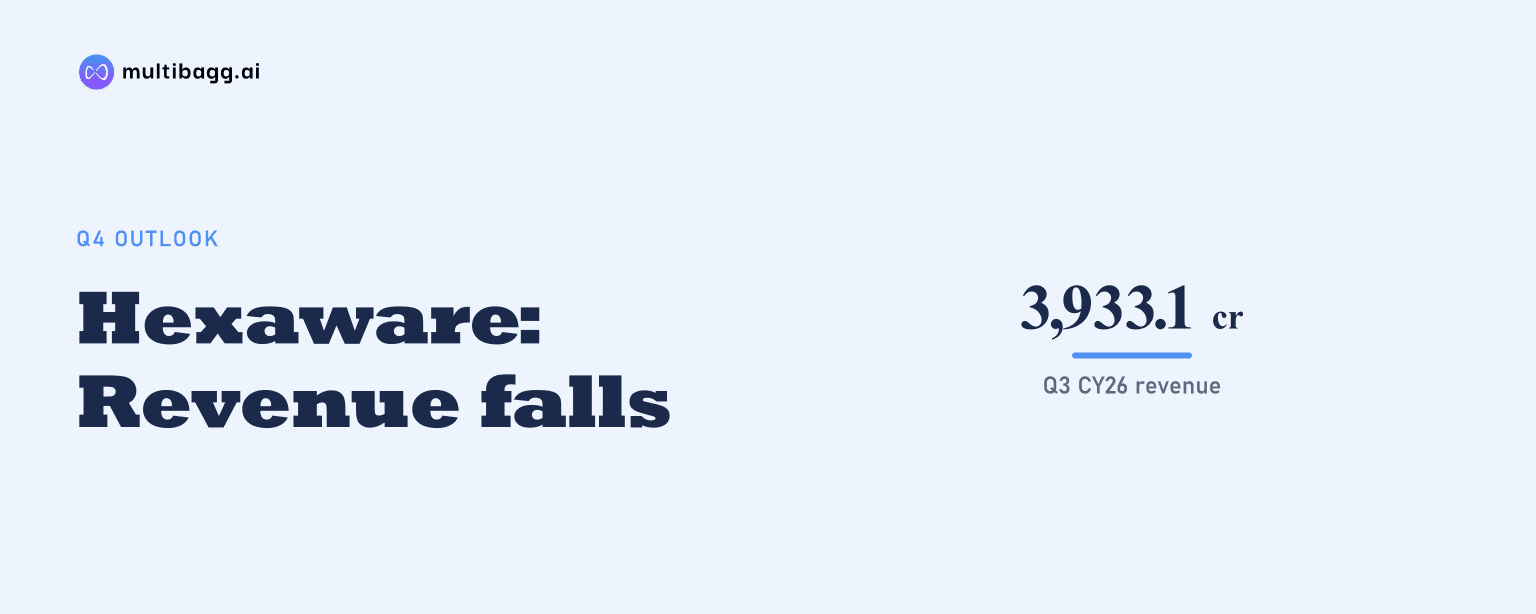
Hexaware Technologies Limited withheld its Q4CY26 revenue outlook after Q3CY26 revenue of Rs 3,933.1 crore rose 1.6% sequentially but came in below management expectations, reflecting softness at one government-sponsored enterprise client and slower progress in selected large deals. The company said the new chief executive officer will review forecast assumptions and revenue-conversion processes.
Know Hexaware Technologies inside out
Results, valuation, peers and who's buying, in one view.
Why did Hexaware withhold its Q4CY26 revenue outlook?
Hexaware withheld Q4CY26 guidance to assess client commitments, pipeline quality and the assumptions supporting its growth expectations. Chief Executive Officer Vivek Jetley said the company will also review its sales-to-revenue-realisation process and forecasting before it can confidently stand behind its next outlook.
The decision followed Q3CY26 revenue growth of 1.6% sequentially, below management’s expectations. Jetley attributed the gap to softness at one government-sponsored enterprise, or GSE, client and slower-than-anticipated progress in selected large deals, while saying several verticals still expanded during the quarter.
Jetley said Hexaware will share priorities for the following year and the assumptions behind them when it reports full-year results. His initial 90-day review covers strategic clients, people and execution, and capability and investment choices, with the stated aim of improving the rigor and accuracy of forecasts.
What was Hexaware’s Q3CY26 revenue performance?
Hexaware reported Q3CY26 revenue of Rs 3,933.1 crore, up 2.3% sequentially and 12.9% year on year in rupee terms. In US dollar terms, revenue was US$411.9 million, up 1.6% sequentially and 4.3% year on year; constant-currency growth was 1.7% sequentially and 4.5% year on year.
Management said a US$7 million sequential increase in dollar revenue reflected volume growth and better seasonality, partly offset by lower licence revenue. Banking and Technology Products and Platforms, or TPP, led sequential growth by vertical, while Europe and Asia-Pacific were the principal geographic contributors.
Six of seven verticals delivered year-on-year growth in Q3CY26, according to management. That comparison indicates the revenue miss was linked to the identified GSE account and large-deal timing rather than a decline described across the entire portfolio.
How did GSE softness and delayed deals affect Hexaware?
Hexaware said a GSE client in its Financial Services segment is conducting a cost-optimisation exercise that affected Q3CY26 and will continue to affect Q4CY26. Management said Hexaware retained its market share at that client and was not losing business to a competitor, but the customer’s cost actions reduced demand.
Financial Services grew 3.0% sequentially and 2.4% year on year in Q3CY26 despite that headwind. Another GSE client in the segment was gaining traction after a vendor-consolidation exercise completed during the year, providing an offset to the cost-optimisation pressure at the other account.
Management expects Financial Services to grow for the full year, but below Hexaware’s company average after absorbing the GSE impact. The company also identified slower progress in selected large deals as a separate Q3CY26 constraint, but did not disclose the value of those deals, the customers involved or revised conversion timing.
Got a follow-up? Ask IRIS
Which businesses offset the Q3CY26 pressure?
Hexaware’s Manufacturing and Consumer segment grew 1.8% sequentially and 3.0% year on year in Q3CY26, its fifth consecutive quarter of year-on-year growth. Management said earlier deal closures began converting into revenue, with contributions from existing accounts and new clients across subsectors and geographies.
Healthcare and Insurance declined 0.4% sequentially but rose 6.3% year on year. Management attributed the sequential decline mainly to lower asset revenue, partly offset by volume and calendar benefits, while saying ramp-ups and broad-based growth in its Europe portfolio should make the segment one of the stronger full-year growth drivers.
TPP was also among the sequential-growth leaders. In Q3CY26, Hexaware cited a smart-home and property-technology engagement for artificial intelligence-enabled customer experience using outcome-based pricing, as well as artificial-intelligence work in pharmaceuticals, manufacturing, banking and utilities; it did not disclose revenue from these wins.
What is Hexaware expecting for Q4CY26 margins?
Hexaware expects Q4CY26 margins to face seasonal and merit-increase headwinds, partly offset by better realisation and operational improvements. The company narrowed its CY26 adjusted earnings before interest and tax, or EBIT, margin range to 13.0% to 13.5%.
Q3CY26 reported EBIT margin was 12.2%, while adjusted EBIT margin was 13.8% after excluding 160 basis points of specified items. Adjusted EBIT improved 17 basis points sequentially, supported by calendar effects and foreign exchange, partly offset by capability investments, growth investments and a higher onshore revenue mix.
The restructuring of Netherlands operations created a one-off cost of close to US$6 million in Q3CY26, including severance, legal and lease-closure effects. Management expects this action to improve annual operating margin by 40 basis points, but said merit increases effective October 1 carry an impact of close to 100 basis points in Q4CY26.
The quarter also included acquisition-related accounting effects: a 530-basis-point earnout reversal related to SMC and a 110-basis-point earnout charge related to Cybersolve. Management said the resulting 420-basis-point net credit in other income was partly offset by 140 basis points of intangible amortisation.
What will Hexaware assess before its next outlook?
Hexaware will use the next 90 days to assess strategic-client priorities, delivery execution and investments in industry expertise, differentiated solutions and artificial-intelligence offerings. Jetley said this work will inform a strategic plan setting out where Hexaware intends to compete, its choices and measures of progress.
The company’s artificial-intelligence strategy has three pillars: AI for information technology, AI for business and AI foundations. Its Zero Friction Enterprise offering includes Zerovity, an enterprise technology-intelligence platform, and management said eight customers had moved workloads to AI-native or cloud-native environments since the offering launched earlier in 2026.
Hexaware remains on track for its previously stated target of 250 focused technology experts and 1,000 AI architects by the middle of next year. It also reported that about 1,200 employees were Anthropic certified in Q3CY26, but did not quantify revenue expected from Anthropic-related work or from its broader artificial-intelligence pipeline.
Conclusion
Hexaware’s withdrawal of Q4CY26 revenue guidance reflects a reset of forecasting processes after Q3CY26 revenue grew 1.6% sequentially but fell below management expectations. Financial Services faced a GSE cost-optimisation headwind and delayed large deals, while Banking, TPP, Manufacturing and Consumer, and year-on-year Healthcare and Insurance growth provided offsets.
The next scheduled disclosure is Hexaware’s full-year result, when Jetley said he will set out priorities for the following year and the assumptions behind them. Q4CY26 will also show whether better realisation, Netherlands restructuring benefits and operating improvements can partly offset seasonal pressure, merit increases and continued GSE-related demand softness.