










Hexaware reverses SMC earnout as GCC setup demand slows
Key highlights
- SMC met its first-year earnout targets and received a material payout last year, but missed ambitious targets in year two.
- Hexaware reported 1.7% growth in the third quarter and said revenue was below its expectations.
- Asset revenue contributes 2% of Hexaware’s full-year revenue and typically ranges from 1.5% to 2.5% of quarterly revenue.
- Hexaware said it won most vendor-consolidation initiatives entered, with one pending result and one negative outcome.
powered by IRIS
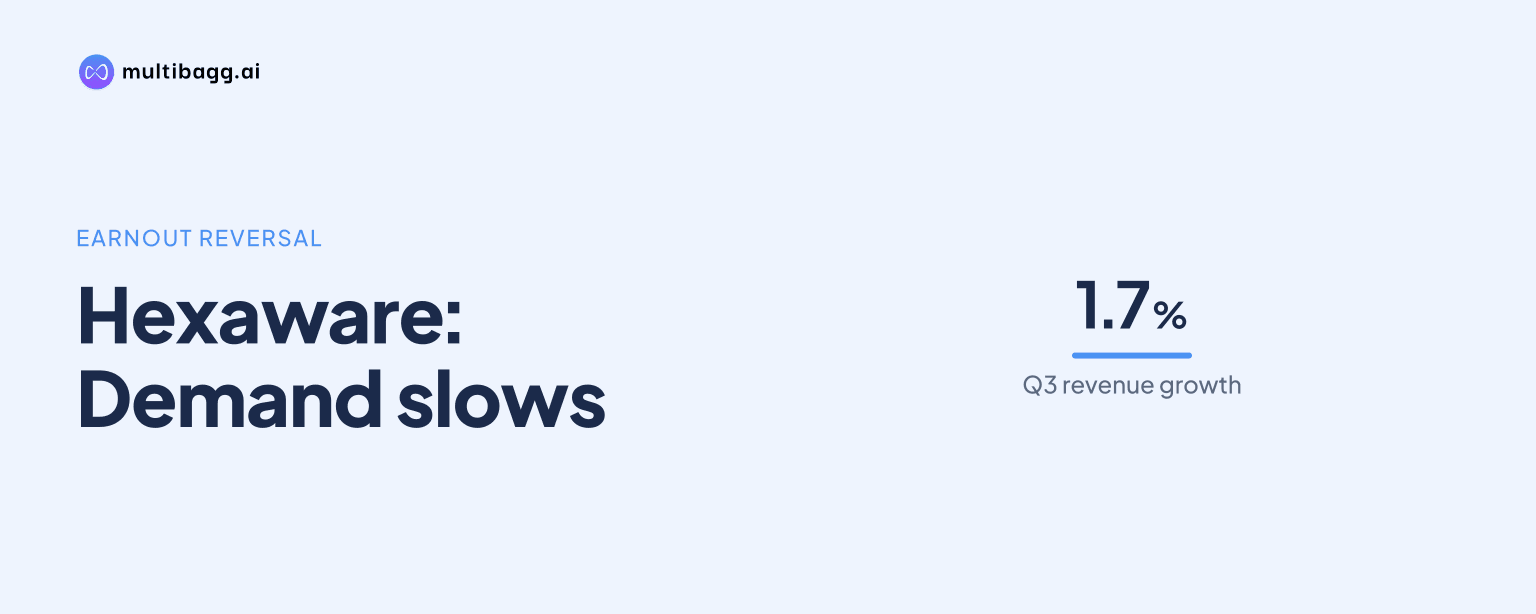
In SMC’s second performance year, Hexaware reversed part of its earnout after the global capability centre business missed ambitious growth targets, while security acquisition CyberSolve exceeded acquisition assumptions and prompted an enterprise valuation restatement. Management linked part of SMC’s shortfall to clients delaying global capability centre setups while introducing artificial intelligence into existing operations.
Know Hexaware Technologies inside out
Results, valuation, peers and who's buying, in one view.
Why did Hexaware reverse the SMC earnout?
Hexaware reversed the SMC earnout because SMC fell short of the ambitious growth targets set for its second performance year. Management said SMC was acquired to establish global capability centre, or GCC, capability rather than to add scale, so the transaction’s underlying business case assumed high growth and tied a large part of the payment to that delivery.
The comparison between SMC’s first and second years is clear. SMC met the required numbers in its first year, and Hexaware paid a material portion of the earnout last year. In year two, however, SMC was below the ambitious targets, which led to the reversal. The call did not disclose the value of the reversal, the target thresholds, SMC revenue, or the original transaction value.
Hexaware has continued to run SMC as a separate business because, management said, clients view an information-technology services provider differently from a GCC service provider. That separate operating model means the year-two shortfall relates to the acquired GCC capability and its growth case, rather than representing a disclosed measure of Hexaware’s overall revenue performance.
The earnout mechanism is central to interpreting the result. Management said small capability acquisitions are principally intended to help the wider business grow revenue at a different momentum, and performance-linked payouts are therefore part of their structure. SMC’s lower year-two delivery reduced the expected payout after a first year that had produced a material payment.
How did artificial intelligence affect Hexaware’s GCC opportunity?
Hexaware said some clients are moving more slowly on GCC setup decisions because they are introducing artificial intelligence, or AI, into their existing operations before deciding on new setups. Management said these clients are seeking a new cost baseline after AI adoption, and that reassessment contributed to SMC missing its year-two growth expectations.
The mechanism affects the specific capability SMC was bought to provide. A client considering a new GCC may first assess how AI changes the cost and operating model of work already performed internally. Hexaware said that sequence has slowed certain decisions, reducing the pace at which SMC could deliver the growth embedded in its earnout targets.
Management did not describe the issue as a broad macroeconomic contraction in GCC demand. Vikash Jain said there was some industry effect but that he would not call out much macro impact. The disclosed issue is therefore delayed client decision-making around GCC formation, not evidence from the call that clients have cancelled GCC strategies altogether.
The decision delays occurred alongside a softer third quarter for the wider company. Hexaware reported 1.7% growth in the third quarter, below its expectations, citing spending curbs at one client and slower progress on some large deals. Management said delayed deal decisions were largely in healthcare and insurance and travel and transportation, while healthcare and insurance remained one of its fastest-growing and best-performing verticals in the current year.
Got a follow-up? Ask IRIS
Why did CyberSolve require an additional charge?
CyberSolve required an additional charge because it performed above the assumptions used when Hexaware set its enterprise valuation at acquisition. Management said CyberSolve, acquired in the security space, was performing very well against the estimates made when the transaction was structured.
The outcome is the opposite of SMC’s year-two result. SMC missed ambitious growth targets and generated an earnout reversal, whereas CyberSolve outperformed the assumptions supporting its original valuation. Hexaware said that, after making CyberSolve’s first earnout payment, it concluded the business was likely to exceed its numbers and had to restate the enterprise valuation.
Management described the additional charge as the consequence of paying for better performance, not an operating shortfall at CyberSolve. The transcript does not provide the restated enterprise valuation, the charge amount, CyberSolve revenue, or the timing and size of future payments. It nevertheless establishes that the revised valuation followed performance above the acquisition model.
The two acquisitions illustrate how the same contingent-payment framework can produce different accounting outcomes. For SMC, delivery below the year-two case resulted in a reversal. For CyberSolve, delivery significantly ahead of the original estimate resulted in a higher expected payment and an incremental charge.
What do these acquisition outcomes mean for Hexaware’s growth plans?
Hexaware’s acquisition results show divergent performance in two capability areas: security is ahead of the assumptions used for CyberSolve, while GCC services are behind the ambitious year-two case for SMC. CyberSolve’s result supports management’s assessment that the security acquisition is exceeding its original transaction expectations, whereas SMC is affected by slower client GCC setup decisions.
These outcomes come as Hexaware’s third-quarter growth was 1.7% and management said revenue was below expectations. The company attributed that result to one client’s spending curbs and slower large-deal progress, rather than to the asset-revenue business. Management said asset revenue contributes 2% of full-year revenue and can range from 1.5% to 2.5% of quarterly revenue.
Management also said the commercial pipeline remained intact, although it could not be definitive on whether delayed deals would close in the fourth quarter or first quarter. Hexaware said it had won most vendor-consolidation initiatives it entered, with one initiative pending and one negative result. Those comments concern the broader pipeline and do not provide a revenue outlook for SMC or CyberSolve.
On AI, management identified three areas of focus: AI for information technology work, AI for business outcomes, and AI foundations. It cited the Zerovity platform for AI for information technology and an Anthropic partnership in its AI-foundation efforts. The call did not quantify revenue from Zerovity, the Anthropic partnership, SMC, or CyberSolve.
Conclusion
Hexaware’s earnout outcomes reflect different delivery trajectories across its capability acquisitions. SMC met its first-year targets but missed ambitious second-year growth expectations as some clients deferred GCC decisions while assessing AI-led changes to their cost base. CyberSolve moved in the other direction, exceeding acquisition assumptions and causing Hexaware to restate its enterprise valuation after the first earnout payment.
The next indicators are whether delayed large deals close in the fourth quarter or first quarter and whether GCC setup decisions resume after clients complete their AI-related cost assessments. Management expects the fourth quarter to follow its usual seasonal pattern of furloughs and fewer working days, leading to a sequential decline, while it continues to assess where Hexaware should play, invest and execute.