










Hindustan Foods footwear returns to profitability in Q2 FY27
Key highlights
- Hindustan Foods said footwear returned to profitability in Q2 FY27 after completing legacy fixed-price orders.
- Hindustan Foods said its footwear order book is full until March 2027.
- October 2026 was the highest-ever monthly turnover for Hindustan Foods’ footwear division.
- Hindustan Foods reported Q2 FY27 adjusted profit after tax of Rs 46 crore, up 22% year on year.
powered by IRIS
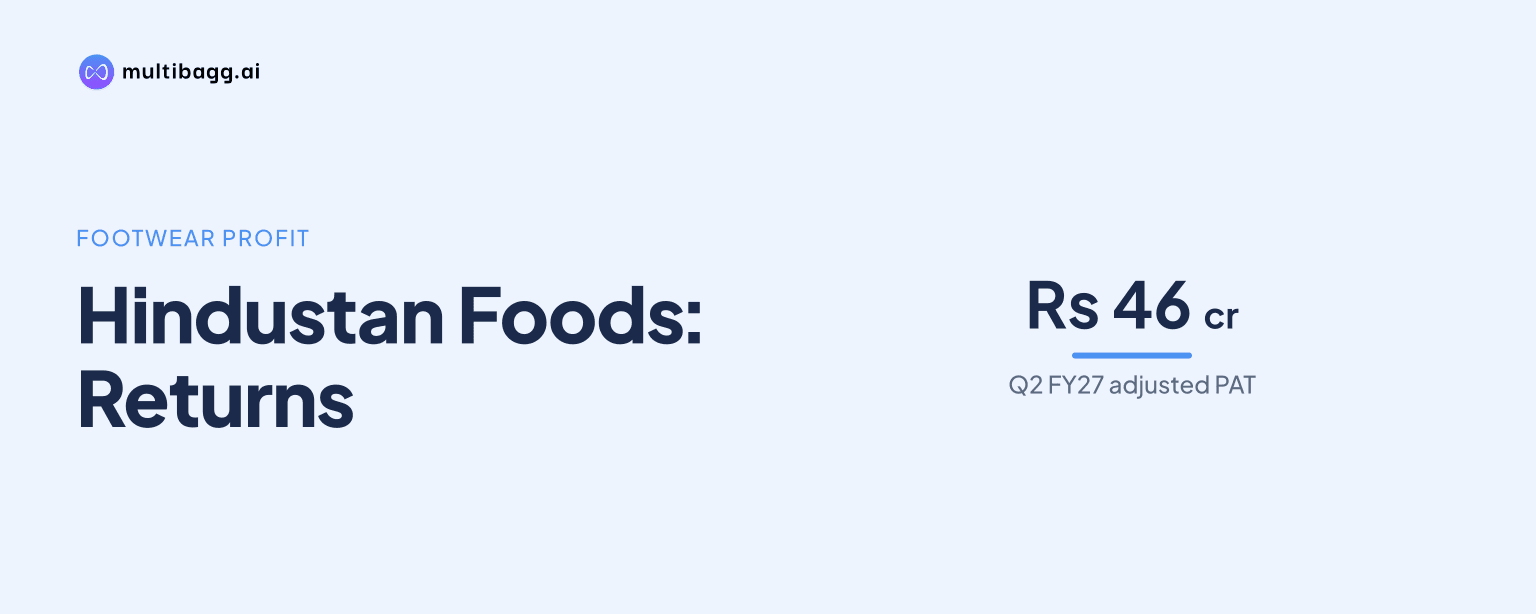
In the second quarter of financial year 2027 (Q2 FY27), Hindustan Foods Limited said its footwear division returned to profitability after completing legacy fixed-price orders affected by higher input and wage costs; management said the division’s order book is full through March 2027. The recovery coincided with adjusted profit after tax of Rs 46 crore for the quarter.
Know Hindustan Foods inside out
Results, valuation, peers and who's buying, in one view.
Why did Hindustan Foods footwear return to profit?
Hindustan Foods said footwear returned to profitability in Q2 FY27 because it completed the remaining older fixed-price orders and secured fresh orders at prices reflecting its current cost base. In the first quarter of financial year 2027 (Q1 FY27), the division faced a two-part cost increase: higher raw-material costs and revised wage rates. Management said the older orders had been priced before those increases, which reduced the division’s profitability while they were being fulfilled.
The Q2 FY27 change was therefore driven by a reset in the order mix rather than by a disclosed fall in wage or material costs. Hindustan Foods said all new footwear orders now carry revised prices that reflect the current cost structure. It also cited improved raw-material procurement and ongoing shop-floor efficiency measures. Hindustan Foods did not disclose footwear revenue, profit, margin or the monetary scale of the Q1 FY27 impact, so the turnaround can be identified operationally but not quantified from the call.
What changed in Hindustan Foods footwear pricing?
Hindustan Foods said the key pricing change was the replacement of legacy fixed-price contracts with fresh orders negotiated at revised prices. The legacy orders were the direct problem in Q1 FY27 because raw-material costs and wage rates had moved higher after the contracts were priced. By Q2 FY27, management said the remaining fixed-price legacy orders had been completed, removing that stated source of pressure.
This sequence matters because Hindustan Foods described the recovery as an adjustment to current manufacturing costs, not as a one-time accounting movement. The footwear division also worked on procurement and factory efficiencies alongside repricing, according to management. Hindustan Foods did not specify whether revised prices were accepted by every customer, the size of price increases, or the time needed for procurement savings to flow through, leaving those details unresolved despite the Q2 FY27 return to profitability.
Is Hindustan Foods footwear recovery supported by orders?
Hindustan Foods said the footwear order book is full until March 2027, giving management visibility for the remainder of FY27. It also said October 2026 produced the highest-ever monthly turnover in the history of the footwear division. Those disclosures show activity continued after the legacy orders were completed, although Hindustan Foods did not provide the October turnover amount or order-book value.
Management said Hindustan Foods had onboarded new brands for sports shoes and sneakers, broadening the footwear division’s customer portfolio. To meet that demand, Hindustan Foods has started work at its existing Chennai factory to add capacity for sports shoes. Hindustan Foods did not state the additional capacity, investment amount or commissioning date for the Chennai work. Its expectation that footwear profitability will ramp up through the second half of FY27 is management’s outlook, based on revised pricing, the order book and incoming customers.
Got a follow-up? Ask IRIS
How did footwear affect Hindustan Foods’ Q2 FY27 results?
Hindustan Foods reported adjusted profit after tax of Rs 46 crore in Q2 FY27, up 22% year on year, while adjusted profit after tax for the first half of FY27 rose 30% to Rs 89 crore. Management identified footwear as the biggest change between Q1 and Q2 when discussing the increase in earnings from shared manufacturing. It said the division had started “delivering money” in Q2 FY27 after the Q1 cost pressure.
Hindustan Foods’ Q2 FY27 total income was Rs 1,269 crore, up 18% year on year, and earnings before interest, tax, depreciation and amortisation (EBITDA) increased 26% to Rs 115 crore. Profit before tax before exceptional items rose 25% to Rs 61 crore. Reported profit after tax was Rs 45 crore after a Rs 1.3 crore exceptional loss linked to flooding at the Silvassa facility, where operations were disrupted for about 1.5 months.
The footwear recovery occurred while other parts of Hindustan Foods’ manufacturing platform absorbed the Silvassa disruption. Management said operations at the existing Silvassa factory had since normalised, while home and personal care, food and beverages, ice cream, and over-the-counter pharmaceutical businesses continued to see healthy demand and capacity utilisation. The comparison shows footwear moved from a Q1 FY27 cost issue to Q2 FY27 profitability while the broader group delivered higher quarterly income and adjusted profit despite the flooding-related loss.
What could determine Hindustan Foods footwear earnings in H2 FY27?
Hindustan Foods said second-half FY27 footwear earnings should be shaped by execution of its full order book, the durability of revised pricing, procurement improvements and the ramp-up of sports-shoe capacity at Chennai. Management expects the division to further increase profitability during the second half of FY27 and to contribute significantly to growth over the next few years. That is a management expectation rather than a forecast supported by disclosed divisional revenue or margin targets.
At the group level, management said assets worth more than Rs 300 crore would begin commercialisation from December 2026 and contribute to the bottom line in Q4 FY27. It said this, together with improved capacity utilisation and easing first-half disruptions, supports its aim to close FY27 with profit after tax above Rs 200 crore. Footwear is one component of that plan, but Hindustan Foods did not separate the division’s expected contribution from new projects in beverages, ice cream, malt beverages, Ayurvedic supplements or carbonated soft drinks.
Conclusion
Hindustan Foods’ footwear turnaround in Q2 FY27 rests on a stated operational change: it completed old fixed-price orders exposed to higher raw-material and wage costs, then shifted fresh orders to revised pricing. The full order book through March 2027 and record October 2026 turnover support management’s view that activity continued beyond the legacy contracts, but the absence of divisional financial disclosure means the size and margin of the recovery cannot be measured from the call.
The next disclosed milestone is Hindustan Foods’ planned Capital Markets Day in early December 2026, when management said it would discuss FY28 and longer-term plans in more detail. Other disclosed items to watch are the Chennai sports-shoe capacity work, conversion of the order book through March 2027, and commercialisation from December 2026 of assets worth more than Rs 300 crore as management pursues profit after tax above Rs 200 crore for FY27.