










Hindustan Foods shifts contracts to improve cash conversion
Key highlights
- Hindustan Foods reported operating cash flow of more than Rs 57 crore in H1 FY27, compared with negative operating cash flow in H2 FY26.
- Hindustan Foods said its net-revenue model preserves absolute EBITDA and PAT while reducing GST, inventory and receivables needs.
- Additional Hindustan Foods customers are scheduled to move to the net-revenue model from Q4 FY27.
- Hindustan Foods reported Q2 FY27 adjusted PAT of Rs 46 crore, up 22% year on year.
powered by IRIS
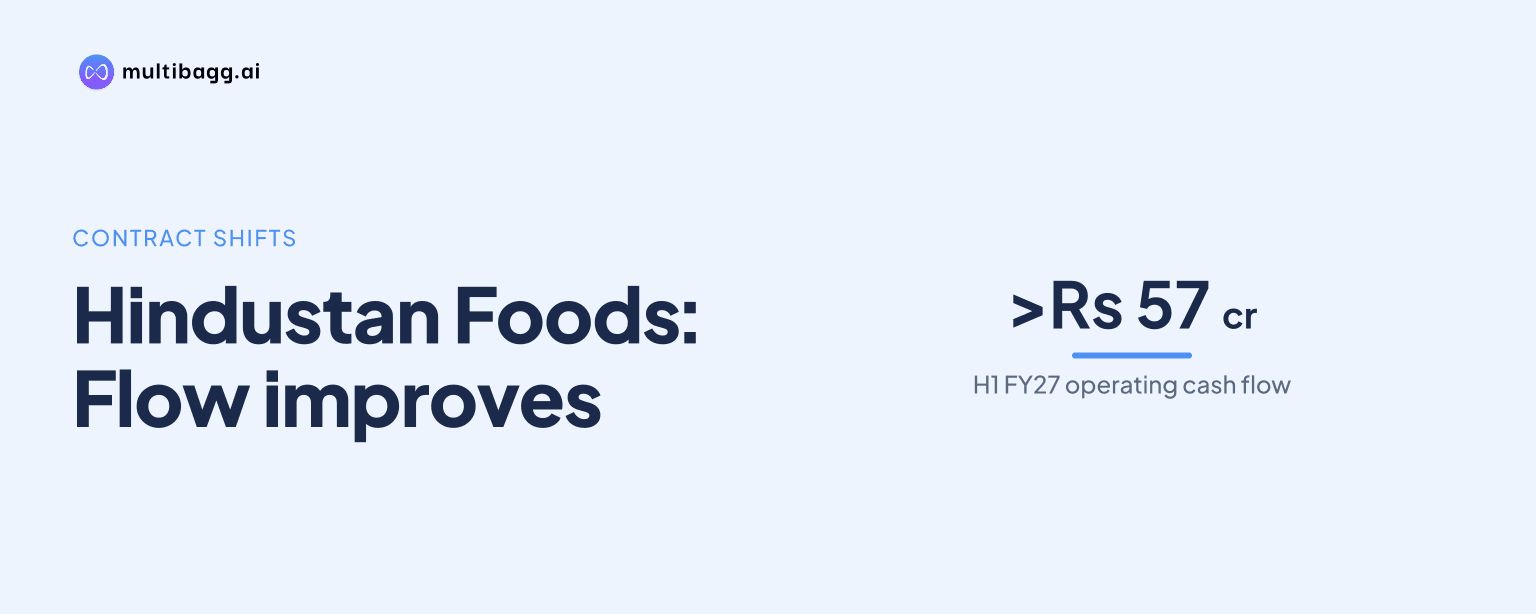
Hindustan Foods Limited said its shift of selected customer contracts from gross to net revenue recognition helped deliver operating cash flow of more than Rs 57 crore in H1 FY27, while preserving absolute profitability. Management said the model reduces goods and services tax, inventory and receivables-related working-capital needs, with further customer transitions planned from Q4 FY27.
Know Hindustan Foods inside out
Results, valuation, peers and who's buying, in one view.
Why is Hindustan Foods moving selected contracts to net revenue?
Hindustan Foods is moving selected customer businesses to a net-revenue model to reduce working capital locked in tax, inventory and receivables without changing the absolute profit earned from those businesses. Group Chief Financial Officer Mayank Samdani said the measure addresses an inverted goods and services tax, or GST, structure in some product categories, where GST paid on raw materials and packaging was higher than tax collected on finished-goods sales.
That tax mismatch led to accumulated input tax credit, leaving part of Hindustan Foods' working capital with the government. The company also increased inventory amid geopolitical uncertainty to protect supplies for customers, which added to cash tied up in stock. Management identified these two mechanisms when explaining the earlier operating cash-flow pressure.
Under the revised arrangement, Hindustan Foods said material-related GST outflow, inventory needs and receivables on its balance sheet are lower. The company did not disclose the number of customers already transitioned, the sales covered, the contract terms or the amount of working capital released, so the direct impact on reported revenue cannot be calculated from the call.
What changed in Hindustan Foods' H1 FY27 cash flow?
The initial benefit of the net-revenue transition was reflected in cash flow from operations of more than Rs 57 crore in H1 FY27, according to Hindustan Foods. Management compared this with negative operating cash flow in H2 FY26, when the GST structure and higher inventory absorbed cash. The transcript does not state the H2 FY26 cash-flow amount, preventing a calculation of the improvement.
Management said the accounting and operating change is neutral to absolute earnings. In a later analyst exchange, Samdani said earnings before interest, tax, depreciation and amortisation, or EBITDA, and profit after tax, or PAT, would remain the same under net revenue. Therefore, a lower reported gross revenue figure for transitioned contracts would not itself indicate lower profit from those businesses.
Hindustan Foods reported total income of Rs 1,269 crore in Q2 FY27, up 18% year on year, while EBITDA rose 26% to Rs 115 crore. Adjusted PAT increased 22% to Rs 46 crore. Profit growth exceeded total-income growth in the quarter, although management did not isolate the contribution of net-revenue contracts to income, EBITDA or margins.
Will more Hindustan Foods customers adopt net revenue in Q4 FY27?
Yes, Hindustan Foods said additional customers had agreed to transition to the new revenue-recognition model from Q4 FY27. Management expects the working-capital benefits to become more meaningful as further businesses move to the model. It did not identify the customers or disclose the proportion of sales, inventory and receivables expected to transition.
Management also expects recently announced GST changes to ease the inverted-duty structure in several product categories and reduce the accumulation of input tax credit. These are separate mechanisms: the contract transition reduces cash needs for selected businesses, while GST changes may lower the underlying mismatch between taxes on inputs and finished goods. The company did not quantify either benefit.
Hindustan Foods expects significantly stronger cash flow from operations in H2 FY27 as the customer transitions proceed. Management said this would support investment in its manufacturing platform through internal cash generation alongside appropriate debt. This is management's outlook rather than a stated H2 FY27 cash-flow target.
Got a follow-up? Ask IRIS
How does working capital support Hindustan Foods' expansion plan?
Hindustan Foods said assets worth more than Rs 300 crore would start being commercialised from December, with projects beginning to contribute to profit in Q4 FY27. Management linked better internal cash generation to funding this pipeline and said it expects PAT of more than Rs 200 crore for FY27 as new capacities ramp up.
Malt-beverage expansion at Coimbatore and an Ayurvedic supplement project at Baddi are expected to be commercialised in Q4 FY27. A carbonated-soft-drinks line at Guwahati is also scheduled to begin production in Q4 FY27, while an additional ice-cream cone and sleeve line at Nashik is expected to start commercial production in Q1 FY28.
Hindustan Foods said geopolitical and weather-related issues delayed certain projects, though management described the financial impact as not material. In response to an analyst, management estimated that project delays and the Silvassa disruption together could have produced Rs 3 crore to Rs 4 crore of additional EBITDA. It separately described the net-revenue transition as earnings-neutral.
How should Hindustan Foods' reported revenue growth be read now?
Hindustan Foods' revenue growth should be read alongside changes in the mix of contracts reported on a gross or net basis. Management explicitly said it would earn the same absolute profit from businesses transitioned to net revenue, but it provided no pro forma revenue bridge between the two reporting approaches.
In Q2 FY27, Hindustan Foods reported profit before tax before exceptional items of Rs 61 crore, up 25% year on year. Reported PAT was Rs 45 crore after one-time exceptional losses of Rs 1.3 crore linked to flooding at its Silvassa facility, compared with adjusted PAT of Rs 46 crore. The factory faced disruption for about 1.5 months before operations normalised.
The call indicates that reported revenue, cash conversion and absolute profitability should be assessed separately during the transition. Revenue can be affected by presentation of selected contracts, while cash flow can benefit from lower tax, inventory and receivable needs. The company has not disclosed the eventual effect on working-capital days, cash-flow conversion or reported growth rates.
Conclusion
Hindustan Foods has positioned its net-revenue transition as a working-capital measure rather than an earnings measure. Management said it preserves absolute EBITDA and PAT while reducing GST-related cash outflow, inventory and receivables. More than Rs 57 crore of H1 FY27 operating cash flow followed negative operating cash flow in H2 FY26, alongside Q2 FY27 adjusted PAT growth of 22% to Rs 46 crore.
The next checkpoints are additional customer transitions from Q4 FY27, expected GST relief across several product categories and commercialisation of more than Rs 300 crore of assets from December. Management is targeting PAT of more than Rs 200 crore for FY27, while the undisclosed customer coverage and revenue effect of net-revenue reporting remain unresolved matters to watch.