










Hindustan Zinc approves ₹12,000 crore Debari smelter project
Key highlights
- Hindustan Zinc Limited approved a ₹12,000 crore project for a 250 KTPA integrated smelter at Debari, Rajasthan.
- The Debari project is targeted for completion within 36 months from the zero date.
- Hindustan Zinc's existing refined-metal capacity was 1,129 KTPA at 93% utilisation in FY25.
- The company has outlined ₹40,000 crore to ₹50,000 crore of growth capex over five years.
powered by IRIS
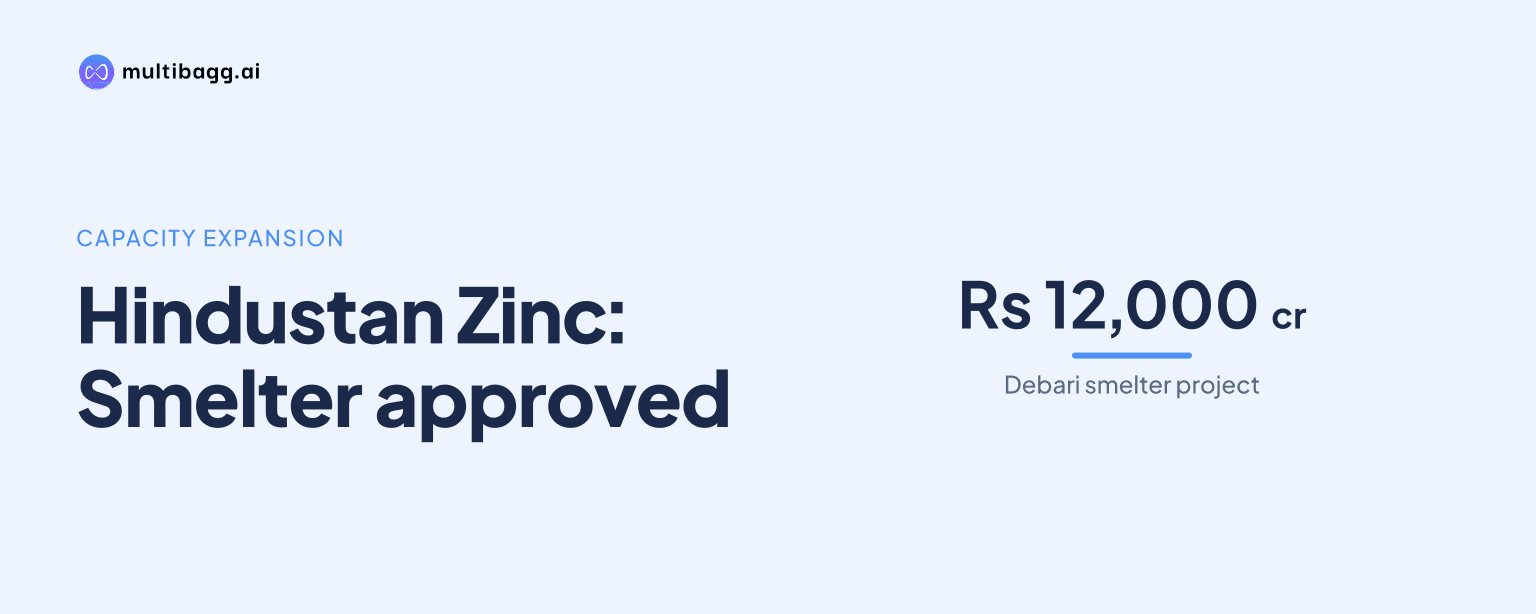
Hindustan Zinc Limited has approved a ₹12,000 crore integrated zinc metal complex at Debari, Rajasthan, adding 250 KTPA of refined metal capacity within a targeted 36 months as part of its plan to double zinc, lead and silver production.
Know Hindustan Zinc inside out
Results, valuation, peers and who's buying, in one view.
What has Hindustan Zinc Limited approved at Debari?
Hindustan Zinc Limited has approved initial plans to build a new 250 kilo tonnes per annum, or KTPA, integrated smelter at Debari in Rajasthan. The board-approved project also includes matching expansion of mine and mill capacity across its operations, ensuring that additional ore supply can support the proposed smelter output.
The estimated investment is about ₹12,000 crore. The company said the project is part of its 2x growth plan, which seeks to double capacity across zinc, lead and silver. The completion target is 36 months from the zero date, according to the company’s exchange filing dated June 17, 2025.
The plan comes as Hindustan Zinc seeks to respond to projected demand growth in India and overseas over the next five years. Zinc consumption is closely linked to infrastructure and steel demand because the metal is widely used for galvanising steel and protecting it from corrosion.
The announcement was followed by a fall of more than 4% in Hindustan Zinc shares, according to the reported market reaction. The source material does not provide the share price, trading date or closing level associated with that movement.
How will the ₹12,000 crore project be funded and executed?
Hindustan Zinc said the Debari project will be funded through internal accruals and debt. The company has indicated that the ₹12,000 crore investment will be deployed over three financial years, with ₹3,000 crore planned for FY26, ₹5,000 crore for FY27 and ₹4,000 crore for FY28.
The expansion will combine the new integrated smelter with related mine and mill investments. This integrated approach matters because refined-metal production depends on both processing infrastructure and adequate mined ore availability. The company said the associated mine and mill expansion would be carried out across its mines.
Arun Misra, Managing Director and Chief Executive Officer of Hindustan Zinc, said the project is intended to double capacity in zinc, lead and silver and is aligned with India’s expanding economic activity, demand opportunities and the objective of self-reliance in zinc.
The company operates mines including Sindesar Khurd, Zawar and Kayad in Rajasthan. The reported expansion plans refer to development at at least two mining sites, while a further Phase-II plan for additional mines was under development for board consideration.
Why is Hindustan Zinc Limited expanding its refined-metal capacity?
Hindustan Zinc is expanding because it sees stronger domestic and global demand for zinc over the coming years. The company has linked the opportunity to infrastructure development and steel consumption, sectors where galvanised steel is an important end use for zinc.
Before the new project, Hindustan Zinc’s refined-metal production capacity stood at 1,129 KTPA and utilisation was 93% in FY25. High utilisation indicates that much of the existing installed capacity was already in operation, providing the operational context for adding another 250 KTPA of integrated capacity.
The Debari investment forms one part of a wider five-year capital expenditure programme under the company’s HZL 2.0 strategy. Hindustan Zinc has outlined total growth capital expenditure of ₹40,000 crore to ₹50,000 crore to increase annual production capacity from 1.1 million tonnes to 2 million tonnes.
Chairperson Priya Agarwal Hebbar has said the board’s broader capital programme is aimed at raising refined-metal capacity to 2 million tonnes per annum. She also said the plan could almost double annual revenue and EBITDA, although the company has not provided a detailed financial timeline or a specific future revenue figure in the material provided.
Got a follow-up? Ask IRIS
What does HZL 2.0 mean for Hindustan Zinc Limited?
HZL 2.0 is Hindustan Zinc’s strategy to move beyond a primarily zinc-focused operating profile toward a broader multi-metal business. Alongside zinc, lead and silver capacity, the company is building a pipeline in minerals identified as important for industrial, energy and strategic applications.
The company has secured critical-mineral blocks for rare earth elements in Uttar Pradesh, tungsten in Andhra Pradesh and potash in Rajasthan. It has also referred to a rare earth monazite block. These acquisitions were described as part of its effort to strengthen India’s resource security.
Rare earth elements are used in permanent magnets for electric-vehicle motors and wind turbines. Tungsten has defence, industrial-tool and energy-system applications, while potash is used in fertilisers. Hindustan Zinc has framed these mineral positions as a longer-term diversification effort rather than as part of the immediate Debari smelter construction programme.
The broader strategy also includes downstream manufacturing, circular resource recovery, digital and AI-led mining, and renewable energy. Its Zinc Industrial Park initiative, undertaken with Tripura Group and CMR Green Technologies, is intended to support zinc-based manufacturing, MSMEs and domestic value addition.
How does the expansion affect investors and the zinc industry?
For investors, the announcement establishes a substantial multi-year capital commitment. The ₹12,000 crore Debari project will use internal cash flow and borrowings, while the wider five-year programme is estimated at ₹40,000 crore to ₹50,000 crore. The reported decline of more than 4% in the share price followed the project announcement, though no detailed market explanation was provided in the source material.
The company expects the project to support capacity growth in a market where it currently has a reported 70% to 75% share in India. It has also indicated that it may target around 20% of production for exports. These points underline the relevance of both domestic demand and overseas markets to the investment case.
For the domestic zinc industry, the additional smelting and associated mine capacity could increase local refined-metal availability once the project is operational. The company’s stated objective is to support demand growth and reduce reliance on external supply, but the source does not disclose production volumes from Debari by year or firm commissioning milestones before the 36-month target.
Hindustan Zinc has also stated an ambition to increase metal reserves from 13 million tonnes to 50 million tonnes and support a mine life of more than 25 years. Those longer-term targets place the Debari project within a wider effort to expand the company’s resource base, processing capacity and product portfolio.
Conclusion
Hindustan Zinc Limited’s ₹12,000 crore Debari project is a major component of its 2x growth programme, combining a 250 KTPA integrated smelter with related mine and mill expansion. With existing refined-metal capacity of 1,129 KTPA operating at 93% utilisation in FY25, the investment addresses the company’s stated need for additional capacity as it pursues higher zinc, lead and silver output.
The next disclosed milestone is execution against the 36-month completion target and the planned spending schedule of ₹3,000 crore in FY26, ₹5,000 crore in FY27 and ₹4,000 crore in FY28. Investors will also track board decisions on the proposed Phase-II mine expansion and progress under the larger ₹40,000 crore to ₹50,000 crore five-year HZL 2.0 programme.