










Hindustan Zinc ties 2.0 expansion to 300 million-tonne steel target
Key highlights
- India’s crude-steel capacity is projected to rise from 205 million tonnes in FY2025 to 300 million tonnes in FY2030.
- Hindustan Zinc says Indian zinc demand could double within five to 10 years.
- Hindustan Zinc targets 2.0 million tonnes per annum of refined-metal capacity within three to five years, from 1.1 million tonnes per annum.
- The board-approved 2.0 projects carry overall investment of about Rs 80,000 crore.
powered by IRIS
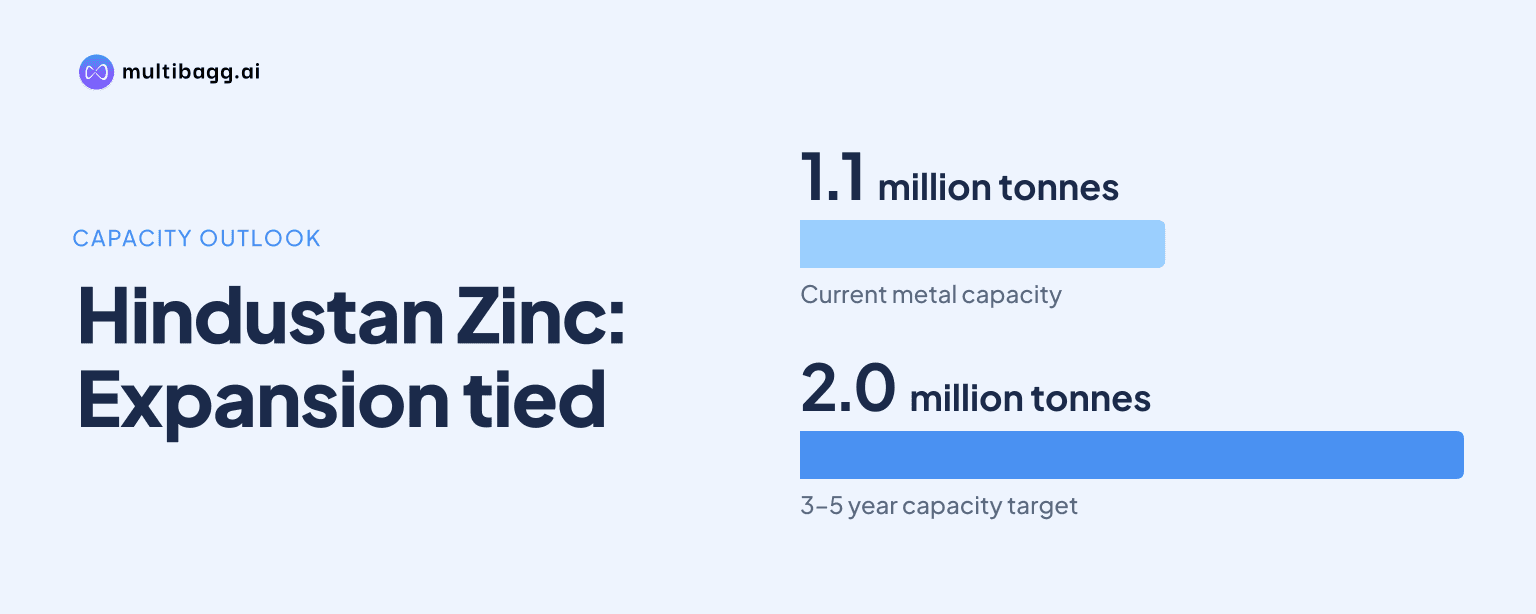
Hindustan Zinc Limited is basing its 2.0 expansion case on India’s planned rise in crude-steel capacity to 300 million tonnes by FY2030 and its view that domestic zinc demand could double within five to 10 years. Hindustan Zinc also expects mined-zinc supply to decline sharply after 2030, while its projects carry investment of about Rs 80,000 crore.
Know Hindustan Zinc inside out
Results, valuation, peers and who's buying, in one view.
What is driving Hindustan Zinc’s domestic zinc-demand outlook?
Hindustan Zinc’s domestic demand outlook is supported by India’s projected economic growth and government capital expenditure. India’s gross domestic product growth is shown at 7.7% in 2025, compared with 5.0% for China, 3.5% for the world and 2.1% for the United States. The presentation forecasts Indian growth of 6.4% in 2026 and 6.7% in 2027.
Government capital expenditure rose from Rs 4.1 lakh crore in FY21 to Rs 10.5 lakh crore in FY25 and is shown at Rs 11 lakh crore for FY26(RE), or revised estimate. The FY27(BE), or budget estimate, is Rs 12.2 lakh crore, while grants in aid for capital-asset creation are projected at Rs 4.9 lakh crore. Management says proposed effective capital expenditure in FY27 would be about 4.4% of gross domestic product.
How does the steel-capacity plan support zinc consumption?
India’s planned crude-steel capacity increase is Hindustan Zinc’s central domestic demand mechanism. Capacity rose from 34 million tonnes in FY2000 to 205 million tonnes in FY2025 and is projected to reach 300 million tonnes in FY2030. This implies a further 95 million tonnes of capacity, or about 46%, over five years from FY2025.
Hindustan Zinc says Indian zinc demand could double within five to 10 years, supported by the planned expansion to 300 million tonnes per annum of steel capacity. The presentation does not provide a zinc-demand volume forecast, zinc intensity per tonne of steel, or an annual domestic supply-demand balance. The doubling statement is therefore management’s market outlook rather than a reported volume outcome.
Construction, automobiles, renewable energy and manufacturing are the other end-user sectors identified in the presentation. It cites Rs 11.21 lakh crore of government infrastructure capital expenditure in FY2026, 7.9% year-on-year passenger-vehicle growth with record FY2026 sales, 54.6 gigawatts of renewable capacity additions, and 11.6% manufacturing gross value added growth in FY2026.
Why does Hindustan Zinc expect tighter zinc supply?
Hindustan Zinc expects global zinc demand to grow at a compound annual growth rate of 1.4% over the next decade, led by infrastructure and electrification. Against that demand outlook, the company expects mined-zinc supply to decline sharply after 2030 because of mine closures and limited new projects. It also expects smelter-capacity growth to remain constrained by mine-supply tightness and project delays.
The company also points to declining mine grades, which it shows falling from 6.9% in the 1990s to 2.8%. Hindustan Zinc says falling grades and exploration will contribute to structural supply tightness, but the presentation does not quantify a future zinc deficit or state a metal-price outcome. Its supply case is consequently an outlook based on the stated mine-closure, project and grade assumptions.
Got a follow-up? Ask IRIS
What does Hindustan Zinc’s 2.0 expansion include?
Hindustan Zinc’s board-approved 2.0 projects target refined-metal capacity of 2.0 million tonnes per annum within three to five years, from current capacity of 1.1 million tonnes per annum. The overall investment is about Rs 80,000 crore and includes earlier approved phase one, new zinc and lead smelters, a silver refinery, and required mine and milling expansion.
The planned refined-metal mix is 1.6 million tonnes per annum of zinc and 0.4 million tonnes per annum of lead, compared with current capacity of 0.9 million tonnes and 0.2 million tonnes, respectively. A 265,000-tonnes-per-annum integrated zinc smelter at Debari is expected to be commissioned in the second quarter of FY29. Additional facilities of 500,000 tonnes per annum of zinc and 200,000 tonnes per annum of lead are expected in three to five years.
Silver-refining capacity is planned to increase from 800 tonnes per annum to 1,500 tonnes per annum through a new 700-tonnes-per-annum refinery. On the mining side, total ore-production capacity is estimated to rise from 19.3 million tonnes per annum to 35.0 million tonnes per annum. Rajpura Dariba has the largest proposed increase at 5.4 million tonnes per annum, followed by Zawar at 4.3 million tonnes per annum.
What execution points should readers monitor?
The 2.0 capacity targets and commissioning dates are forward-looking statements. Hindustan Zinc expects the 265,000-tonnes-per-annum Debari smelter in the second quarter of FY29, while the further 700,000 tonnes per annum of zinc and lead capacity is expected over three to five years. The company’s presentation cautions that forward-looking statements rely on assumptions that may prove incorrect.
The detailed plan shows total smelting capacity increasing from 1.144 million tonnes per annum to 2.021 million tonnes per annum. An existing 88,000-tonnes-per-annum Debari zinc-smelter cell house is to be discontinued, and the company has disclosed an additional Rs 3,823 crore investment in a Rampura Agucha tailings reprocessing plant to provide smelter input. Mine-capacity estimates are based on a conceptual plan and may change after further detailing.
Conclusion
Hindustan Zinc’s expansion thesis combines higher Indian metal consumption with its expectation of tighter global mine supply. India’s crude-steel capacity is projected to move from 205 million tonnes in FY2025 to 300 million tonnes in FY2030, while management says Indian zinc demand could double in five to 10 years and mined-zinc supply could decline sharply after 2030. The proposed move from 1.1 million tonnes to 2.0 million tonnes per annum of refined-metal capacity is its operational response.
The next disclosed milestones are execution-related. Hindustan Zinc expects the Debari integrated zinc smelter to be commissioned in the second quarter of FY29 and the additional zinc and lead smelters within three to five years. Readers can also monitor final mine-plan detailing, progress on the Rs 3,823 crore Rampura Agucha tailings reprocessing plant, and the planned discontinuation of the 88,000-tonnes-per-annum Debari cell house.