










HIRECT starts copper conductor production, gains Railways approvals
Key highlights
- HIRECT has begun commercial production of CTC, EPICC and PICC copper conductors for transformer applications.
- HIRECT's detailed update reports 350 TPM of capacity against internal demand of about 220 TPM.
- HIRECT received Indian Railways approvals in Q2 FY27 for CTC and PICC deployment in traction transformers.
- HIRECT's facility summary cites 500 TPM, 150 TPM above its detailed 350-TPM capacity figure.
powered by IRIS
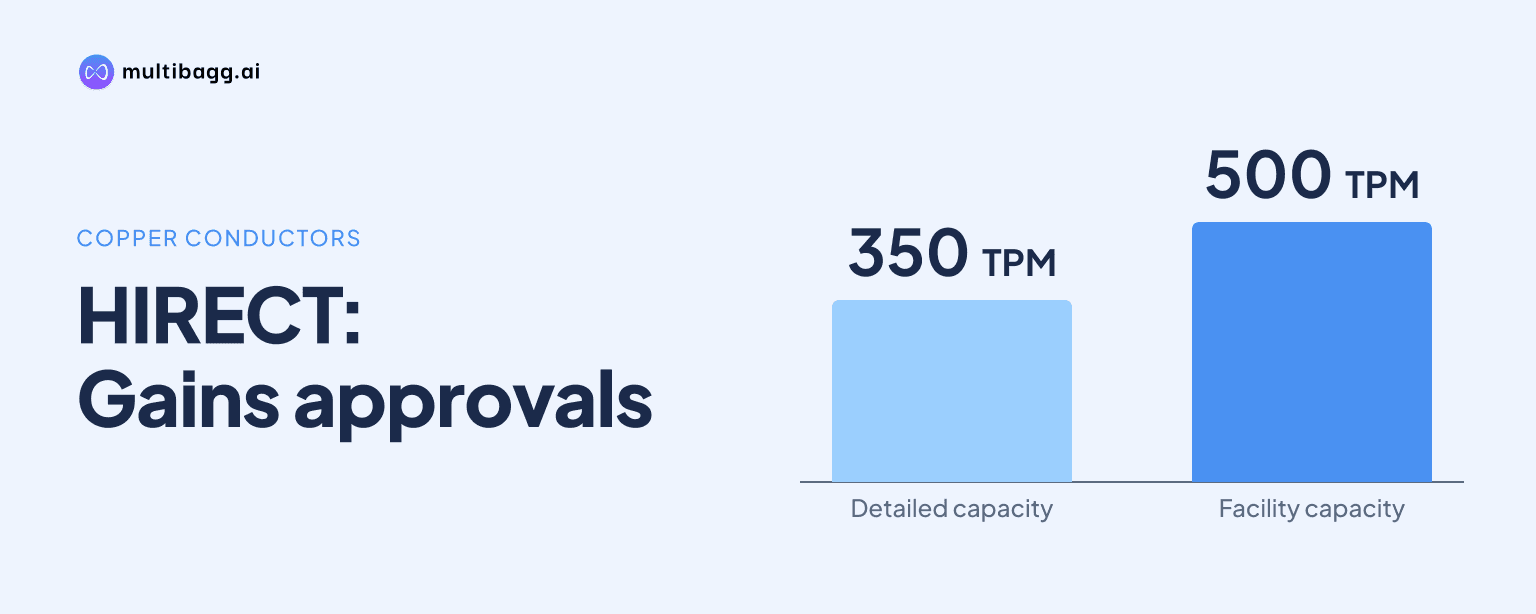
In Q2 FY27, HIRECT received Indian Railways approvals for CTC and PICC traction-transformer conductors after beginning commercial copper-conductor production, with its detailed update reporting 350 tonnes per month (TPM) of capacity against internal demand of about 220 TPM. The facility summary separately states 500 TPM, a difference the presentation does not reconcile.
Know Hirect inside out
Results, valuation, peers and who's buying, in one view.
What copper conductors has HIRECT started producing?
HIRECT has started commercial production of three specialised copper-conductor categories for transformer applications: Continuously Transposed Conductors (CTC), Enameled Paper Insulated Copper Conductors (EPICC), and Paper Insulated Copper Conductors (PICC). The presentation describes the manufacturing facility as fully automated and identifies all three products as established manufacturing capabilities.
The project brings a key transformer component into HIRECT's manufacturing chain. Management says this backward-integration step reduces dependence on external suppliers and improves visibility and control over a critical stage of transformer manufacturing. The presentation does not disclose the commercial-production start date, product-wise output, product pricing or the share of production allocated to each of CTC, EPICC and PICC.
CTC and PICC have a disclosed railway application because Indian Railways approved them for deployment in traction transformers in Q2 FY27. EPICC is listed among HIRECT's three product categories, but the presentation does not include it in the Indian Railways approval update. This separates the facility's overall manufacturing capability from the two conductor categories specifically named in the railway development.
HIRECT also says it has secured orders from private customers for specialised copper conductors. Those orders provide evidence of customer activity beyond internal requirements, but the presentation gives no customer names, order values, product mix, delivery timetable or indication of whether the orders concern transformer applications in railway or non-railway markets.
How much copper-conductor capacity does HIRECT report?
HIRECT reports 350 TPM of installed capacity in its detailed growth-capacity update, compared with internal demand of about 220 TPM. That comparison indicates capacity exceeds the stated internal requirement by about 130 TPM, supporting management's plan to offer surplus output to external transformer-industry customers.
The presentation does not explain why the facility summary cites 500 TPM while the detailed update cites 350 TPM. The two figures may refer to different phases, products, commissioning levels or definitions, but HIRECT provides no reconciliation. The 500-TPM figure is 150 TPM above the detailed 350-TPM figure.
The about-130-TPM difference is not a disclosed forecast of third-party sales. HIRECT does not state current utilisation, output actually produced, stock levels, the portion reserved for internal transformer production, or a target date for selling the surplus. What is disclosed is a capacity level above cited internal demand and a stated intention to participate in the broader transformer industry.
Got a follow-up? Ask IRIS
What do the Indian Railways approvals cover?
HIRECT says Indian Railways approved its CTC and PICC products in Q2 FY27 for deployment in traction transformers. The approval is product-specific, covering two of the facility's three listed conductor categories and naming traction transformers as their intended railway application.
The presentation does not disclose an Indian Railways purchase order, approved volume, contract value, approval date within Q2 FY27 or delivery schedule. The approval therefore establishes a disclosed route for deployment in traction transformers, but it is not presented as a confirmed revenue contract or a quantified order pipeline.
HIRECT's disclosed private-customer orders are separate from the Indian Railways approval update. The presentation does not say whether those orders are for CTC, EPICC or PICC, whether they are connected to railway supply chains, or whether they came before or after the Q2 FY27 approval. It also does not identify any customer among the private orders.
The company reports other railway milestones for different products. HIRECT says it is included in the Research Designs and Standards Organisation's UVAM list as a Development Source for propulsion systems and that supplies have commenced, while it has initiated official 50,000-kilometre field trials for propulsion systems. Those propulsion-system disclosures are distinct from the CTC and PICC approvals for traction transformers.
How does the conductor facility fit HIRECT's strategy?
HIRECT presents the conductor facility as part of its move from a component supplier to a vertically integrated system player from 2026 onward. Its 2022-2025 phase lists traction transformers, rectifiers, auxiliary converters and locomotive panels, while the 2026-onward phase includes propulsion systems, brake systems, integrated power electronics, design and integration.
The facility's stated strategic mechanisms are supply-chain resilience, higher value creation and a new business vertical. Making CTC, EPICC and PICC internally is intended to strengthen control over a transformer input, while capacity beyond about 220 TPM of internal demand is intended to enable sales to third-party transformer customers. HIRECT does not quantify procurement savings, conductor margins, capital expenditure or expected third-party revenue.
HIRECT associates its 2022-2025 products and sub-systems phase with Rs 1.5-1.6 crore per locomotive. It associates the 2026-onward integrated-systems and global-expansion phase with Rs 5-5.5 crore per locomotive, and separately lists traction motors, insulated-gate bipolar transistor-based electronics, heating, ventilation and air-conditioning systems, and battery chargers at Rs 3-3.5 crore per locomotive.
These per-locomotive figures are presentation benchmarks for product and system content rather than guidance for the conductor facility. The disclosed near-term conductor evidence is commercial production, private-customer orders and Q2 FY27 Indian Railways approvals for CTC and PICC. HIRECT gives no conductor-revenue target, external-sales mix, utilisation target or number of third-party customers.
Conclusion
HIRECT's copper-conductor initiative adds CTC, EPICC and PICC production to its transformer-related manufacturing activities and creates capacity for sales beyond internal use. The detailed comparison of 350 TPM capacity with about 220 TPM of internal demand supports the stated surplus-capacity rationale, while Q2 FY27 Indian Railways approvals give CTC and PICC a disclosed traction-transformer deployment pathway.
The next issue to watch is whether HIRECT explains the difference between the 500-TPM facility-summary figure and the 350-TPM detailed figure. Management's plan depends on converting capacity above internal demand into third-party business, but the presentation does not disclose a utilisation target, order value, conductor-revenue target or timetable for external sales.