










HIRECT operating cash flow turned negative as financing lifted cash
Key highlights
- HIRECT reported negative net operating cash flow of Rs 14.7 crore in Sep-26, versus an inflow of Rs 63.3 crore in Sep-25.
- Working-capital changes were an outflow of Rs 50.3 crore in Sep-26, compared with an inflow of Rs 13.5 crore a year earlier.
- Financing activities provided Rs 73.6 crore in Sep-26 and funded a Rs 59.2 crore increase in cash and cash equivalents.
- Consolidated inventory rose by Rs 35.9 crore to Rs 185.0 crore between Mar-26 and Sep-26.
powered by IRIS
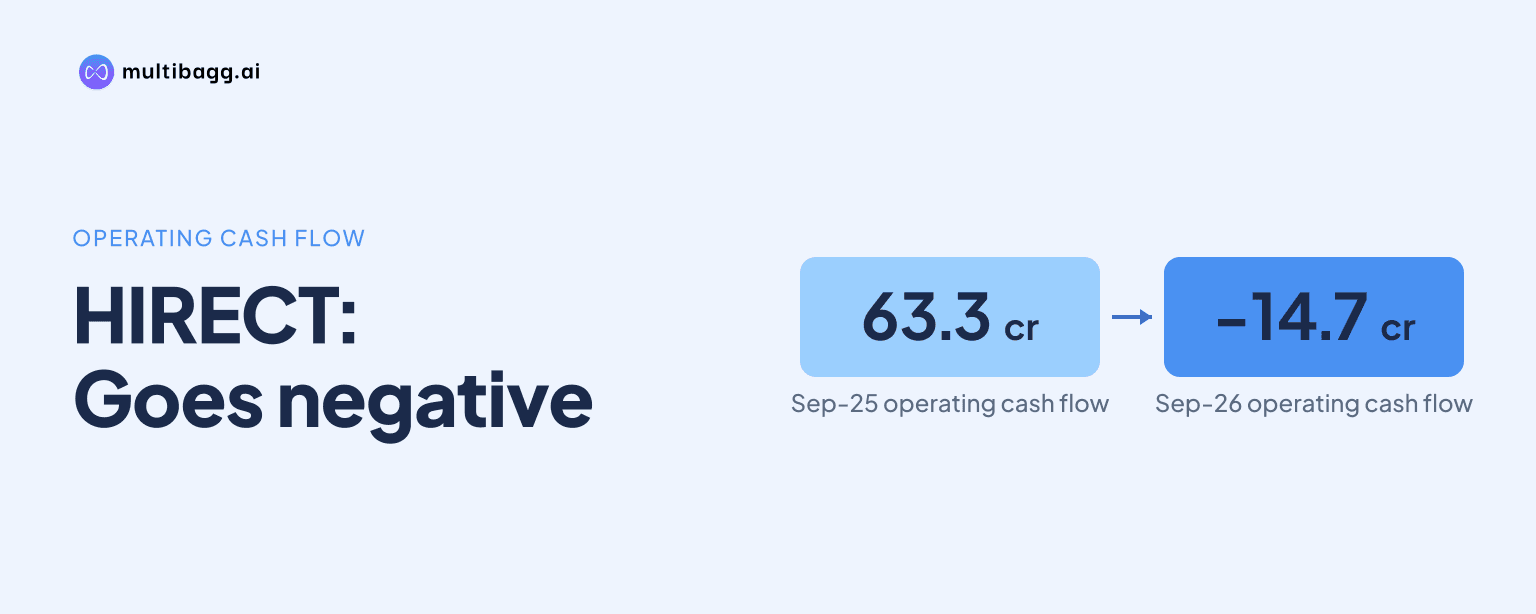
HIRECT reported net cash used in operating activities of Rs 14.7 crore for Sep-26, as a Rs 50.3 crore working-capital outflow outweighed Rs 41.5 crore of operating profit before working-capital changes. Financing activities supplied Rs 73.6 crore, funding a Rs 59.2 crore increase in cash and cash equivalents.
Know Hirect inside out
Results, valuation, peers and who's buying, in one view.
Why did HIRECT report negative operating cash flow?
HIRECT reported negative operating cash flow because working-capital changes consumed Rs 50.3 crore in Sep-26, reversing the Rs 13.5 crore cash release recorded in Sep-25. Operating profit before working-capital changes was Rs 41.5 crore, down from Rs 58.3 crore a year earlier, but the working-capital movement was the larger factor that turned cash generated from operations into an Rs 8.8 crore outflow.
After direct taxes paid, net of refunds, of Rs 5.9 crore, net cash from operating activities was negative Rs 14.7 crore. In Sep-25, HIRECT generated Rs 71.8 crore from operations and reported net operating cash inflow of Rs 63.3 crore after Rs 8.5 crore of tax payments. The working-capital line therefore shifted by Rs 63.8 crore, from an inflow to an outflow, between the two periods.
Which balance-sheet movements coincided with HIRECT’s working-capital outflow?
HIRECT’s consolidated inventory rose to Rs 185.0 crore at Sep-26 from Rs 149.1 crore at Mar-26, an increase of Rs 35.9 crore. Other current assets increased to Rs 49.2 crore from Rs 27.2 crore, adding Rs 22.0 crore. These movements coincided with the Rs 50.3 crore aggregate working-capital outflow, although the presentation does not provide a line-by-line cash-flow reconciliation.
Trade receivables moved in the opposite direction, falling to Rs 171.5 crore at Sep-26 from Rs 246.4 crore at Mar-26, a decrease of Rs 74.9 crore. Trade payables also fell to Rs 104.9 crore from Rs 118.9 crore, reducing that liability balance by Rs 14.0 crore. The cash-flow statement reports only the combined working-capital result, rather than the precise contribution from each asset and liability category.
HIRECT’s total current assets increased to Rs 490.0 crore at Sep-26 from Rs 442.2 crore at Mar-26, while current liabilities declined to Rs 353.6 crore from Rs 396.3 crore. Cash and cash equivalents on the consolidated balance sheet were Rs 63.7 crore at Sep-26, compared with Rs 3.9 crore at Mar-26, alongside higher inventory and other current assets.
Got a follow-up? Ask IRIS
How was HIRECT’s increase in cash funded?
HIRECT funded its Sep-26 increase in cash primarily through Rs 73.6 crore of net cash from financing activities. That inflow exceeded the Rs 59.2 crore net increase in cash and cash equivalents reported in the consolidated cash-flow statement, offsetting the Rs 14.7 crore operating outflow and leaving Rs 0.3 crore of net cash from investing activities.
The pattern was materially different in Sep-25, when financing activities provided Rs 4.5 crore, investing activities used Rs 43.2 crore, and operating activities supplied Rs 63.3 crore. HIRECT’s Sep-26 cash-flow statement shows cash and cash equivalents rising from Rs 4.9 crore at the beginning of the period to Rs 64.2 crore at the end, after an exchange translation difference of negative Rs 0.04 crore.
HIRECT’s balance sheet shows total borrowings, excluding lease liabilities, of Rs 200.5 crore at Sep-26, comprising Rs 24.8 crore of non-current borrowings and Rs 175.7 crore of current borrowings. This was lower than Rs 236.7 crore at Mar-26. The presentation does not break down the Rs 73.6 crore financing cash-flow line, so it does not identify the individual transactions behind that inflow.
What did HIRECT’s profit trend show alongside cash flow?
HIRECT reported consolidated revenue from operations of Rs 574.1 crore in H1FY27, up 29.9% from Rs 441.9 crore in H1FY26, while EBITDA, or earnings before interest, tax, depreciation and amortisation, declined 46.5% to Rs 26.8 crore. EBITDA margin fell to 4.7% from 11.3%, while profit before exceptional items and tax declined to Rs 13.1 crore from Rs 37.7 crore.
Management attributed higher employee and operating expenses to Elventive France’s integration and scale-up phase and investments in human capital. Employee expenses were Rs 80.9 crore in H1FY27, versus Rs 38.1 crore a year earlier, while other expenses rose to Rs 41.5 crore from Rs 25.6 crore. These profit-and-loss figures do not reconcile operating cash flow but show that the cash outflow occurred during lower operating profitability.
Profit after tax after minority interest was Rs 16.2 crore in H1FY27, down 40.9% from Rs 33.6 crore in H1FY26. HIRECT reported Rs 6.2 crore of exceptional items for H1FY27 relating to the sale of the Dehradun plant. The consolidated cash-flow statement labels its Rs 19.3 crore net profit before tax as after exceptional items, while non-cash and other investment or financial adjustments totalled Rs 22.1 crore.
Conclusion
HIRECT’s Sep-26 consolidated cash increase did not come from operating cash generation. A Rs 50.3 crore working-capital outflow converted Rs 41.5 crore of operating profit before working-capital changes into negative Rs 14.7 crore of net operating cash flow, while Rs 73.6 crore of financing inflow more than funded the Rs 59.2 crore increase in cash.
The next disclosures to watch are whether inventory, which rose by Rs 35.9 crore since Mar-26, and other current assets reverse or continue absorbing cash. Management expects near-term margin pressure to continue as Elventive France moves towards breakeven, with EBITDA expected to remain moderated over the next few quarters before gradual improvement as that business reaches breakeven.