










Honasa Consumer Limited focus categories exceed 80% revenue
Key highlights
- Honasa said focus categories exceeded 80% of revenue in Q2 FY2027, up from about 70% six to seven quarters earlier.
- Focus categories grew more than 40%, while face wash, shampoo, sunscreen and moisturizers each grew more than 20%.
- Honasa reported 36% net-sales growth and 31.3% UVG in Q2 FY2027, with a 12.7% EBITDA margin.
- Honasa estimates its focus-category market at Rs 50,000 crore and its share at about 5%.
powered by IRIS
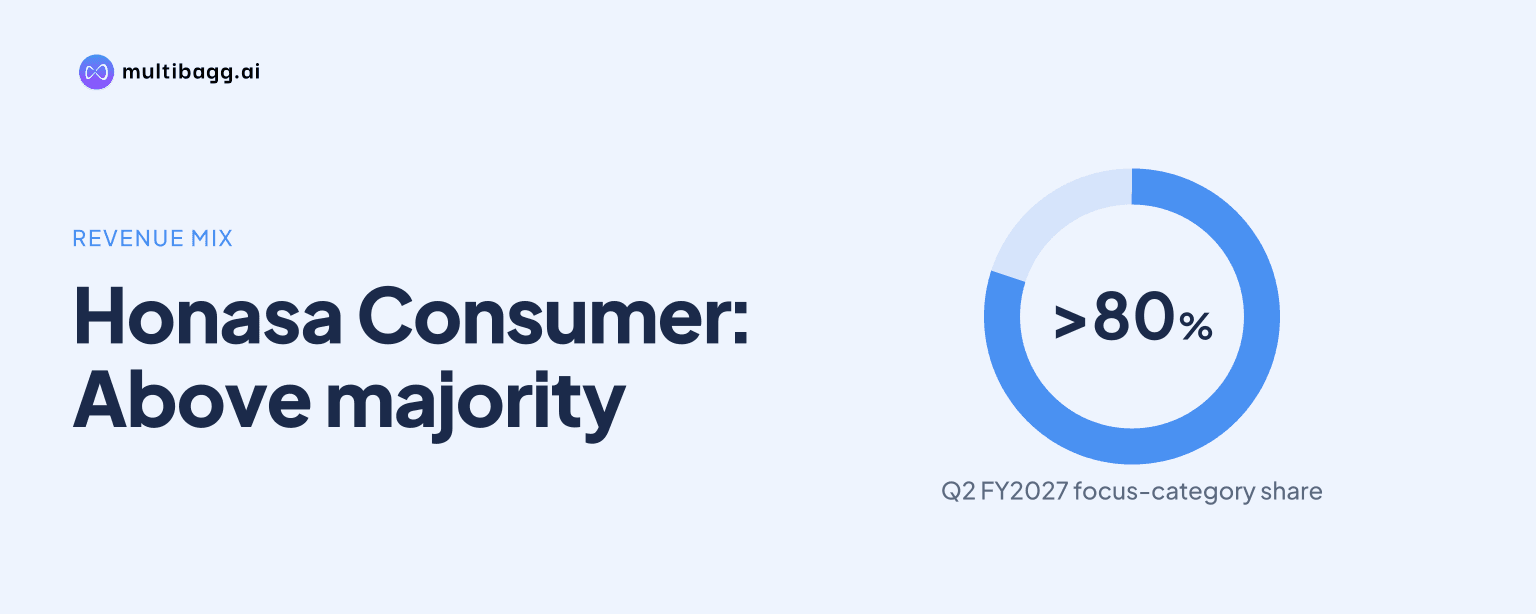
Honasa said focus categories accounted for more than 80% of revenue in Q2 FY2027 after growing more than 40%, compared with about 70% of revenue six to seven quarters earlier. Management said face wash, shampoo, sunscreen and moisturizers all grew more than 20%, concentrating growth in categories where it estimates about 5% market share.
Know Honasa Consumer inside out
Results, valuation, peers and who's buying, in one view.
What changed in Honasa's revenue mix?
Honasa's revenue mix shifted towards selected focus categories, whose contribution rose from about 70% six to seven quarters ago to more than 80% in Q2 FY2027. Management said it had expected these categories to outgrow the remainder of the portfolio, which represented about 30% of revenue when the strategy began.
The company reported 36% net-sales growth in Q2 FY2027, its highest growth quarter since listing across the last 12 quarters. Underlying volume growth, or UVG, was 31.3%, while earnings before interest, tax, depreciation and amortisation, or EBITDA, margin was 12.7% and gross margin was 70% despite crude-related cost pressure.
Which categories are driving Honasa's strategy?
Face wash was Honasa's fastest-growing category in Q2 FY2027, followed by shampoo, while sunscreen and moisturizers also grew more than 20%. Management identified face wash as its largest category, followed by sunscreen and shampoo, indicating that the mix change was supported by several large product areas.
Mamaearth gained 140 basis points in face wash and 50 basis points in shampoo, based on Nielsen data cited by management. A basis point is one-hundredth of a percentage point. Management attributed the gains to media mix, category focus and product superiority, while also saying distribution can be improved further.
Honasa linked recent launches to category development. The Derma Co. entered body washes, Aqualogica introduced tinted sun serums and a mist, and BBlunt focused on curl care. Before winter, Mamaearth renovated its moisturizer range, and management said its Rice Moisturizer performed well in likability and blind testing, without disclosing scores.
How large is Honasa's focus-category market?
Honasa said its focus-category market is worth Rs 50,000 crore and that it has about 5% share within it. Management said the company sees room to premiumize and gain share while remaining concentrated on these categories over the next three to five years.
Hair colour is one additional category under consideration. Management said BBlunt's hair-colour portfolio grew more than 100% year on year after a relaunch last year, while styling was also growing, particularly through quick commerce. It said Honasa is considering a hair-colour entry through another brand and will communicate details after launch.
Younger brands grew more than 45% year on year in aggregate, according to management, and grew more than 40% excluding The Derma Co. The Derma Co. remained in the Rs 1,000 crore-plus annual recurring revenue range disclosed earlier and reached 65,000 outlets after four quarters of increased offline focus.
Got a follow-up? Ask IRIS
How are channels supporting Honasa's category growth?
Honasa said e-commerce grew more than 20% in Q2 FY2027, while general trade and modern trade each grew 40%. Management said both online and offline channels are expanding, although individual brands have different channel mixes and some younger brands remain more concentrated online.
Offline growth included more than 30% same-store growth as Mamaearth and The Derma Co. added product partitions in existing stores. Mamaearth reached 3.2 lakh outlets, a 26% year-on-year increase in numeric distribution, while modern-trade offtake grew more than 40% year on year.
Management said new-store additions were not the main driver of Mamaearth's growth. It estimated that 80% of the brand's growth delta came from its existing distribution universe, including e-commerce, modern trade and general trade. It also cited improved Nielsen-measured inventory turns and lower stock pressure, without providing values.
What does the mix shift mean for Honasa's margins?
Honasa reported a 12.7% EBITDA margin and 70% gross margin in Q2 FY2027. Management said about 250 to 270 basis points of year-on-year EBITDA improvement came from advertising-and-promotion, or A&P, and mix efficiencies, including greater contribution from offline and quick-commerce channels.
Management said operating leverage contributed a further 110 to 140 basis points of EBITDA improvement. In response to an analyst, it confirmed that reduced third-party platform commissions associated with channel mix were part of the improvement in other expenses. Price increases, especially in hair products affected by crude costs, also contributed to the difference between 31.3% volume growth and 36% sales growth.
Management reiterated a four-year objective of a 15% EBITDA margin profile. It said the plan assumes younger-brand growth, new-category building and new brand launches, but does not include a fixed year-by-year margin target. Management added that it may accept only 50 to 70 basis points of improvement in years when it chooses to invest more heavily in growth.
Conclusion
Honasa's Q2 FY2027 results show that its category-concentration strategy has changed the revenue mix: focus categories increased from about 70% to more than 80% of revenue while growing more than 40%. Growth in face wash, shampoo, sunscreen and moisturizers, alongside share gains in face wash and shampoo, supported the shift.
The next disclosures to watch are whether existing-store-led Mamaearth growth persists, whether general trade and modern trade sustain their 40% growth rates, and how newer products develop in body wash, tinted sun serums, curl care and potential additional hair-colour participation. Management's stated longer-term benchmark remains a 15% EBITDA margin profile over four years.