










Honasa’s Q2 sales rose 36% as EBITDA margin reached 12.7%
Key highlights
- Honasa reported 36% net-sales growth and a 12.7% EBITDA margin in Q2 FY2027.
- Focus categories contributed more than 80% of revenue and grew more than 40% in Q2 FY2027.
- A&P and channel-mix efficiencies added about 250 to 270 basis points of year-on-year EBITDA improvement.
- Mamaearth reached 3.2 lakh outlets, with same-store growth of more than 30%.
powered by IRIS
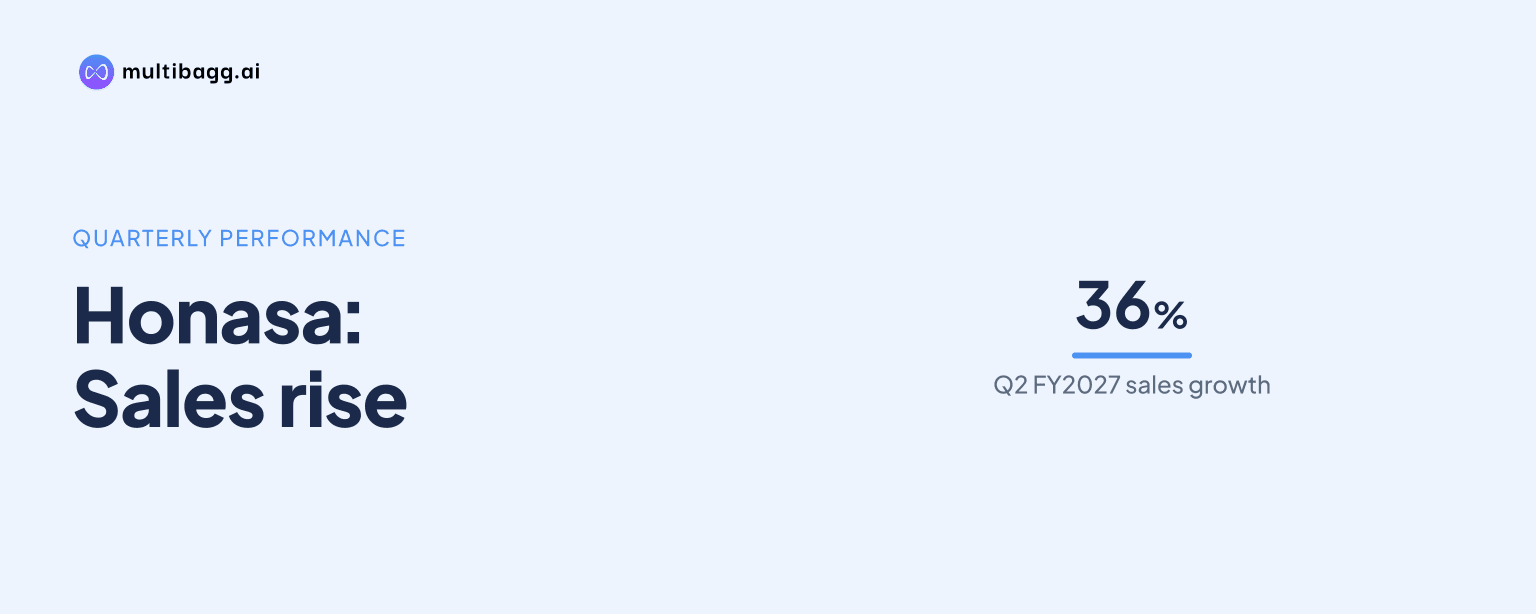
Honasa Consumer Limited reported 36% net-sales growth in Q2 FY2027 and a 12.7% earnings before interest, tax, depreciation and amortisation (EBITDA) margin, its highest quarterly growth since listing over the past 12 quarters. Management said channel mix, advertising efficiency and operating leverage contributed to the margin improvement.
Know Honasa Consumer inside out
Results, valuation, peers and who's buying, in one view.
How did Honasa deliver 36% sales growth in Q2 FY2027?
Honasa delivered 36% net-sales growth in Q2 FY2027, which management said was driven mainly by volume and marked its highest-growth quarter since listing. The company also said EBITDA doubled year on year, combining faster sales growth with a 12.7% margin.
Growth was concentrated in the focus categories, which contributed more than 80% of revenue in Q2 FY2027, compared with about 70% six to seven quarters earlier. These categories grew more than 40%, ahead of company-wide sales growth, reflecting the effect of Honasa’s earlier focus-category agenda on the revenue mix.
Face wash was Honasa’s fastest-growing focus category, followed by shampoo, while sunscreen and moisturisers each grew more than 20%. Management identified face wash, sunscreen and shampoo as its largest categories, and reported Nielsen-measured share gains of 140 basis points in face wash and 50 basis points in shampoo. One basis point equals one-hundredth of a percentage point.
What drove Honasa’s EBITDA margin expansion?
Honasa’s EBITDA margin reached 12.7% because advertising and promotion, or A&P, and mix efficiencies contributed about 250 to 270 basis points of year-on-year improvement, while operating leverage added another 110 to 140 basis points, according to management. The company also maintained a 70% gross margin despite crude-related cost pressure.
Management said a favourable mix toward offline and quick-commerce channels formed part of the A&P and mix benefit. In response to an analyst’s question about commissions paid on third-party platforms, management said the channel-mix shift was contributing to lower other expenses, linking the change partly to a different cost structure.
The gross-margin result also reflected cost management and price increases, particularly in hair products affected by crude costs. Management said some of the difference between value growth and volume growth arose from those price increases, as well as channel and brand mix.
Honasa did not raise its longer-term objective after the Q2 result. Management reiterated its plan to reach a 15% EBITDA-margin profile over the next four years, including assumed growth in younger brands, new-category development and new-brand launches, while saying it was comfortable maintaining a near-term range of around 12.5%.
Got a follow-up? Ask IRIS
Which channels and brands contributed to Honasa’s growth?
Honasa said e-commerce grew more than 20%, while general trade and modern trade each grew 40% in Q2 FY2027. Management does not expect a significant company-wide shift toward offline because Mamaearth and The Derma Co. are growing faster offline, while other portfolio brands remain mainly online.
Offline execution nevertheless expanded distribution and sales in existing stores. Mamaearth reached 3.2 lakh outlets, up 26% year on year in numeric distribution, while same-store growth exceeded 30%. Management said about 80% of the company’s growth delta came from existing stores across e-commerce, modern trade and general trade rather than distribution additions alone.
The Derma Co. increased its offline outlet reach to 65,000, compared with 3 lakh outlets cited for Mamaearth, and recorded about 1.2% Nielsen-measured face-wash share. Management said this progress followed four quarters of focus on offline distribution and that The Derma Co. remained in the previously disclosed Rs 1,000 crore-plus annualised revenue run-rate range.
Younger brands grew more than 45% year on year, while the portfolio excluding The Derma Co. grew more than 40%, according to management. Honasa cited Aqualogica in sunscreen and moisturisers, Dr. Sheth’s for active consumers, BBlunt in hair colour and styling, Staze in colour cosmetics, and Reginald Men in men’s grooming as additive portfolio propositions.
How is Honasa using product categories to sustain growth?
Honasa said its focus-category market is worth Rs 50,000 crore and that it holds about 5% share in that market, which management said leaves scope for premiumisation and share gains over the next three to five years. Face wash, sunscreen, shampoo and moisturisers were the principal categories management identified for this strategy.
BBlunt’s hair-colour portfolio grew more than 100% year on year after its relaunch in the prior year. Management said styling was also growing, particularly on quick commerce, and that BBlunt would relaunch its shampoo-and-conditioner mix to make the range more relevant to current consumers.
Honasa also disclosed product activity across brands in Q2 FY2027. The Derma Co. entered body washes, Aqualogica introduced tinted sun serums and a mist, and Mamaearth collaborated with Chaayos on a tinted lip balm. Before winter, Mamaearth also renovated its Rice Moisturizer, while management said The Derma Co. and Aqualogica developed clinical-product communications.
Mamaearth continued high-teen growth in both online and offline channels in Q2 FY2027, management said. It attributed confidence in the brand’s trajectory to consumer measures, improved inventory turns and growth from existing distribution, rather than relying primarily on new outlet additions.
Conclusion
Honasa’s Q2 FY2027 outcome combined 36% net-sales growth with a 12.7% EBITDA margin as focus categories grew more than 40% and contributed more than 80% of revenue. Management linked about 250 to 270 basis points of year-on-year EBITDA improvement to A&P and mix efficiencies, with another 110 to 140 basis points coming from operating leverage.
The next disclosed markers are whether Honasa can maintain the around 12.5% near-term margin range while moving toward its four-year 15% EBITDA-margin objective. Management also said Q3 should be sequentially higher than Q2, plans a BBlunt care-range relaunch and will communicate any second-brand hair-colour launch after it is introduced.