










Honasa focus categories exceed 80% as offline channels grow
Key highlights
- Honasa said seven focus categories contributed more than 80% of Q2FY27 sales, up 369 basis points year on year.
- General-trade secondary sales and modern-trade offtake each grew more than 40% year on year in Q2FY27.
- Honasa reached about 3.2 lakh FMCG retail outlets as of Sep’26, up 26% year on year.
- Honasa reported Q2FY27 EBITDA of Rs 93 crore and a 12.7% margin, up 389 basis points year on year.
powered by IRIS
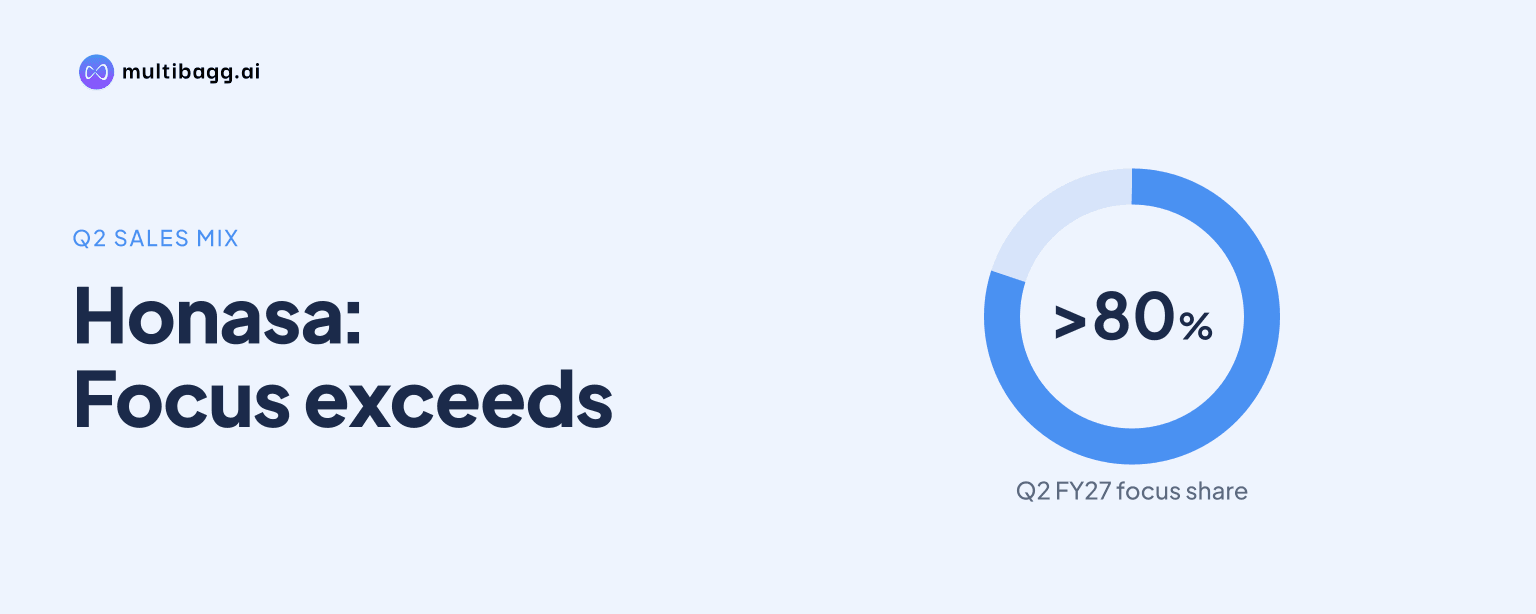
HONASA said seven focus categories contributed more than 80% of Q2FY27 sales, up 369 basis points year on year, as general-trade secondary sales and modern-trade offtake each rose more than 40%. The company reported e-commerce growth of more than 20%, making its disclosed offline-channel growth faster than e-commerce during the quarter.
Know Honasa Consumer inside out
Results, valuation, peers and who's buying, in one view.
What categories drive Honasa’s sales mix?
Honasa’s sales mix is concentrated in seven categories that contributed more than 80% of Q2FY27 sales, 369 basis points more than a year earlier. The categories are face cleanser, shampoo, face serum, suncare, moisturizer, baby and lipstick. The presentation does not disclose sales or market shares separately for each of those seven categories.
Honasa estimates the combined market for those focus categories at about Rs 50,000 crore and estimates its own share at about 5%. The company’s estimate places its category strategy in a large personal-care and beauty market, although the presentation does not state a target share or a timeline for expanding beyond the reported 5% level.
The focus-category performance accompanied revenue from operations of Rs 731 crore in Q2FY27, up 35.9% year on year. Underlying volume growth was 31.3%, a measure Honasa defines as constant-turnover growth using base-period realisation and excluding price impact and BTM Ventures Limited.
How fast are Honasa’s sales channels growing?
Honasa reported more than 40% year-on-year growth in both general-trade secondary sales and modern-trade offtake in Q2FY27, versus more than 20% growth in e-commerce. The disclosed comparison shows that the two offline channels grew faster than e-commerce, while the company said e-commerce had high-single- to double-digit share in some key categories.
In general trade, Honasa said primary-sales growth mirrored secondary-sales growth, based on its distributor management system, or DMS. Secondary sales track movement through to retailers, while primary sales track sales into the distribution system; the company’s reported alignment between the two measures provides its stated evidence that channel growth was not presented as a build-up of distributor inventory.
In modern trade, Honasa said more than 40% offtake growth was backed by similar same-store growth. It attributed growth in key modern-trade accounts to share gains and said modern-trade reach had expanded to more than 90% of its measured store universe.
How is Honasa expanding offline distribution?
Honasa had presence in about 3.2 lakh fast-moving consumer goods, or FMCG, retail outlets in India as of Sep’26, up 26% year on year. The figure includes direct and indirect outlets with Mamaearth presence across urban and rural India, using NielsenIQ data cited in the presentation.
Honasa also reported more than 30% year-on-year growth in average secondary sales per retailer during Q2FY27 in direct-reach outlets. This means the company reported both a wider outlet network and higher sales throughput per directly served retailer, rather than distribution expansion alone.
Modern-trade share gains were most specifically disclosed in face cleansers and shampoo. Face-cleanser share increased by 416 basis points year on year as of Sep’26, while shampoo share rose 136 basis points, based on NielsenIQ data for all-India urban and rural modern trade.
Mamaearth’s offline market-share data gives further category evidence. Its face-cleanser value share was 7.1% in Q2FY27, up 140 basis points year on year, and its shampoo value share was 2.7%, up 52 basis points, according to NielsenIQ’s all-India urban measurement.
Got a follow-up? Ask IRIS
What supports Honasa’s brand and product expansion?
Honasa said its younger brands grew more than 45% year on year, exceeding the more than 40% growth reported for focus categories. The younger-brand group comprises The Derma Co., Aqualogica, Dr. Sheth’s, BBlunt, Staze and BTM Ventures Limited’s Reginald Men, spanning skincare, hair colour, colour cosmetics and men’s grooming.
The Derma Co. had reach in more than 65,000 general-trade and modern-trade outlets, while its offline face-cleanser share was 1.2% as of Sep’26. That share was 101 basis points higher year on year in NielsenIQ all-India urban data, while indexed brand searches increased from 100 in Q2FY26 to 136 in Q2FY27, based on Google Adwords.
The presentation identified products behind several younger-brand initiatives. BBlunt said growth was powered by hair colour after the relaunch of Salon Secret High Shine Hair Colour, while Staze said Gloss Lock 2-in-1 Liquid Lipstick and Twin Flame 2-in-1 Lipstick + Lip Liner together contributed more than 50% of its portfolio.
Honasa also listed new products across focus areas, including Aqualogica’s 3-in-1 Tinted Sun Serum with sun protection factor 50 and 12 shades, and The Derma Co.’s 2% Sali-Cinamide Anti-Acne Body Wash. The presentation does not provide revenue, distribution or repeat-purchase data for these launches.
What does channel mix mean for Honasa’s margins?
Honasa reported earnings before interest, tax, depreciation and amortisation, or EBITDA, of Rs 93 crore in Q2FY27, with a 12.7% margin compared with 8.9% in Q2FY26. The 389-basis-point year-on-year improvement occurred alongside more than 40% growth in general trade and modern trade.
Management attributed 250 to 270 basis points of margin improvement to advertising and promotion, or A&P, and mix efficiencies, and 110 to 130 basis points to operating leverage. It cited a higher contribution from profitable offline and quick-commerce-led business-to-business channels as a favourable mix factor, but did not disclose profitability by channel.
A&P spending grew in absolute terms across core and younger brands but declined as a percentage of revenue, according to management. With gross profit margin at about 70%, Honasa also reported profit after tax of Rs 73 crore in Q2FY27, equal to a 10.0% margin.
Conclusion
Honasa’s Q2FY27 disclosures show category concentration and offline execution progressing together. More than 80% of sales came from seven focus categories, while general-trade secondary sales and modern-trade offtake each grew more than 40%, ahead of the more-than-20% e-commerce growth disclosed for the quarter. Outlet growth, sales per direct retailer and share gains provide the operating evidence behind that shift.
The next indicators are whether Honasa can sustain its offline growth after reaching about 3.2 lakh FMCG outlets and more than 90% of its stated modern-trade store universe. Management’s margin explanation also makes A&P efficiency, the offline and quick-commerce mix, and scale-led overhead leverage relevant measures after Q2FY27 EBITDA margin reached 12.7%.