










HPL Electric says established suppliers will shape meter market
Key highlights
- HPL said almost 7 crore smart meters had been installed around end-September against a planned 22.5 crore programme.
- Around 17 crore smart meters had been awarded to AMISPs around end-September, according to HPL.
- HPL’s order book was Rs 2,700 crore on 2 November 2026, with Metering and Systems contributing more than 96%.
- Metering and Systems revenue increased 18% year on year to Rs 271 crore in the quarter.
powered by IRIS
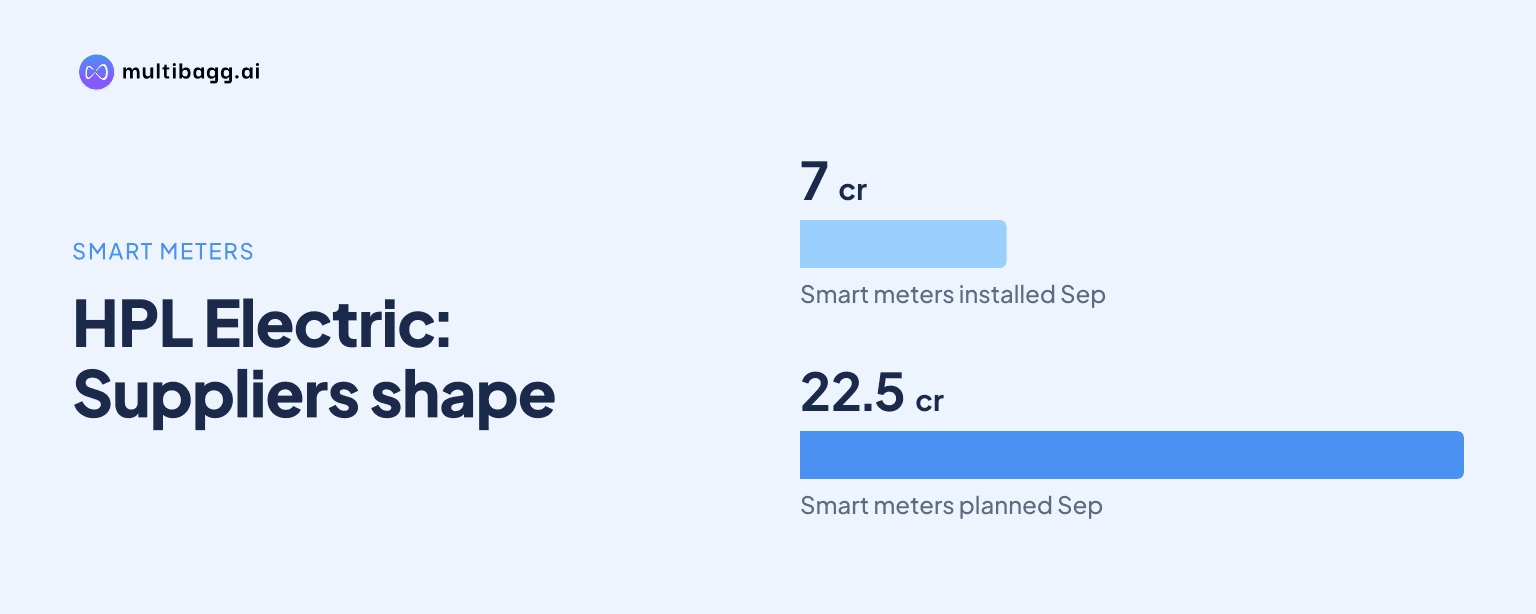
HPL Electric said the smart-meter market should increasingly favour established suppliers because meter performance must be supported for 10 years, while almost 7 crore of a planned 22.5 crore meters had been installed around end-September. Management said low-price disruption is difficult to sustain when warranties, technology, financing and service obligations extend over long project periods.
Know HPL Electric & Power inside out
Results, valuation, peers and who's buying, in one view.
Why does HPL expect smart-meter suppliers to consolidate?
HPL expects smart-meter suppliers to consolidate because Advanced Metering Infrastructure Service Providers, or AMISPs, require meter makers that can meet 10-year performance warranties, technology requirements and ongoing support. Management said HPL’s design, components and manufacturing capability allow it to guarantee meter operation for 10 years, which it believes gives AMISPs confidence to use established manufacturers.
HPL said the commercial model also increases the importance of supplier reliability because AMISP payments are deferred over a long period and depend on project performance. Management contrasted this with the regular-meter market between 1996 and about 2020, when nearly 45 meter manufacturers operated but only five remained after technology changed. It said suppliers that focus primarily on price can cause temporary disruption but may not sustain operations through changing technical requirements.
How much smart-meter demand remains in the pipeline?
HPL said a substantial smart-meter pipeline remains because around 17 crore meters had been awarded to AMISPs from a planned 22.5 crore, while almost 7 crore had been installed around the end of September. Management said installations were rising each month, although it did not provide a later total or forecast a date for deployment of the remaining awarded meters.
HPL said it is approved with independent AMISPs and is a preferred vendor with those providers. In response to an analyst’s comments about Adani and Energy Efficiency Services Limited, or EESL, management said HPL was approved with both and viewed the combination discussed by the analyst as positive for potential meter flows. HPL also cited new state tenders as a source of further AMISP demand, while cautioning that household-level installations involve utilities and consumers and can face execution delays.
Are aggressive smart-meter bids sustainable, according to HPL?
No, according to HPL. An analyst cited a Kerala tender in which the lowest bid was about 50% below HPL’s price, while prices attributed to other established participants were about 100% to 200% higher; HPL did not independently report those tender results. Management said an AMISP or meter supplier must account for execution schedules, financing costs, possible input-cost increases and unforeseen circumstances over a 10-year obligation.
HPL said smart-meter competition cannot rest only on an initial quoted price because products require technology, warranty support and delivery compliance. Management added that the performance of installed meters and adherence to delivery schedules should influence subsequent orders. It expects the market to rely on fewer established suppliers over time, but did not identify potential exits or provide a timetable for consolidation.
Got a follow-up? Ask IRIS
What do HPL’s metering capacity and financial figures show?
HPL said its metering plants were operating at about 70% utilisation after capital expenditure over the previous two and a half years, leaving scope to raise output if implementation accelerates. Management said the production setup has multiple flexible processes and that it sees no current metering-capacity constraint. It referred to a 2028 government deadline for completion of the first phase of smart-meter implementation.
Metering and Systems revenue rose 18% year on year to Rs 271 crore in the quarter and 17% to Rs 509 crore in the first half, while quarterly revenue increased 14% sequentially. HPL’s total order book was Rs 2,700 crore as of 2 November 2026, with Metering and Systems representing more than 96%. Management said the order book provides visibility beyond the current year, although conversion depends on customer requirements and execution schedules.
Management said margins above 15% can be sustained at current metering volumes, but described the past two quarters as unusual because of geopolitical conditions since March. It cited inflation in metals, industrial plastics and electronics, along with higher supply-chain costs and longer electronics lead times. Because metering contracts are fixed-price, HPL said it is pursuing research and development and manufacturing changes rather than directly passing these costs to customers.
Conclusion
HPL’s stated case for consolidation rests on the combination of 10-year meter obligations, deferred AMISP payments and the need for dependable technology and delivery. Almost 7 crore installations against a planned 22.5 crore programme indicate that deployment remains incomplete, while Metering and Systems accounted for more than 96% of HPL’s Rs 2,700 crore order book as of 2 November 2026.
The next issues to watch are the pace at which AMISPs turn awarded meters into installations, progress towards the government’s stated 2028 first-phase deadline and whether delivery performance affects repeat orders. HPL also said work is under way on analytics and software solutions and referred to a future smart-meter technology “2.0” phase, without disclosing a rollout schedule.