










HPL Electric targets 12%-12.5% EBITDA margin stabilisation
Key highlights
- HPL Electric expects FY27 EBITDA margin to stabilise at 12%-12.5% after Q2 FY27 margin reached 11.74%.
- HPL Electric's Q2 FY27 revenue rose 40% year on year to Rs 608 crore, while EBITDA increased 8% to Rs 71 crore.
- HPL Electric's C&I revenue increased 64% year on year to Rs 337 crore in Q2 FY27, about 55% of quarterly revenue.
- HPL Electric expects C&I price increases to recover a large part of higher input costs by the close of Q3 FY27.
powered by IRIS
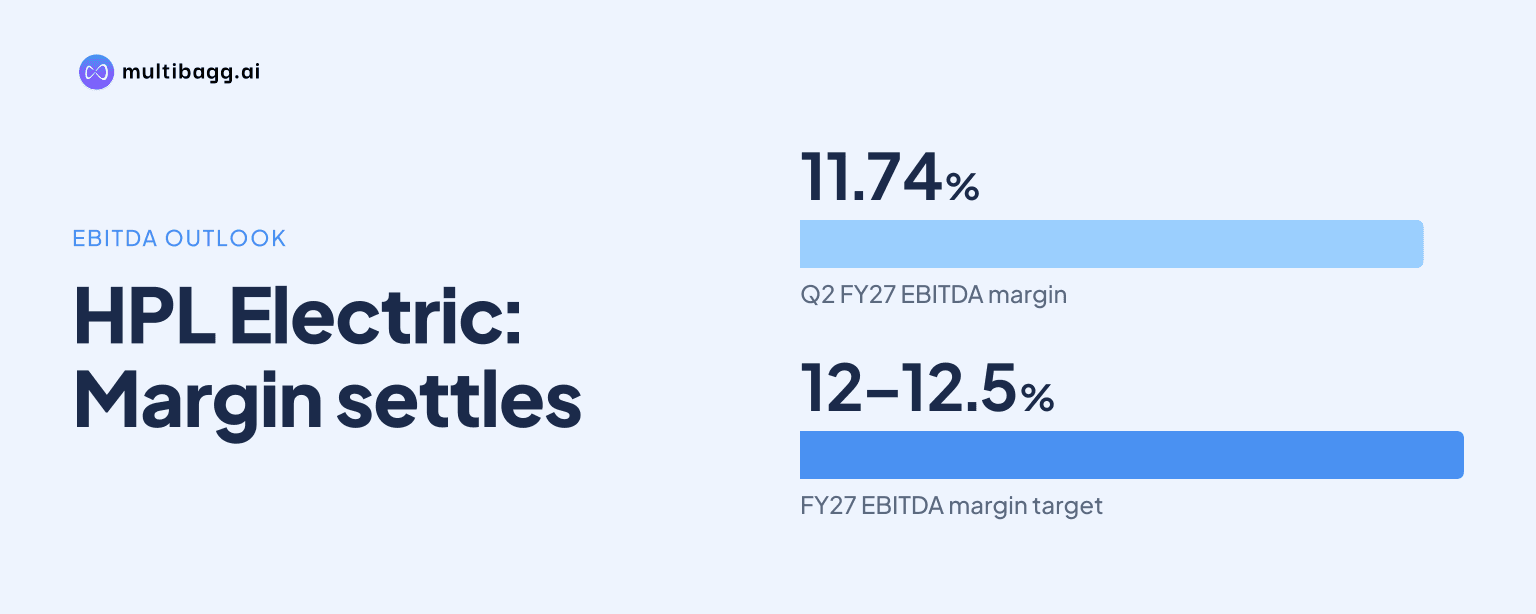
HPL Electric & Power Limited expects FY27 EBITDA margin to stabilise at 12%-12.5% after its Q2 FY27 margin fell to 11.74% from 12.26% in Q1. HPL Electric said Consumer and Industrial price increases should recover a large part of commodity-led input-cost inflation by the close of Q3 FY27.
Know HPL Electric & Power inside out
Results, valuation, peers and who's buying, in one view.
What is HPL Electric's EBITDA margin outlook for FY27?
HPL Electric expects its full-year FY27 EBITDA margin to stabilise in the 12%-12.5% range, Joint Managing Director and Chief Financial Officer Gautam Seth said on November 6, 2026. The outlook follows Q2 FY27 EBITDA margin of 11.74%, down 0.52 percentage points from 12.26% in Q1 FY27 as input-cost volatility and revenue mix affected profitability.
Q2 FY27 revenue from operations rose 40% year on year to Rs 608 crore, HPL Electric's highest quarterly revenue and its first quarter above Rs 600 crore. EBITDA increased 8% to Rs 71 crore and profit after tax was Rs 23 crore, meaning profit growth did not keep pace with revenue growth during the quarter.
For H1 FY27, revenue rose 37% to Rs 1,124 crore and EBITDA increased 9% to Rs 135 crore. Management said it did not expect margins to fall further from current levels, although its 12%-12.5% outlook remains management's expectation rather than formal guidance linked to a disclosed commodity-price assumption.
Why did HPL Electric's Q2 FY27 margin decline?
HPL Electric said material costs increased from March because of the geopolitical situation, with metals, industrial plastics and electronics the principal affected inputs. The company said the impact was amplified by the lag between cost inflation and selling-price revisions, particularly in its Consumer and Industrial business.
The two businesses have different exposure to inflation. In Metering and Systems, contracts are fixed-price, so higher costs of metals, plastics and electronics cannot be directly passed through to customers under existing contracts. In Consumer and Industrial, or C&I, management said price increases can generally be passed on, but usually with a lag of one or two months.
C&I also became the larger revenue contributor in Q2 FY27. Its revenue rose 64% year on year to Rs 337 crore, about 55% of total quarterly revenue, while Metering and Systems revenue increased 18% to Rs 271 crore and was up 14% sequentially. The faster expansion of C&I did not immediately lift consolidated margin because cost recovery was still catching up with higher inputs.
Management cited changing revenue mix alongside input costs as a factor in the margin movement, but did not disclose separate segment EBITDA margins. As a result, the call does not quantify how much of the 0.52-percentage-point Q1-to-Q2 decline came from C&I, Metering and Systems, or the mix between them.
Got a follow-up? Ask IRIS
How will C&I pricing and volumes support HPL Electric's margin?
HPL Electric said it had passed on some C&I price increases during Q2 FY27 and had further increases planned after Diwali. Management expects a large part of the higher input cost to be passed on to consumers by the close of Q3 FY27, which is the central mechanism behind its expectation that C&I margins will start improving.
Volume growth is the second part of the plan. C&I revenue reached Rs 615 crore in H1 FY27, up 60% year on year, and management said volumes had increased across wires and cables, lighting, fans, industrial switchgear and domestic switchgear. Management expects higher volumes to provide some cost differential, although it did not estimate a rupee or percentage impact.
Wires and cables led the expansion, with Q2 FY27 revenue rising 159% year on year to Rs 178 crore and H1 revenue reaching Rs 324 crore. That H1 figure was about 95% of wire and cable revenue achieved during all of FY26, while lighting grew 59% year on year, domestic switchgear increased 43%, and industrial switchgear rose 29% sequentially.
HPL Electric has more than 900 authorised dealers and 90,000 retailers through which it sells its broader C&I product range. Management linked the channel network to its ability to deepen market reach and productivity, while its margin recovery plan relies specifically on implementing product and price actions across this consumer-facing business.
What continues to limit HPL Electric's Metering and Systems margins?
HPL Electric's Metering and Systems business remains exposed to input-cost pressure because its contracts are fixed-price. Management said it cannot directly recover increases in metals, industrial plastics and electronics from customers, making cost control through design and production changes more important than customer price increases.
The company is pursuing research and development, improved product design and better manufacturing methods to compensate for some metering costs. Management did not provide the expected savings, timing for the full benefit, or a separate margin target for Metering and Systems, leaving the scale of this mitigation unresolved.
Metering and Systems remains important to HPL Electric's revenue visibility despite the contract constraint. The segment generated Rs 509 crore in H1 FY27, up 17% year on year, and represented more than 96% of the Rs 2,700 crore order book reported as of November 2, 2026. Management said quarterly conversion of that order book will depend on customer requirements and execution schedules.
Seth said a better geopolitical situation could lead to a positive reversal in margins in the future, but this was an outlook rather than a specified forecast. The company did not disclose commodity-price assumptions, contract-repricing provisions, or a date when its metering design and manufacturing actions would fully offset the reported inflation.
Conclusion
HPL Electric's Q2 FY27 results show a gap between rapid sales growth and slower EBITDA growth: revenue rose 40% to Rs 608 crore while EBITDA increased 8% to Rs 71 crore. Management attributes the difference chiefly to higher material costs and delayed C&I price pass-through, with fixed-price Metering and Systems contracts limiting direct recovery.
The next reported milestone is the close of Q3 FY27, when management expects C&I price actions to have passed through a large part of the higher cost. Investors can also watch the pace at which the Rs 2,700 crore order book converts into Metering and Systems revenue, since customer schedules will determine the quarterly mix between that business and faster-growing C&I.