










HUDCO identifies nearly Rs 3,00,000 crore funding opportunity
Key highlights
- HUDCO identifies a tentative nearly Rs 3,00,000 crore financing opportunity in urban infrastructure.
- The Urban Challenge Fund envisages Rs 4,00,000 crore of investment over five years, including Rs 1,00,000 crore of central assistance.
- HUDCO’s H1 FY27 loan portfolio including EBR was Rs 1,86,111 crore, up Rs 41,557 crore from H1 FY26.
- HUDCO plans to activate 20 regional offices as state-level UiWIN units.
powered by IRIS
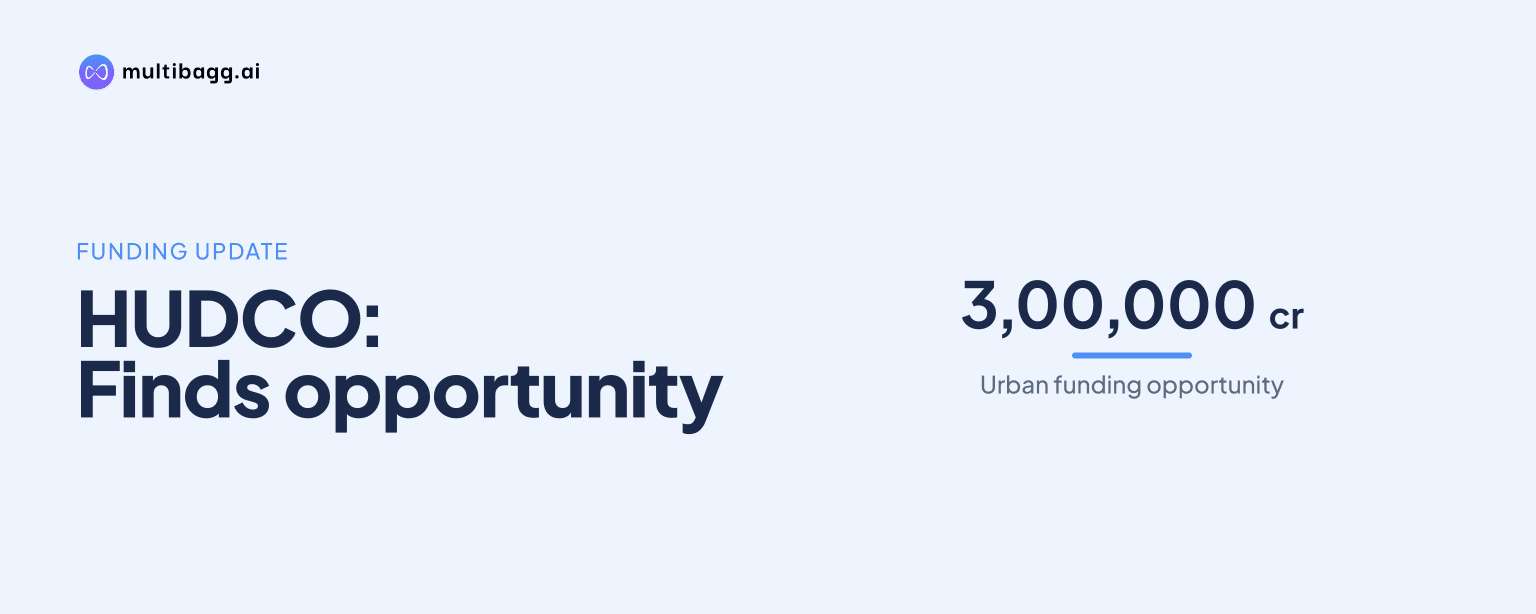
HUDCO identifies a tentative Rs 3,00,000 crore financing opportunity in housing, water, urban mobility and city redevelopment, supported by an Urban Challenge Fund framework envisaging Rs 4,00,000 crore of investment over five years. The figure is prospective rather than a disclosed sanction or disbursement pipeline and depends on projects becoming bankable and ready for loan appraisal.
Know Housing & Urban Development Corporation inside out
Results, valuation, peers and who's buying, in one view.
What is HUDCO’s Rs 3,00,000 crore financing opportunity?
HUDCO’s stated opportunity is tentative long-term financing of nearly Rs 3,00,000 crore for housing, water, urban mobility and city redevelopment. It is not described as a sanctioned loan book, a disbursement target or a list of approved projects, and HUDCO links conversion to preparation of projects suitable for loan appraisal.
The prospective amount exceeds HUDCO’s reported H1 FY27 loan portfolio of Rs 1,86,111 crore including extra-budgetary resources, or EBR. The portfolio was Rs 1,44,554 crore in H1 FY26, an increase of Rs 41,557 crore; excluding the Rs 20,000 crore EBR amount, it rose by the same Rs 41,557 crore to Rs 1,66,111 crore.
HUDCO places the opportunity alongside multiple public programmes rather than one committed lending mandate. These include PMAY-U 2.0, which targets additional urban housing support for 1 crore families, and AMRUT 2.0, which aims for universal sewerage or septage coverage across 500 cities.
How does the Urban Challenge Fund create financing demand?
The Urban Challenge Fund, or UCF, envisages Rs 4,00,000 crore of investment over five years, including Rs 1,00,000 crore of central assistance. Its framework provides central assistance of up to 25% of project funding, requires at least 50% from market finance, and leaves the balance for states, Union Territories, urban local bodies, or ULBs, and other sources.
Market finance under the UCF can include bonds, bank loans and public-private partnerships, or PPPs. HUDCO describes the framework as a shift from grant-based funding towards bankable urban projects, but does not disclose what share of the Rs 4,00,000 crore investment framework it expects to finance.
A project must demonstrate reliable revenue and secure escrow-backed cash flows for repayment, alongside credible detailed project reports, or DPRs, city reforms and funded operations and maintenance. The UCF applies competitive, challenge-based selection to Cities as Growth Hubs, Creative Redevelopment of Cities, and Water and Sanitation, while favouring PPPs where revenues and risk-sharing are identified.
The presentation places this framework within a longer investment requirement. It cites a 2025 World Bank outlook estimating more than US$2.4 trillion of urban investment by 2050 for resilient, low-carbon infrastructure and services, with more than 50% of the infrastructure needed by that year still to be built.
How will UiWIN prepare projects for HUDCO loans?
UiWIN is HUDCO’s technical-assistance and investment-facilitation platform designed to support UCF implementation from readiness through project formulation to financial closure. HUDCO says UiWIN will support DPRs, revenue models and financial structuring, with the intended result of a larger pipeline of projects ready for loan appraisal.
At the readiness stage, UiWIN covers asset identification, inventory and asset-register digitisation, as well as resource identification and debt-management frameworks. It also considers borrowing limits and debt-servicing capacity, mechanisms that address whether ULBs can sustain additional debt before projects reach appraisal.
During formulation, the platform provides for DPR preparation, techno-economic viability studies, project structuring and PPP frameworks. At financial closure, it can support credit ratings, own-revenue strengthening, access to multilateral and bilateral finance, private PPP funds, debt and municipal bond issuance.
HUDCO plans to activate 20 regional offices as state-level UiWIN units supported by regional consultant pools. It also plans to strengthen two institutional support units for project preparation and capacity building, and to create a unified digital interface for project submission, appraisal, financing and monitoring.
Got a follow-up? Ask IRIS
Which programmes could add to HUDCO’s urban infrastructure pipeline?
PMAY-U 2.0, AMRUT 2.0 and other government initiatives could add projects relevant to HUDCO’s identified sectors, although HUDCO does not allocate its Rs 3,00,000 crore opportunity among them. PMAY-U 2.0 offers additional urban housing support for 1 crore families through build, buy or rent options, partnership housing and interest subsidy.
AMRUT 2.0 covers urban water supply, reuse, waterbody rejuvenation and service upgrades in 500 cities. Jal Jeevan Mission 2.0, included by HUDCO among wider initiatives, has been extended to December 2028 for universal rural tap-water coverage and includes reliable drinking-water services and sustainable operations.
HUDCO also highlights City Economic Regions, with Rs 5,000 crore proposed per region over five years, and Bharat Audyogik Vikas Yojna, or BHAVYA. BHAVYA provides for 100 industrial parks with Rs 33,660 crore of outlay from FY2026–27 to FY2031–32 for utilities, logistics and worker facilities.
For Tier-2 and Tier-3 cities, HUDCO identifies asset monetisation, municipal-bond readiness, credit enhancement and ULB capacity building as financing-enabling mechanisms. Its state-partnership model is intended to jointly identify priority projects and take them through UiWIN preparation and financial structuring.
What operating measures provide context for HUDCO’s expansion plans?
HUDCO’s H1 FY27 loan growth was accompanied by lower reported yield, interest spread and net interest margin. Yield on loans including EBR was 8.83% in H1 FY27 against 9.12% in H1 FY26, while the cost of funds rose to 7.07% from 7.04%, reducing interest spread to 1.76% from 2.08%.
Net interest margin, defined by HUDCO as net interest income divided by average interest-earning assets, was 2.64% including EBR in H1 FY27, compared with 2.98% a year earlier. Excluding EBR, the margin declined to 2.93% from 3.43%, while the portfolio increased by Rs 41,557 crore on both reported bases.
HUDCO reported net worth of Rs 22,959.05 crore in H1 FY27, up from Rs 18,037.03 crore in H1 FY26. Its debt-equity ratio was 7.16 times versus 6.98 times, while the ratio excluding Government of India fully serviced bonds and EBR was 6.29 times versus 5.87 times.
Conclusion
HUDCO’s nearly Rs 3,00,000 crore figure identifies a prospective financing opportunity tied to housing, water, mobility and redevelopment, rather than committed lending. The UCF is central because its Rs 4,00,000 crore framework requires at least 50% market finance, but HUDCO has not disclosed its expected share, a project-level pipeline or a timetable for sanctions.
Next, management’s plan to activate 20 regional UiWIN units, strengthen two institutional support units and build a unified digital platform will be important to monitor. The unresolved issue is conversion of project preparation, municipal financial strengthening and UCF-linked proposals into creditworthy projects that proceed to HUDCO loan appraisal and financial closure.