










Huhtamaki India shifts Baddi label volumes after closure
Key highlights
- Huhtamaki India booked a Rs 9.6 crore Baddi restructuring charge in Q3 CY26.
- Huhtamaki India reported about Rs 748 crore of Q3 CY26 sales, up 23.7% year on year.
- Huhtamaki India said physical volume grew about 7% in Q3 CY26.
- Huhtamaki India reported Q3 CY26 profit after tax of about Rs 30 crore versus Rs 37 crore a year earlier.
powered by IRIS
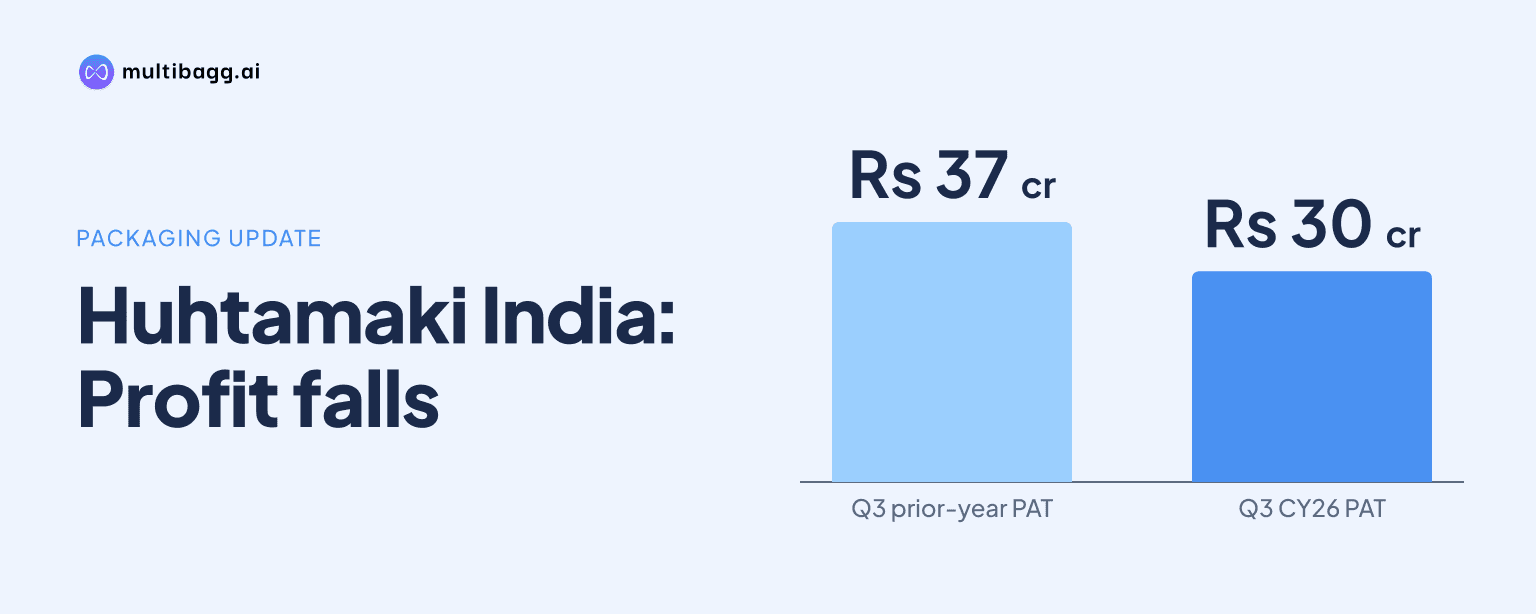
Huhtamaki India Limited closed its Baddi labels plant after Q3 CY26, shifted volume to Ambernath and Bangalore without customer disruption, and booked a Rs 9.6 crore charge that contributed to profit after tax of about Rs 30 crore, versus Rs 37 crore a year earlier.
Know Huhtamaki India inside out
Results, valuation, peers and who's buying, in one view.
Why did Huhtamaki India close the Baddi labels plant?
Huhtamaki India closed the Baddi site because management said it faced operational and financial challenges, while its Ambernath and Bangalore labels plants could take its volumes. Managing Director Kamal Taneja said on the October 30, 2026 earnings call that Baddi was completing a two-month notice period and would close the following day.
The closure followed the quarter ended September 30, 2026, rather than being a reported operating event within that quarter. Huhtamaki India said the transfer was proceeding smoothly, customers were comfortable with the change, and supplies, delivery timing and product quality had been maintained during the move to the two other labels factories.
Management did not disclose Baddi’s revenue, plant capacity, utilisation, employee count or historical losses on the Q3 CY26 call. It identified the Rs 9.6 crore restructuring charge as the immediate financial consequence and said the action was intended to improve efficiency and optimise costs in the future.
Baddi was one of Huhtamaki India’s three labels plants, alongside Ambernath and Bangalore. Management said all three labels plants held Forest Stewardship Council certification, but did not provide a plant-level breakdown of the labels segment’s sales or the certification-related effect of the closure.
What was the financial impact of the Baddi closure?
The Baddi closure resulted in a Rs 9.6 crore restructuring charge in Q3 CY26, which management said was the main reason profit after tax fell about 19% year on year. Chief Financial Officer Amit Gupta said quarterly profit after tax was about Rs 30 crore, compared with Rs 37 crore in the prior-year quarter.
Huhtamaki India recorded the Rs 9.6 crore charge in its Q3 CY26 profit and loss account. Gupta said profit after tax would have compared differently without that charge, while the company still reported about 13% growth in profit after tax for the nine months ended September 2026.
The Baddi charge was not the only factor affecting year-on-year comparisons. Management said the prior-year third quarter included one-off employee-retirement reversals or corrections that did not recur in Q3 CY26, meaning reported earnings before interest and tax, or EBIT, were broadly flat, while comparable EBIT was about 18% higher after excluding the respective items.
For the nine months ended September 2026, Huhtamaki India reported about Rs 153 crore of EBIT, up about 22% from the prior-year period. Gupta said that figure included nearly Rs 8.8 crore of prior-period depreciation correction booked in Q1, another non-recurring effect that management separated from operating comparisons.
Got a follow-up? Ask IRIS
How will Huhtamaki India handle Baddi’s transferred volumes?
Huhtamaki India is handling Baddi’s label volumes through Ambernath and Bangalore rather than by announcing new investment for the transfer. Taneja said on October 30 that work had moved to the two plants and that customer supply had remained uninterrupted during the plant’s two-month closure process.
Management’s wider Q3 CY26 capacity comments support that approach. In response to an analyst, Taneja said Huhtamaki India had enough capacity for the next two to three years and did not expect to need major investment to meet market demand or increased volumes during that period.
Huhtamaki India did not disclose utilisation at Baddi, Ambernath or Bangalore, nor did it quantify the incremental sales possible at full utilisation. Management said productivity and efficiency programmes were designed to create more available capacity, so the financial contribution of the transferred Baddi volumes cannot be calculated from the call.
The transfer takes place while physical volumes are rising across the business. Huhtamaki India reported volume growth of about 7% in Q3 CY26 and 4% in the nine months ended September 2026, after what management described as a couple of years of stagnant volume growth.
How does the closure fit Huhtamaki India’s Q3 growth?
The Baddi action coincided with Huhtamaki India reporting about Rs 748 crore of Q3 CY26 sales, its highest quarterly sales level over the previous couple of years. Sales rose 23.7% year on year, and management said the increase reflected raw-material price pass-through, product mix and the 7% volume increase.
Management said the three contributors to sales growth were close to one-third each, though not exactly equal, and did not provide a detailed split. Taneja said Huhtamaki India was prioritising higher-value products over lower-margin, less complex or commoditised work, while declining to quantify the share of Q3 CY26 volume growth from those products.
For the nine months ended September 2026, Huhtamaki India reported about Rs 204 crore of earnings before interest, tax, depreciation and amortisation, or EBITDA. Management said EBITDA increased about 25% against 16% top-line growth in the same nine-month period, despite the Baddi charge reducing Q3 profit after tax.
Q3 CY26 margins were also affected by raw-material timing in September 2026. Taneja said raw-material costs rose sharply during that month and some contract-based pass-throughs could not be implemented immediately, with the effect expected to be reflected over the next quarter; he added that the timing can also work in the company’s favour when costs decline.
Conclusion
Huhtamaki India has concentrated Baddi’s labels production in Ambernath and Bangalore after closing a site management said had operational and financial challenges. The Rs 9.6 crore charge reduced Q3 CY26 profit after tax to about Rs 30 crore, but the company also reported 23.7% sales growth, 7% quarterly volume growth and about 13% growth in nine-month profit after tax.
The next results update should show whether the transferred labels volumes continue without customer disruption and whether the expected efficiency and cost benefits emerge. Management’s stated two-to-three-year capacity outlook and the expected next-quarter effect of September 2026 raw-material pass-through timing are the disclosed points to watch.