










Huhtamaki India sees recycled rules creating packaging work
Key highlights
- Huhtamaki India cited recycled-plastic requirements of about 10% for complex laminates and 30% to 40% for simple mono-material structures.
- Management said recycled-plastic requirements increase progressively each year under existing industry regulation.
- Huhtamaki India said new packaging commercialisation can take from 3 months to a couple of years.
- Physical volume growth was about 7% in the third quarter discussed on the October 30, 2026 call.
powered by IRIS
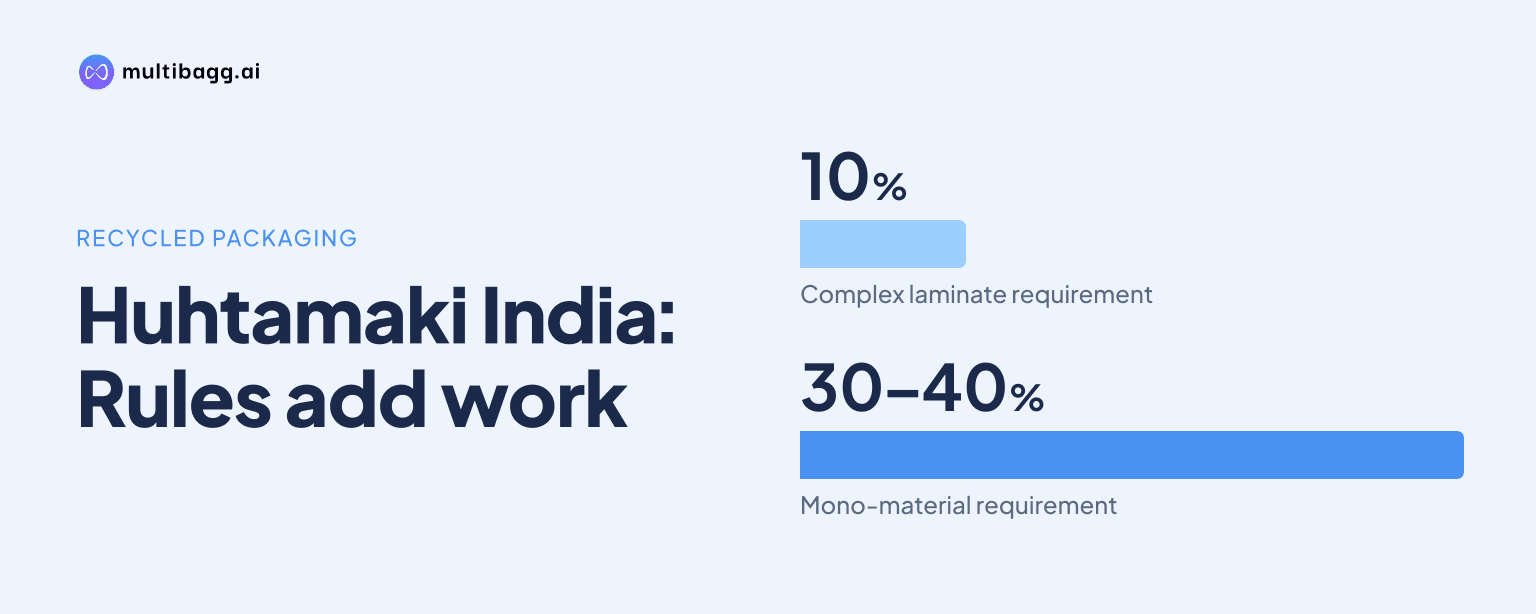
Huhtamaki India Limited said on October 30, 2026 that rising recycled-plastic requirements create packaging-development opportunities because complex laminates currently require about 10% recycled content, while simple mono-material structures may require 30% or 40%. Management said compliance can require revised job specifications and different manufacturing technology from virgin-plastic laminates.
Know Huhtamaki India inside out
Results, valuation, peers and who's buying, in one view.
How do recycled-content rules affect Huhtamaki India?
Huhtamaki India said existing industry regulation specifies the recycled-plastic content required in laminate packaging, with the percentage varying by the type of laminate. Management said the required content rises progressively every year, rather than staying at the current levels it cited for simple and complex packaging structures.
Management differentiated between simple mono-material laminates and complex packs made from multiple materials. It cited a recycled-plastic requirement of 30% or 40% for a simple mono-material structure, depending on the category, versus about 10% for a more complex laminate that may include aluminium foil.
The distinction means the rule is not applied as one uniform requirement across flexible packaging. A mono-material pack can carry the higher 30% or 40% requirement, while a multi-material laminate currently has an approximately 10% threshold. Huhtamaki India did not disclose revenue, volume or operating profit linked to recycled-content conversions on the October 30 call.
Why can recycled plastic change packaging specifications?
Huhtamaki India said adding recycled plastic can require a changed specification for an individual customer job. Management said the complexity and manufacturing technology can differ from that used for a laminate made with virgin plastic, creating work in both technical development and production execution.
Management described its potential value addition as arising from changing a packaging specification and, in some cases, adopting technology suited to the revised structure. It did not quantify the cost of conversion, the price premium if any, or the margin effect of using recycled content in a 10% complex-laminate requirement.
The company’s product-development activity also includes using more recyclable material, increasing mono-material use and reducing material consumption. Those initiatives go beyond meeting the cited 10% recycled-content level because they can involve redesigning a multilayer package into a single-layer or double-layer alternative.
Which packaging formats does Huhtamaki India want to expand?
Huhtamaki India said it aims to encourage customers to adopt its blueloop product and move, where feasible, from multilayer packaging to mono-material, single-layer or double-layer formats. Management described this innovation-led route as more encouraging than compliance alone, but did not disclose blueloop sales or the number of customer conversions.
The company also referred to an IFCA award as an example of work supported by its innovation team. That team is assessing recyclable materials, mono-material construction and material reduction together, rather than treating the 30% to 40% recycled-content requirements in simple structures as the only sustainability measure.
Material sourcing is another component of the product programme. Huhtamaki India said all three of its label plants are certified by the Forest Stewardship Council. Management did not say that the certification covers all flexible-packaging sites or that it determines compliance with recycled-plastic rules for laminates.
Got a follow-up? Ask IRIS
Is Huhtamaki India ready for tighter recycled-content rules?
Huhtamaki India said it is well prepared if recycled-content requirements are implemented more widely or tightened. Management did not claim exclusive industry capacity, and it did not quantify available capacity for recycled-content packaging, committed customer volumes or the timing of future regulatory increases.
That readiness statement is supported by management’s wider capacity position, although it is not a dedicated recycled-packaging forecast. In response to a separate utilisation question, Huhtamaki India said it did not expect to need huge investment over the next 2 to 3 years to meet market demand or volume growth.
Management said productivity and efficiency programmes are intended to create more capacity for future growth. In the third quarter discussed on the call, physical volume growth was about 7%, while management said pricing, product mix and volume each contributed roughly one-third of the increase in top-line revenue, though not in exactly equal proportions.
How long does Huhtamaki India take to change packaging?
Huhtamaki India said a new customer or product can take from 3 months to a couple of years to move from concept to commercial supply, depending on complexity. The process includes defining customer requirements, artwork development, pre-press activity, selection of a technology or laminate, trials and market introduction.
Management said expanding business with an existing customer is generally faster than converting a new customer because the commercial relationship and approval process are already in place. Larger customers can take longer because of their verification, control and internal approval requirements, while smaller regional customers usually move more quickly.
Artwork demand follows a different timetable from regulatory specification changes. Huhtamaki India said festive-pack artwork for Diwali and Dussehra would generally have been produced in the second quarter rather than the third quarter, because packaging is supplied before customers fill and market their products.
Conclusion
Huhtamaki India’s identified regulatory opportunity is based on technical adaptation rather than a disclosed near-term financial contribution. Requirements ranging from about 10% for certain complex laminates to 30% or 40% for simple mono-material structures can require revised specifications, manufacturing changes and customer-led product development.
The next issue to watch is whether recycled-content requirements rise as management expects and whether customers adopt blueloop, mono-material or lower-layer designs. Conversion timing remains material because Huhtamaki India said a new packaging programme can take from 3 months to a couple of years, depending on technical complexity and customer approvals.