










Huhtamaki India Says September Costs Delayed Margin Recovery
Key highlights
- Huhtamaki India said current-quarter EBITDA margin of about 8% reflected late-September costs awaiting pricing recovery.
- Nine-month EBITDA margin was 10%, up from 9.2% in the comparable prior-year period.
- Management said cost inflation and pricing pass-through can occur in different quarters, causing margin fluctuations.
- Huhtamaki India said it has less than double-digit market share in a fragmented packaging market.
powered by IRIS
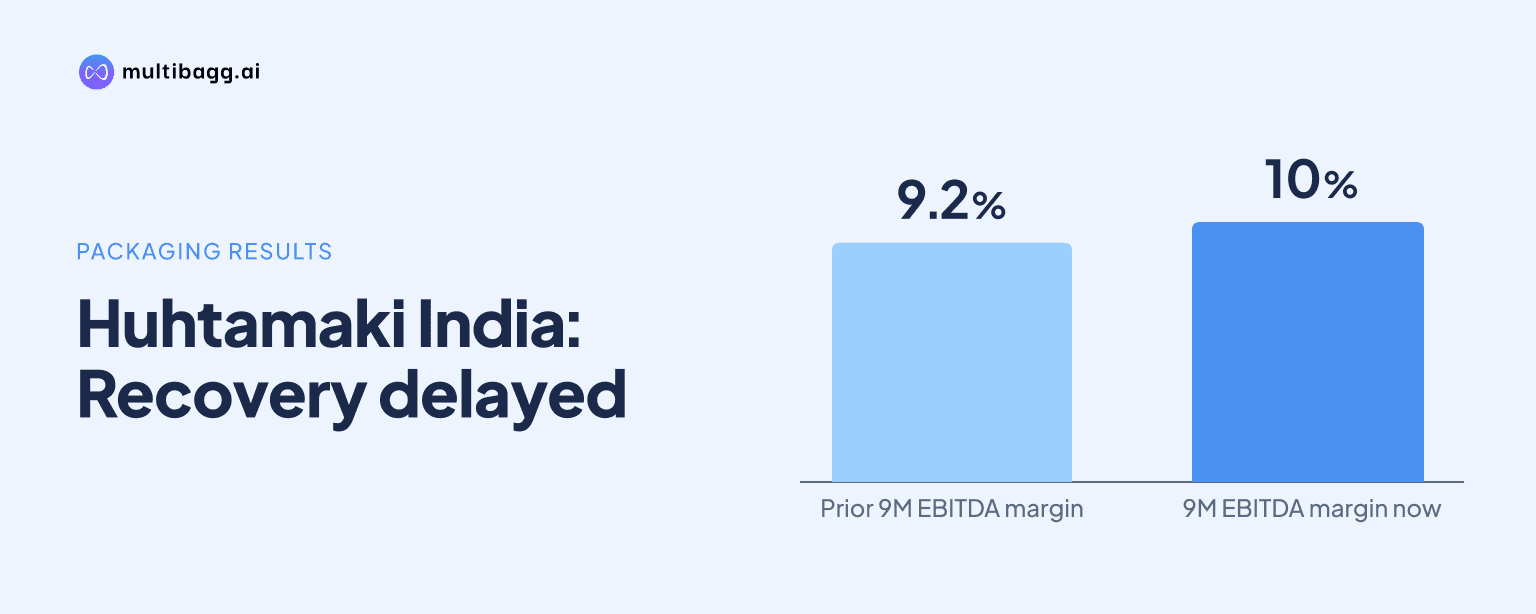
Huhtamaki India Limited said its current-quarter EBITDA margin of about 8% reflected late-September input-cost inflation that had not yet been recovered through customer pricing, rather than a structural operational change. Management pointed to a nine-month EBITDA margin of 10%, up from 9.2%, as evidence of improvement over the longer reporting period.
Know Huhtamaki India inside out
Results, valuation, peers and who's buying, in one view.
Why did Huhtamaki India’s quarterly EBITDA margin decline?
Huhtamaki India said the movement to about 8% EBITDA margin in the current quarter from around 10% in the previous quarter primarily reflected a timing gap between higher costs and price pass-through. Amit Gupta said costs that arose late in September would be recovered in subsequent months, leaving the quarter with costs that pricing had not yet fully offset.
Management described a business cycle in which it establishes a particular cost and subsequently implements corresponding price changes. That sequence can leave the company temporarily behind or ahead in cost recovery in a given quarter. Gupta said this timing difference, rather than an identified inventory issue or a stated loss of pricing ability, explained the quarterly margin variation.
The timing of the cost increase was central to management’s explanation. Because the higher costs came in late September, the reporting period closed before the related pricing recovery was complete. Gupta said quarterly EBITDA margins may therefore show “some play” even while Huhtamaki India seeks to recover costs through pricing in later months.
What does Huhtamaki India’s nine-month margin comparison show?
Huhtamaki India reported EBITDA margin of 10% on a nine-month basis, compared with 9.2% in the comparable prior-year period, an increase of nearly 80 basis points. A basis point is one-hundredth of a percentage point, making the 0.8-percentage-point difference a longer-period improvement despite the sequential quarterly decline.
The two comparisons measure different periods and show different movements. The current-quarter margin of about 8% was lower than the previous quarter’s roughly 10%, while the nine-month margin of 10% was above 9.2% a year earlier. Gupta said profit margins in absolute terms were growing versus last year, even though quarterly percentages can fluctuate with the timing of cost recovery.
Huhtamaki India did not provide a numerical split of the September cost increase by raw material, customer, product category or inventory. It also did not disclose a quarterly EBITDA-margin target. Its stated evidence was the 10% nine-month margin and the expected recovery of late-September costs in subsequent months.
Does Huhtamaki India see a structural margin issue?
Huhtamaki India said it sees no structural change in its operations compared with the previous quarter or future quarters. Managing Director Kamal Taneja said the company remained focused on margin improvement, while Gupta said there was no major concern around the movement from about 10% in the previous quarter to about 8% in the current quarter.
That assessment was management’s view, not a forecast that each quarter will deliver the same margin. Gupta said the cost-and-pricing cycle creates quarterly fluctuations because some costs are incurred before the related customer pricing takes effect. The late-September timing meant that the current quarter included a larger mismatch between costs and recovery.
Management also said growth was not coming solely from pricing. Taneja said Huhtamaki India’s growth reflected a combination of pricing, volume increase and a healthier product mix, which it had maintained for the last few quarters. This distinction matters because management presented margin recovery alongside volume and mix, rather than as a result of price changes alone.
Got a follow-up? Ask IRIS
What could affect Huhtamaki India’s future pricing and margins?
Huhtamaki India said inflation and geopolitical disruption can make customer price pass-through more difficult because higher prices affect the end consumer. Taneja said customers were reporting flat or slower volume growth in some cases, making price recovery an outcome that the company must work to achieve rather than an automatic response to input inflation.
Product mix is one mechanism Huhtamaki India tracks. Taneja said the company focuses on higher-value products, including innovation and sustainable offerings, because these form part of its value proposition to customers. He did not provide a numerical target for the share of higher-value products, saying mix changes by season and by customer.
Management also cited reducing material use, whether in plastic, compostable materials or paper, as an innovation focus. Huhtamaki India said it was seeing growth in sustainability during the year, but Taneja and Gupta did not call it an assured near-term tailwind. They said broader customer adoption and greater regulatory enforcement would be needed, particularly where sustainable products cost more than commoditised alternatives.
How is Huhtamaki India pursuing volume growth?
Huhtamaki India said it is pursuing volume growth even when customers report flat or modest volume trends. Taneja said the company’s growth could indicate market-share gains, although he did not provide a market-share figure. He said Huhtamaki India remained at less than double-digit market share in a fragmented packaging market.
Taneja said the company did not see many external tailwinds amid geopolitical crises and inflation. Instead, management attributed its recent growth to execution across volume, pricing and product mix. The company’s position at less than double-digit market share was cited as scope to grow within a fragmented market, rather than as a quantified forecast for future volume.
For the margin outlook, the recovery of late-September costs is one disclosed element, but it sits alongside customer acceptance of pricing and demand conditions. Management said its focus remained on growth and margin improvement if the market holds up, while acknowledging that customer price sensitivity can affect both pricing actions and volumes.
Conclusion
Huhtamaki India’s explanation for the sequential margin decline is that late-September costs entered the quarter before the related pricing recovery. Management contrasted the current-quarter EBITDA margin of about 8% with a nine-month margin of 10%, up from 9.2%, and said the difference reflected timing in its cost-recovery cycle rather than a structural change.
The key next item is whether late-September costs are recovered in subsequent months as management said they would be. Huhtamaki India also said it expects to speak with investors again next quarter, when its progress on pricing, volume growth, product mix and the market conditions affecting customer demand can be assessed.