










Huhtamaki India says high-value packs drove 7% Q3 volume growth
Key highlights
- Huhtamaki India reported Q3 sales of Rs 748 crore, up 24% year on year.
- Huhtamaki India’s Q3 physical volume grew 7%, while nine-month volume growth was 4%.
- Management said higher-value products supplied the majority of Q3 volume growth.
- Q3 profit after tax was Rs 30 crore versus Rs 37 crore a year earlier, primarily due to a Baddi restructuring charge.
powered by IRIS
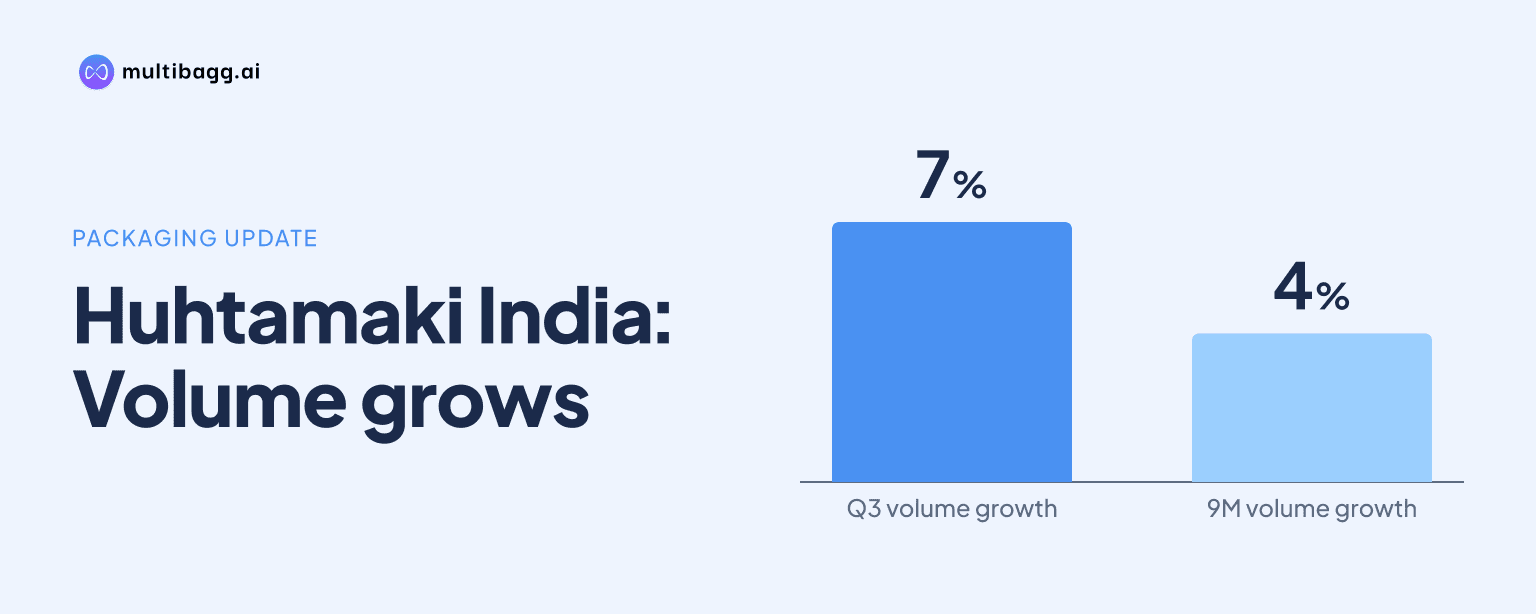
Huhtamaki India Limited said Q3 physical volume grew 7%, with management attributing the majority of that increase to higher-value packaging, as quarterly sales rose 24% year on year to Rs 748 crore. The company said the outcome followed several years of stagnant volumes, while price pass-through and product mix also contributed.
Know Huhtamaki India inside out
Results, valuation, peers and who's buying, in one view.
What drove Huhtamaki India’s Q3 sales increase?
Huhtamaki India’s Q3 sales increase was driven by raw-material price pass-through, product mix and a 7% increase in physical volumes. Management said the three contributors were close to equal in the rise from roughly Rs 600 crore to Rs 620 crore three or four quarters earlier to Rs 748 crore in Q3, although it did not provide an exact split.
The Rs 748 crore Q3 sales figure was 24% above the prior-year quarter and was the highest quarterly sales level in the past couple of years, according to management. Management contrasted Huhtamaki India’s 7% volume increase with comments from some customers that had reported higher sales but declining volumes, indicating that the company’s revenue gain was not solely an inflation-led price movement.
For the nine months ended September 2026, Huhtamaki India reported 4% volume growth after volumes had been stagnant for a couple of years. Management said the 4% year-to-date gain reflected a healthier sales composition because pricing, mix and physical output were all contributing, rather than only contractual recovery of volatile raw-material costs.
How did higher-value packaging lift Huhtamaki India’s volumes?
Higher-value products supplied the majority of Huhtamaki India’s 7% Q3 volume growth, management said, without disclosing a percentage or tonnage breakdown. The company said it is selecting products that fit its value proposition instead of lower-margin, low-complexity or commoditised work, which can raise value per unit as well as physical output.
Huhtamaki India cited packaging redesign as one mechanism for this mix shift. It described replacing a structure containing three or four plastic layers with a duplex structure that eliminated aluminium foil, which management said improved sustainability and generated significant cost savings for the customer; it also referred to a metallic-film label developed for a UK customer.
Product development can extend across several reporting periods because a new customer conversion may take from three months to a couple of years. Management said the process can involve artwork, pre-press work, technology selection, trials and approvals, with larger customers generally taking longer because of their verification and control procedures.
Festive artwork is another source of value-added work, but management said related Diwali and Dussehra packaging would have been produced mainly in Q2 rather than Q3. That timing means the 7% Q3 volume gain was not presented as a single seasonal-artwork effect, but as part of a broader focus on technically differentiated packaging.
Got a follow-up? Ask IRIS
Why did Huhtamaki India’s Q3 profit trail sales growth?
Huhtamaki India’s Q3 profit after tax was Rs 30 crore, down from Rs 37 crore a year earlier, primarily because of a Baddi restructuring charge. Management said operational and financial challenges at Baddi led to the charge, which reduced the comparability of the 24% sales increase with the reported profit outcome.
Reported Q3 margins were also affected by one-off items in the prior-year period. Management said employee-retirement reversals or corrections had benefited the earlier profit and loss account, while those benefits were absent in the current period; excluding one-off effects, it said Q3 earnings before interest and tax, or EBIT, margin would have improved 18% year on year and exceeded 8%.
Raw-material costs added a timing effect in September. Management said input prices rose sharply during that month, while customer contracts can take a few weeks or until the next month to implement pass-throughs, so the September increase was expected to affect the following quarter; the same contractual lag can also delay price reductions when costs fall.
For the nine months ended September 2026, earnings before interest, tax, depreciation and amortisation, or EBITDA, were Rs 204 crore, up 25% against 16% sales growth. EBIT was Rs 153 crore, up 22%, after a Rs 8.8 crore prior-period depreciation correction booked in Q1, while management said nine-month profit after tax and earnings per share each increased 13%.
Can Huhtamaki India grow volume without major capital spending?
Huhtamaki India said it has sufficient capacity for the next two to three years and does not expect huge investment to meet demand or support higher volumes in that period. Management did not disclose plant utilisation or quantify potential revenue at full utilisation, so the amount of unused capacity cannot be calculated from the call.
The company’s plan is to create additional headroom through productivity and efficiency improvements, which management described as a core operations priority. It said its productivity plan was on track against targets set for the year and was intended to optimise the cost structure while enabling more capacity for future growth.
Packaging innovation is part of that plan. Management said it is encouraging customers to use blueloop products, mono-material packaging and structures that move from multiple layers to one or two layers; it also said recycled-plastic requirements can range from about 10% for some complex laminates to 30% or 40% for simpler mono-material structures.
Management said the recycled-content requirement rises progressively each year, potentially creating demand for specification changes and different technologies. Separately, its Khopoli captive solar-generation project began contributing in August and increased renewable electricity’s share to 23% in Q3, though management did not disclose its financial effect.
Conclusion
Huhtamaki India’s Rs 748 crore Q3 sales result combined a 7% physical volume increase with pricing and product mix, rather than relying on raw-material pass-through alone. Management’s statement that higher-value packaging delivered most of the volume growth links the improvement after stagnant volumes to portfolio selection, product complexity and customer-development work.
The next quarter will show whether September’s raw-material increase is recovered through customer contracts after the disclosed timing lag and how that affects reported margins. Investors can also monitor the company’s stated two-to-three-year capacity runway, the delivery of its productivity targets and whether the 4% volume growth recorded in the nine months ended September 2026 continues.