








Ice Make sees FY27 EBITDA margin at 6-6.5% from H2 sales mix
MAX Plan at ₹4,999/yr

Find your next multibaggerBe a Pro Investor
Research stocks and track your picks on the go. Download the app.
Key highlights
- Ice Make targets FY27 EBITDA margin of approximately 6-6.5%.
- Ice Make expects FY27 revenue of approximately Rs 900 crore, above its earlier Rs 850 crore guidance.
- Ice Make historically generates approximately 60% of annual business in H2 and 40% in H1.
- Ice Make implemented two phased price increases of approximately 6-7% each.
powered by IRIS
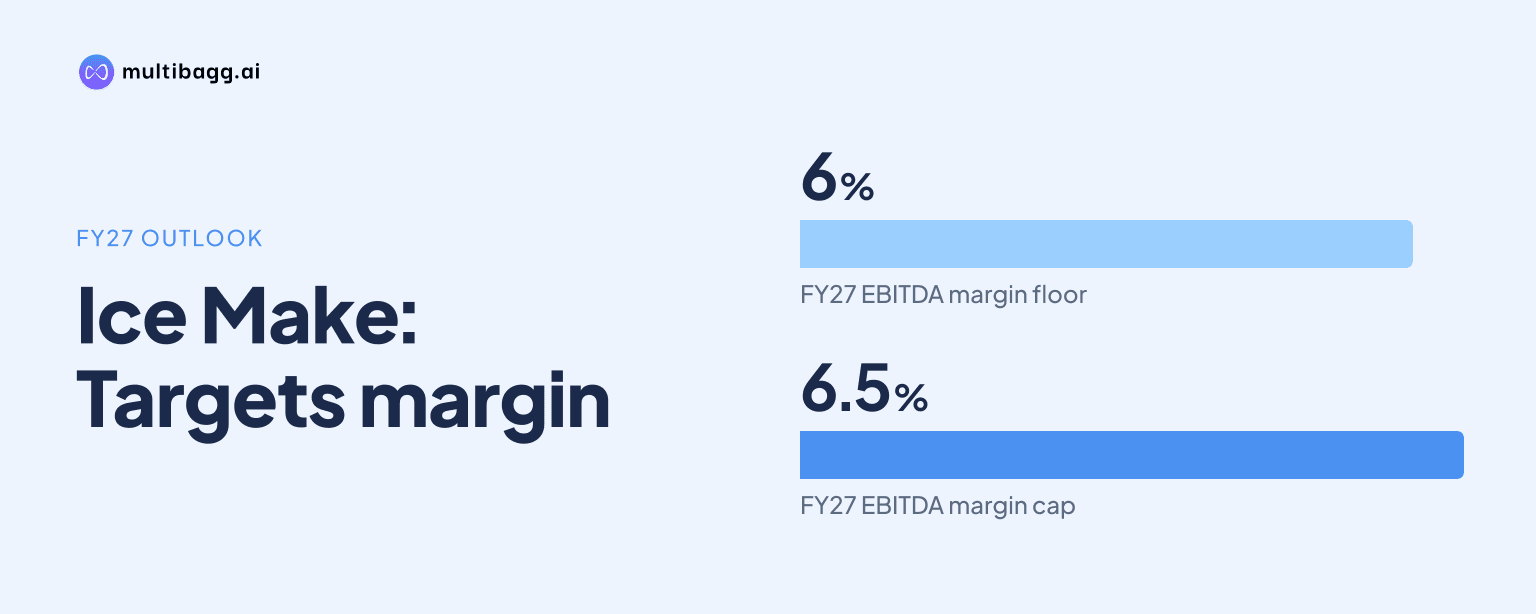
Ice Make Refrigeration Limited expects FY27 EBITDA margin of approximately 6-6.5%, with the historically larger H2 sales contribution, phased price increases and higher volumes expected to provide operating leverage. Management said around 60% of annual business is typically generated in H2, although gross-margin recovery should be moderate rather than complete immediately.
Know ICE Make Refrigeration inside out
Results, valuation, peers and who's buying, in one view.
How does Ice Make expect to reach a 6-6.5% FY27 EBITDA margin?
Ice Make expects higher H2 volumes, improved realisations and a relatively stable operating-cost base to support its FY27 EBITDA margin outlook of approximately 6-6.5%. Management said about 40% of annual business is historically generated in H1 and about 60% in H2, with Q3 and Q4 particularly important for full-year performance. It also described its order pipeline, quotations and order book as healthy.
The margin outlook is not based on pricing alone. Management said FY27 revenue could reach approximately Rs 900 crore, exceeding its earlier guidance of Rs 850 crore, compared with revenue of about Rs 670-680 crore in the prior year. It said volume growth would contribute meaningfully alongside price increases, while greater revenue is expected to support operating leverage.
Management distinguished the full-year margin target from an assurance of quarter-on-quarter improvement. When asked whether margins could improve if raw-material costs stabilise, it said it would seek to benefit from favourable input-cost movements but could not provide a firm commitment on the timing or extent. Competition and customer considerations would continue to influence selling prices.
When will Ice Make's price increases affect margins?
Ice Make expects the first price increase introduced in Q1 to flow through more fully in Q3, while the price increase implemented in Q2 should contribute progressively thereafter. Management said each phase was approximately 6-7%, but cautioned that the stated price rises should not be treated as a direct addition to EBITDA because realised pricing varies by customer and channel.
Management cited competitive pressures, customer negotiations and the mix of direct, dealer and e-commerce sales as reasons why the full price benefit may not be immediately visible. It therefore expects moderate gross-margin improvement in H2 rather than a complete year-on-year recovery at this stage. Gross margins had recovered sequentially but remained lower year-on-year when the question was raised.
Input costs remain a variable in the margin calculation. Management said commodity movements have been highly dynamic over the past six to 12 months and that a decline in crude oil prices does not necessarily reduce procurement costs immediately. For chest freezers and visi coolers, it said price increases are being implemented across the industry and are not expected to materially affect overall category demand, despite possible customer discount negotiations.
Got a follow-up? Ask IRIS
Why are Ice Make's newer businesses limiting margin expansion?
Ice Make said its newer businesses are still developing scale, which keeps operating costs relatively high and limits near-term margin expansion. Refrigeration Products and Continuous Panels each contribute approximately 14-15% of topline, according to management. It expects their margins to improve towards normal levels as operating scale rises, while its immediate priority remains topline growth and operating efficiency.
The newer Refrigeration Products portfolio includes chest freezers and visi coolers launched during the past 18 months to two years. Management said these categories performed particularly well in Q2 and that Indian market penetration remains below 10%. Ice Make is expanding dealer and distribution coverage in northern and southern India after using its established western India presence for the initial market entry.
The older cold-room business remains Ice Make's largest contributor, accounting for approximately 50-55% of topline. Management said its businesses serving dairy, ice-cream and process-industry applications grew about 20-25%, while Continuous Panels is linked to infrastructure development and cold-storage demand. The FY27 outcome therefore depends on sales execution in both the established cold-room operations and newer commercial refrigeration categories.
Management referred to EBITDA margins of approximately 9.5-10.5% as longer-term operating potential for the newer businesses. It did not present that range as FY27 guidance. The nearer-term 6-6.5% FY27 outlook reflects the fact that Refrigeration Products and Continuous Panels have not yet reached the scale at which management expects their operating costs to normalise.
What could affect Ice Make's FY27 margin delivery?
Ice Make's FY27 margin delivery could be affected by procurement costs, competitive pricing, customer negotiations and order execution. Management said the order book was approximately Rs 200-225 crore and that it maintains raw-material inventory to meet customer commitments and seasonal commercial refrigeration demand. It estimated working-capital needs at about 15% of topline, potentially rising to approximately 15-17% with seasonality and inventory requirements.
Imported compressors are a specific supply-chain consideration. Management said there was no broad-based component shortage, but domestic compressor manufacturing capacity remains limited. It said import restrictions or quota constraints could create challenges for the refrigeration industry and that it would continue monitoring this issue while taking a cautious approach to procurement and cost management.
Larger expansion projects are not expected to add material FY27 benefits. Management said approximately Rs 58 crore from the preferential issue was allocated for expansion, modifications and potential acquisitions, with around Rs 3 crore invested upfront. It is evaluating four to five opportunities across cold rooms, chest freezers and Continuous Panels, but said benefits from the projects are expected to begin emerging around FY29.
The Galilei joint venture is also a longer-dated initiative. Ice Make said approximately Rs 35 crore had been invested in the venture, whose activities had commenced, and production was expected in about 18 months. Management said it intended to combine Galilei's Japanese technology with its understanding of Indian customer requirements, but it was too early to specify the final product portfolio.
Conclusion
Ice Make's approximately 6-6.5% FY27 EBITDA margin outlook combines a historically 60% H2 sales weighting, two phased price increases of approximately 6-7% each and revenue potential of around Rs 900 crore. Management's comments indicate that improvement is expected to be gradual because pricing realisation can lag, procurement costs remain volatile and newer businesses still carry relatively high operating costs.
The next items to watch are Q3 realisations from the Q1 price increase, the progressive contribution from the Q2 increase and whether H2 follows the historical 60% sales pattern. Management has not provided guidance for the following financial year, saying assessment will be more meaningful after FY27 is complete, while larger expansion-project benefits are expected around FY29.

