








Ice Make invests ₹35 crore; Galilei production due in 18 months
MAX Plan at ₹4,999/yr

Find your next multibaggerBe a Pro Investor
Research stocks and track your picks on the go. Download the app.
Key highlights
- Ice Make invested approximately ₹35 crore in the Galilei joint venture, and activities have commenced.
- Ice Make expects Galilei JV production to begin in approximately 18 months.
- Ice Make reported Q2 FY27 revenue of ₹207.38 crore, up 40.6% from Q2 FY26.
- Ice Make said approximately ₹73 crore of preferential-issue proceeds remained to be deployed.
powered by IRIS
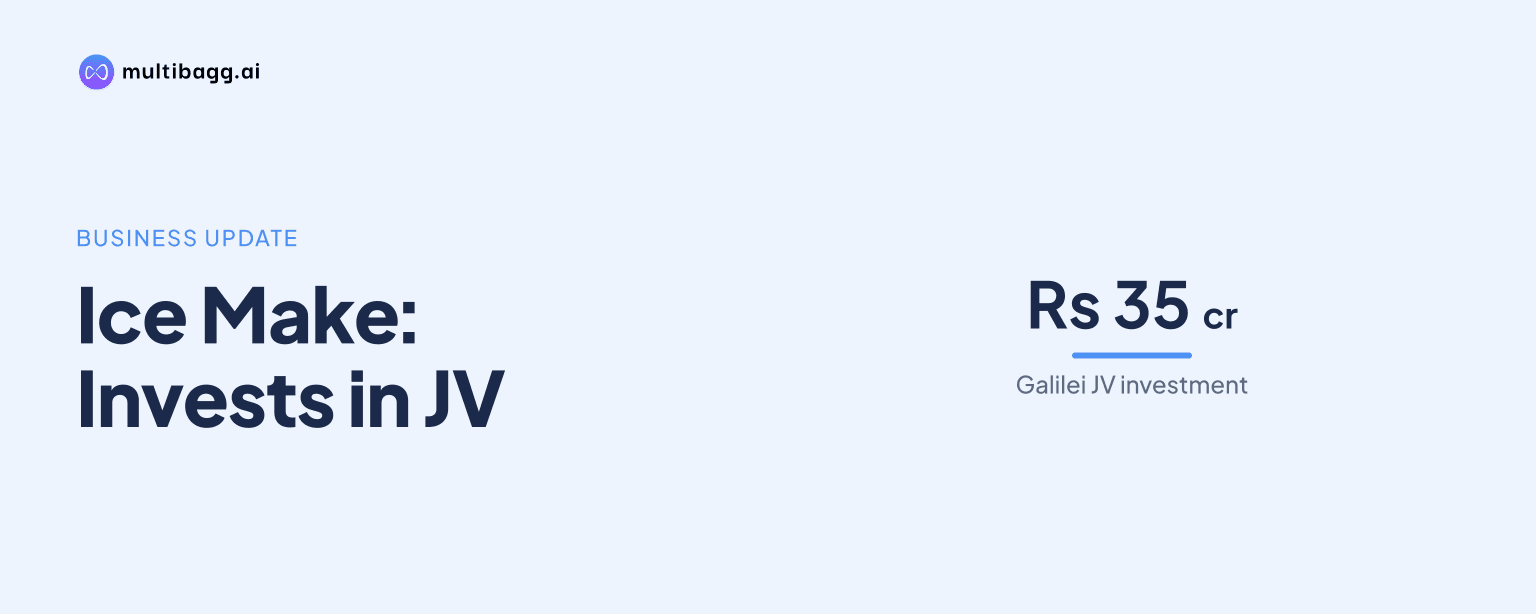
Ice Make said during its FY27 earnings call that it had invested approximately ₹35 crore in the Galilei joint venture, with activities commenced and production expected in about 18 months. Management said the India-specific product portfolio remains under development, requiring market research before further details may be shared, possibly around a year after the call.
Know ICE Make Refrigeration inside out
Results, valuation, peers and who's buying, in one view.
How much has Ice Make invested in the Galilei joint venture?
Ice Make has invested approximately ₹35 crore in the Galilei joint venture, or JV, and the venture's activities have commenced. Management disclosed this allocation while explaining the use of preferential-issue proceeds, which were also earmarked for expansion projects, a corporate office, debt repayment, working capital and issue-related expenses.
The ₹35 crore JV investment is part of a wider capital-allocation programme rather than a separately disclosed operating budget. Management said Ice Make's existing refrigeration portfolio and Galilei's products serve similar market segments, creating potential synergies through Japanese technology, product expertise and established operating practices. The call did not disclose the JV ownership split, manufacturing location, revenue target or profit target.
When will the Galilei joint venture begin production?
Ice Make expects Galilei JV production to begin in approximately 18 months. This was management's stated operating timetable after confirming that the ₹35 crore investment had been made and activities had started.
The 18-month production schedule is separate from the timeline for deciding the final India-oriented product range. Management said it needs considerable groundwork and market research to assess Indian operating conditions, customer requirements, competition and appropriate price points. It may provide more portfolio detail around a year after the FY27 call, but did not commit to a final product-launch date.
What products could the Galilei joint venture develop for India?
Ice Make has not finalised the Galilei JV's India-specific product portfolio. Management said it is too early to determine whether existing international products will be introduced directly or adapted after research into local requirements and price points.
Ice Make has more than three decades of experience in refrigeration, particularly cold storage and solutions for dairy and ice-cream customers. In the past 18 months to two years, it has also entered plug-and-play categories including chest freezers and visi coolers. Management's two-year objective is to build a more comprehensive refrigeration products and solutions portfolio, supported by dealer-network expansion across India.
The existing revenue mix shows why the product decision matters. The cold-room business remains Ice Make's largest contributor at about 50-55% of topline, while dairy, ice-cream and process-industry businesses grew around 20-25%. In Q2 FY27, newer commercial refrigeration products represented about 14% of the segment-wise mix, continuous panels 14%, ammonia systems and projects 11%, and transport refrigeration 5%.
Got a follow-up? Ask IRIS
How is Ice Make deploying preferential-issue proceeds?
Ice Make allocated approximately ₹58 crore for expansion, modifications and potential acquisitions, alongside the ₹35 crore Galilei JV investment. About ₹3 crore had been invested upfront in expansion-related initiatives, while management said it would evaluate returns and potential earnings before interest, tax, depreciation and amortisation, or EBITDA, contribution before deploying additional funds.
The expansion evaluation covers higher cold-room capacity, the door division used in the Continuous Panels business, rockwool panels, machinery, automation and internal manufacturing capabilities. Ice Make said it has a three-year deployment period and does not intend to rush investments without assessing project returns. Management expects full-scale benefits from these projects to become visible from FY29 onward.
Management is also assessing four to five opportunities across cold rooms, chest freezers and continuous panels. It said each project is being reviewed for required investment, expected returns and strategic fit, with further disclosures to follow only after plans are finalised. This means the ₹58 crore allocation is not a commitment to a single specified capacity project at this stage.
What is Ice Make's financial backdrop for the rollout?
Ice Make reported consolidated Q2 FY27 revenue from operations of ₹207.38 crore, up 40.6% from ₹147.49 crore in Q2 FY26. Profit after tax rose to ₹2.71 crore from ₹2.02 crore, while revenue increased sequentially from ₹178.88 crore in Q1 FY27. Management described Q2 as a return to quarterly profitability following the loss reported in Q1 FY27.
For H1 FY27, consolidated revenue reached ₹386.26 crore, a 49.1% increase from ₹258.99 crore in H1 FY26. Profit after tax was ₹1.05 crore versus ₹0.55 crore a year earlier, and earnings per share rose to ₹0.64 from ₹0.38. The contrast between H1 profit and Q2 profit reflects the Q1 loss that management referred to on the call.
Management said it expects FY27 revenue to exceed its earlier ₹850 crore guidance and could reach approximately ₹900 crore, based on the business environment and order pipeline. Ice Make reported an order book of about ₹225 crore across product verticals. It retained an FY27 EBITDA-margin outlook of approximately 6-6.5%, while cautioning that gross-margin improvement in H2 would be moderate rather than a full year-on-year recovery.
Input costs remain a stated execution issue for the JV and core business alike. Ice Make identified steel, copper, aluminium and compressors as key raw materials, while noting that imported compressors remain important because domestic manufacturing capacity is limited. Management said it had implemented price increases of around 6-7% in one phase and a further 6-7% in the following quarter, but said competitive conditions and sales-channel mix may delay the benefit in realisations.
Conclusion
Ice Make has moved the Galilei partnership into execution through a ₹35 crore investment and an approximately 18-month production target. The venture sits alongside ₹58 crore reserved for expansion and potential acquisitions, while Ice Make's Q2 FY27 revenue rose 40.6% year on year to ₹207.38 crore and management continued to focus on profitability, procurement costs and working-capital discipline.
The next disclosed milestones are possible portfolio details around a year after the call, the expected production start in about 18 months and capital deployment during the three-year window. Management's stated FY29 timing for full-scale benefits from wider expansion projects, plus progress on four to five evaluated opportunities, will indicate how quickly the investment programme translates into operating capacity.

