










ICONIQA Mumbai turns EBITDA-positive as revenue hits Rs 20 crore
Key highlights
- ICONIQA reported Rs 20 crore of revenue in Q2 FY27, compared with Rs 3 crore in the prior-year Q2.
- ICONIQA moved from a Rs 1.4 crore EBITDA loss to about Rs 30-odd lakh of positive EBITDA in Q2 FY27.
- ICONIQA occupancy was 70% in Q2 FY27 and H1 FY27, versus 17% in the prior-year Q2.
- ICONIQA's Q2 FY27 ADR was Rs 8,000-odd, compared with Rs 7,800 a year earlier.
powered by IRIS
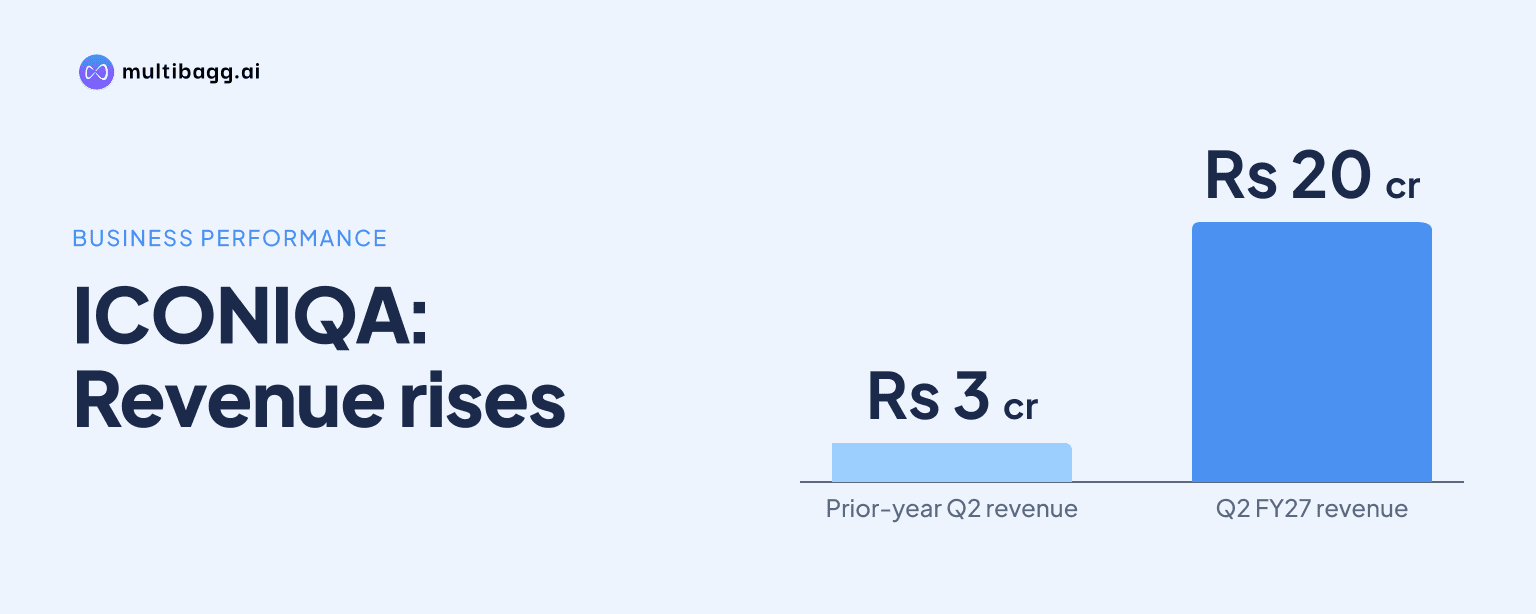
ICONIQA Mumbai turned EBITDA-positive in Q2 FY27, reporting about Rs 30-odd lakh of earnings before interest, tax, depreciation and amortisation (EBITDA) on Rs 20 crore of revenue, versus a Rs 1.4 crore EBITDA loss and Rs 3 crore of revenue in the prior-year Q2. Management said occupancy reached 70%, from 17%, while average daily rate (ADR) rose to Rs 8,000-odd from Rs 7,800.
Know Royal Orchid Hotels inside out
Results, valuation, peers and who's buying, in one view.
How did ICONIQA reach positive EBITDA in Q2 FY27?
ICONIQA reached positive EBITDA in Q2 FY27 as revenue rose by Rs 17 crore year on year to Rs 20 crore and occupancy increased by 53 percentage points to 70%. Management compared this with Rs 3 crore of revenue, 17% occupancy and a Rs 1.4 crore EBITDA loss in the prior-year Q2. The hotel reported about Rs 30-odd lakh of positive EBITDA in Q2 FY27.
The change followed the hotel’s operating ramp-up after launch, according to management. Management said ICONIQA was approaching one year of operations and that hotels require time to settle. The year-on-year Q2 comparison showed occupied rooms increasing substantially, while ADR rose by about Rs 200 to Rs 8,000-odd.
What drove ICONIQA's Q2 FY27 revenue growth?
ICONIQA's Q2 FY27 revenue growth was associated with higher occupancy and a higher ADR. Management said occupancy rose from 17% in the prior-year Q2 to 70% in Q2 FY27, while ADR increased from Rs 7,800 to Rs 8,000-odd. These measures accompanied the increase in revenue from Rs 3 crore to Rs 20 crore.
Occupancy was the larger disclosed operational change between the two Q2 periods. ADR increased by roughly Rs 200, whereas occupancy rose by 53 percentage points, indicating that higher room utilisation was the principal disclosed contributor to the Rs 17 crore revenue increase. Management did not provide a numerical split between room revenue and food and beverage revenue on the call.
Management also said ICONIQA recorded 70% occupancy in H1 FY27, matching its Q2 level. For the current quarter, management said occupancy was marginally higher than 70% and pointed to a period through 20 December without holidays as a possible support for occupancy. It did not provide a current-quarter revenue or EBITDA estimate.
Why was ICONIQA occupancy below 81% in Q4?
ICONIQA's 70% occupancy in Q1 and Q2 FY27 was below the 81% reported in Q4, but management said the periods have different seasonal conditions. Management said Q4 covers January, February and March, while Q1 covers April, May and June. It described Q1 and Q2 as typically the lowest hotel-demand quarters, with Q3 and Q4 building thereafter.
Management also cited an April disruption, saying 40% of inbound traffic into Bombay went to zero at the start of the war referred to on the call. That comment was offered as context for Q1 rather than as a quantified estimate of ICONIQA's revenue impact. The reported occupancy levels were 81% in Q4 and 70% in each of Q1 and Q2 FY27.
The more direct comparison presented by management was between the two Q2 periods. On that basis, ICONIQA's occupancy rose from 17% to 70%, alongside revenue increasing from Rs 3 crore to Rs 20 crore. Management asked investors to compare equivalent quarters when assessing the seasonal movement from Q4 into Q1.
Got a follow-up? Ask IRIS
Can ICONIQA reach 75% annualised occupancy?
Management said around 75% year-to-date or annualised occupancy was the relevant market comparison and that ICONIQA was on its way to that level. This was management's assessment rather than formal guidance, and management did not state a date for reaching 75%. The disclosed Q2 FY27 and H1 FY27 occupancy level was 70%.
Management did not provide an ADR target, an annual revenue target or a sustained EBITDA target for ICONIQA. Its comments on the next two quarters focused on the usual seasonal build in Q3 and Q4 after the lower-demand Q1 and Q2 periods. The indication that current-quarter occupancy was marginally above 70% was directional rather than a full-quarter forecast.
A move from 70% to the 75% level cited by management would need to occur while maintaining room rates around the Rs 8,000-odd Q2 FY27 ADR. The prior-year Q2 ADR was Rs 7,800, so the hotel has increased rate as well as occupancy during its ramp-up. Management did not disclose the occupancy or ADR level at which it expects a particular EBITDA amount.
What does ICONIQA's progress mean for the wider portfolio?
ICONIQA's positive EBITDA provides an operating example for management's premiumisation strategy, which aims to increase the share of higher-rate hotels. Management said it previously had more than 100 hotels in the mid-market category at around Rs 5,000 ADR. ICONIQA reported an Rs 8,000-odd ADR and 70% occupancy in Q2 FY27, above the disclosed managed-hotel averages.
For the managed-hotel portfolio, management reported occupancy of roughly 59% and ADR of around Rs 4,000. It said newer managed hotels take about six months to stabilise, while older hotels improve over a longer period. Management was operating 127 hotels and said the number rises to 177 when signed hotels are included.
Management cited Royal Orchid Resort in Bangalore as another result of its investment programme, saying EBITDA rose from Rs 80 lakh to Rs 2 crore after premiumisation investments. It also referred to around 50 hotels in the pipeline and said newer, larger properties were delivering higher ADR and occupancy for the management business. The call did not quantify ICONIQA's contribution to consolidated profit beyond its Rs 20 crore revenue and about Rs 30-odd lakh EBITDA.
Conclusion
ICONIQA's Q2 FY27 performance marked a clear change from the prior-year Q2: revenue increased by Rs 17 crore to Rs 20 crore, occupancy rose from 17% to 70%, and EBITDA moved from a Rs 1.4 crore loss to about Rs 30-odd lakh positive. The disclosed operating data indicates that the expansion in occupancy was more substantial than the ADR increase from Rs 7,800 to Rs 8,000-odd.
The next disclosed benchmark is management's view that about 75% annualised occupancy is the market comparison level, against ICONIQA's 70% Q2 and H1 FY27 occupancy. Management expects normal seasonal improvement in Q3 and Q4, but did not give a date, ADR target or EBITDA target. Investors can also watch whether newer hotels, which management said take about six months to stabilise, affect the wider 127-hotel operating base.