










Royal Orchid Plans 30 Hotels as Managed Margins Hold Near 38%
Key highlights
- Royal Orchid plans about 30 hotel openings with close to 1,800 keys in the next 12 months.
- Royal Orchid said managed-hotel operating margins were about 37% to 38% in Q2 FY27.
- Royal Orchid has more than 50 upcoming properties in its pipeline, representing over 3,500 rooms.
- Royal Orchid reported Q2 FY27 consolidated total income of Rs 116 crore, up 34% from Rs 86.77 crore.
powered by IRIS
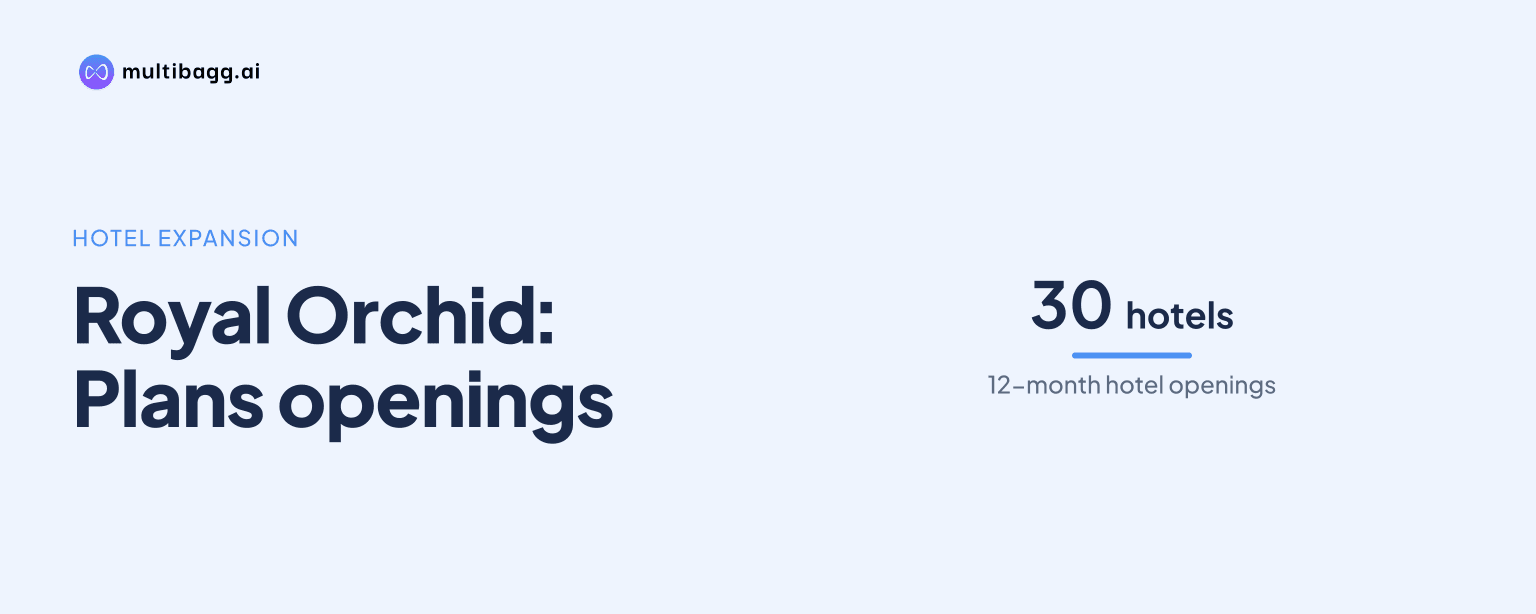
Royal Orchid Hotels Limited plans to open about 30 hotels with close to 1,800 keys during the next 12 months, while management said its managed-hotel operating margins were maintained at about 37% to 38% in Q2 FY27. The plan follows five openings and 426 added rooms in the preceding quarter.
Know Royal Orchid Hotels inside out
Results, valuation, peers and who's buying, in one view.
What is Royal Orchid’s 12-month hotel-opening plan?
Royal Orchid plans about 30 hotel openings with close to 1,800 keys over the next 12 months. Whole-Time Director Keshav Baljee called the period a “step up year” and said the company was expanding its development team to support a pace above the 10% to 15% growth range raised by an analyst.
The target follows five hotel openings in the preceding quarter, which added 426 rooms. Royal Orchid said its portfolio then comprised more than 127 hotels across India, making the proposed 30 openings a substantial addition to its current network if the projects commence as planned.
Management said the expansion will continue to use an asset-light model, under which Royal Orchid enters business and leisure destinations through partnerships rather than requiring ownership of every hotel asset. It described the model as supporting capital efficiency and financial discipline, but did not disclose the ownership or management mix of the 30 planned properties.
Royal Orchid did not give a managed-hotels revenue target for FY27 or for the following three to four years. Management instead indicated that growth should remain in double digits and could exceed the analyst’s suggested 10% to 15% range, subject to market conditions and partners completing projects on time.
How profitable were Royal Orchid’s managed hotels in Q2 FY27?
Royal Orchid said managed-hotel operating margins were about 37% to 38% in Q2 FY27, and that profit before tax, or PBT, in the segment grew around 11.5% from Q2 FY26. Chief Financial Officer Amit Jaiswal said the company had maintained this operating-margin range during the quarter.
The margin exchange did not produce a fully reconciled segment calculation. Jaiswal initially confirmed that the 37% to 38% figure was pre-tax, then said Royal Orchid charges 5% of revenue, and subsequently agreed that removing an inter-company adjustment would result in a 36% figure. The call did not provide a separate managed-hotels income statement to reconcile these descriptions.
An analyst estimated managed-hotel revenue growth at roughly 10% to 10.5% in Q2 FY27, based on a 7%-plus increase in keys, an approximately 4.5% rise in average room rate and roughly 2% higher occupancy. Royal Orchid did not validate that calculation, although management said the 30-hotel plan points to a faster expansion trajectory.
The segment’s PBT growth of around 11.5% provides the only directly stated year-on-year managed-hotel profit comparison on the call. Royal Orchid did not disclose managed-hotel revenue, PBT or margin in rupees for either Q2 FY27 or Q2 FY26, limiting a more detailed comparison between the two periods.
How large is Royal Orchid’s hotel development pipeline?
Royal Orchid has more than 50 upcoming properties in its development pipeline, expected to add over 3,500 rooms. The 30 hotels and close to 1,800 keys planned for the next 12 months are therefore a nearer-term subset of a pipeline that is larger by more than 20 properties.
The difference between the more than 50 pipeline hotels and the 30 planned openings means not every project is expected to start operations within the next year. Management said conversion depends on the right partnership, operational readiness and commercially viable opportunities, alongside the construction and development schedules of its partners.
Royal Orchid said it is seeking a scalable and profitable hospitality business rather than expansion solely for size. Its management identified domestic travel, improving corporate travel, meetings, incentives, conferences and exhibitions activity, and demand for branded accommodation as sector drivers, but it gave no occupancy or room-rate forecast for the new hotels.
The company’s opening schedule is also exposed to factors management explicitly identified, including hotel-development timing and the market environment. Those qualifications matter because the 1,800-key target is a management plan, not a reported addition already made to the more than 127-hotel portfolio.
Got a follow-up? Ask IRIS
How did Royal Orchid’s Q2 FY27 earnings compare with last year?
Royal Orchid reported consolidated total income of Rs 116 crore in Q2 FY27, up 34% from Rs 86.77 crore in Q2 FY26, while earnings before interest, tax, depreciation and amortisation, or EBITDA, rose 53% to Rs 31.66 crore. Management said Hotel ICONIQA Mumbai was a significant contributor to revenue growth after commencing commercial operations toward the end of September 2025.
PBT before exceptional items increased by Rs 1.14 crore to Rs 5.57 crore from Rs 4.43 crore. This comparison excludes the exceptional gain that affected reported profit after tax, which rose to Rs 14.73 crore from Rs 4.29 crore following the successful disinvestment of the Tanzania subsidiary Multi Hotels Limited.
On a standalone basis, Royal Orchid reported total income of Rs 58.75 crore and profit after tax after exceptional items of Rs 12.46 crore in Q2 FY27. The company also reported standalone earnings per share of Rs 4.54, while consolidated earnings per share was Rs 5.25.
What could affect Royal Orchid’s profit improvement?
Royal Orchid said ICONIQA recorded its first EBITDA-positive quarter, and management is working toward Rs 25 crore of quarterly revenue during FY27. Management said ICONIQA generated Rs 23 crore of top-line revenue in Q4 of the prior financial year and described Q4 as the hotel’s strongest quarter.
Management said ICONIQA had obtained full licensing only at the end of November 2025, after its September 2025 commercial start. It said the hotel would complete four full quarters of operation at the end of the current quarter, and that a more settled ICONIQA could help improve company profitability from its second year.
Royal Orchid also cited upfront costs associated with expansion. Management said pre-opening expenses for a Vadodara hotel taken up during the quarter exceeded Rs 1 crore, while expecting that property to generate revenue over time rather than immediately offsetting its launch cost.
Jaiswal said disallowance of goods and services tax, or GST, input credit was creating an approximately Rs 2 crore quarterly hit. He said the effect was particularly relevant where Royal Orchid pays 18% GST on rent under revenue-share and lease arrangements, and management had made representations to the government while looking for a possible outcome from January.
Conclusion
Royal Orchid’s 30-hotel, 1,800-key target represents an acceleration from the five hotels and 426 rooms added in the preceding quarter. The company is pursuing that growth through partnerships, while management’s stated 37% to 38% managed-hotel operating-margin range and 11.5% segment PBT growth indicate its focus on retaining profitability during expansion.
The next developments to watch are the conversion of the more than 50-property, 3,500-room pipeline into openings, ICONIQA’s progress toward management’s Rs 25 crore quarterly revenue aspiration in FY27, and any January outcome on GST input-credit treatment. Royal Orchid has not issued managed-hotels revenue guidance, leaving partner execution, opening timing and market conditions unresolved.