










Royal Orchid Hotels Q2 Income Rises 34% to ₹116 Crore
Key highlights
- Royal Orchid Hotels reported Q2 FY27 consolidated total income of ₹116 crore, up 34% from ₹86.77 crore.
- Q2 FY27 EBITDA increased 53% to ₹31.66 crore from ₹20.79 crore.
- Royal Orchid Hotels opened 5 hotels and added 426 rooms during the quarter.
- PBT before exceptional items rose to ₹5.57 crore from ₹4.43 crore, while reported PAT included a Tanzania divestment gain.
powered by IRIS
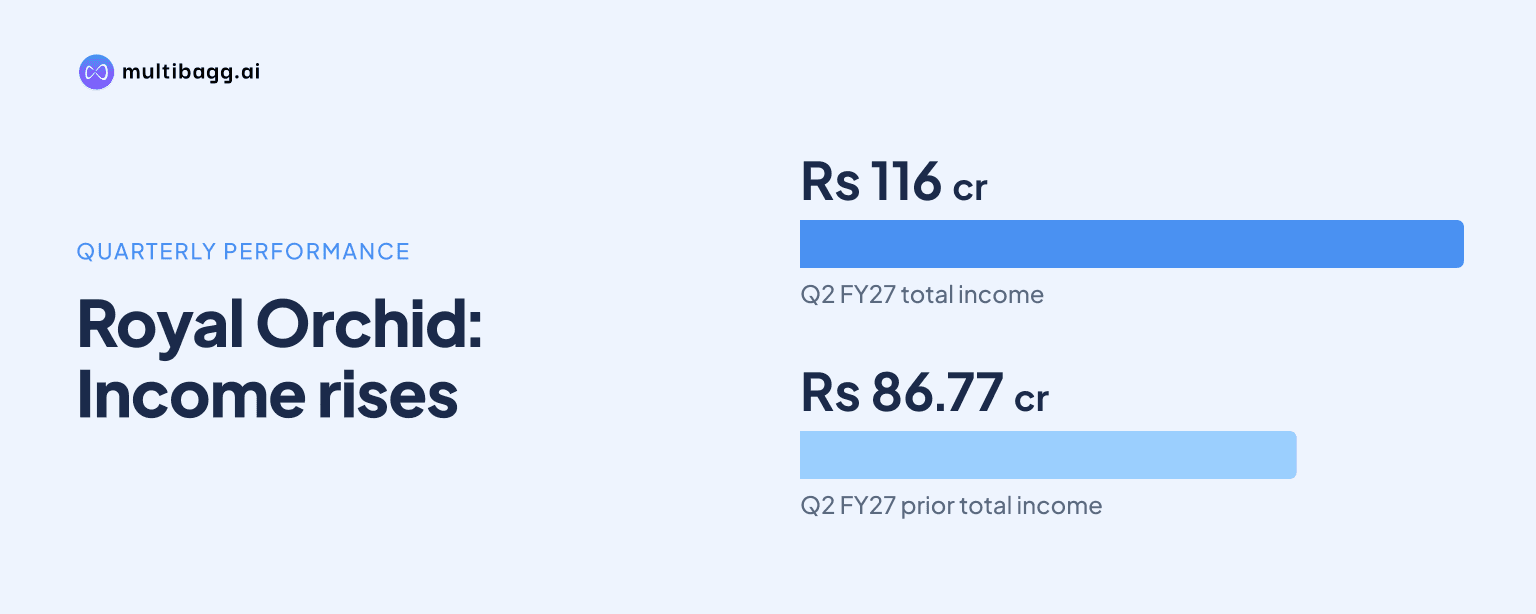
Royal Orchid Hotels Limited reported consolidated total income of ₹116 crore in Q2 FY27, up 34% from ₹86.77 crore a year earlier, while EBITDA rose 53% to ₹31.66 crore. The performance reflected operating leverage and contributions from the expanding hotel portfolio, including five hotel openings during the quarter.
Know Royal Orchid Hotels inside out
Results, valuation, peers and who's buying, in one view.
What drove Royal Orchid Hotels' Q2 FY27 income growth?
Royal Orchid Hotels said higher portfolio contribution and improved operating performance supported its Q2 FY27 results. Chairman and Managing Director Chander K. Baljee told investors that the quarter reflected healthy revenue growth as the hotel network expanded across India.
Consolidated total income increased to ₹116 crore from ₹86.77 crore in the corresponding quarter of the previous year. EBITDA rose to ₹31.66 crore from ₹20.79 crore, a 53% increase, indicating that operating profit grew faster than income during the period.
The company reported profit before tax, before exceptional items, of ₹5.57 crore, compared with ₹4.43 crore a year earlier. This represents growth of about 26%, which was lower than the increase in EBITDA because profit before tax also reflects items beyond hotel-level operating performance.
How did the hotel portfolio expand during the quarter?
Royal Orchid Hotels opened five hotels and added 426 rooms during the quarter, taking its portfolio to more than 127 hotels across India. The additions are central to the company's stated long-term growth objective because a larger managed and operating network can broaden its presence across travel markets.
Management identified Iconica as the main contributor to the reported income growth. The call summary also cited demand from domestic travel, corporate customers and meetings, incentives, conferences and exhibitions, or MICE, as supportive factors for hotel demand.
The company discussed a pipeline of more than 50 hotels comprising around 3,500 rooms. However, it did not disclose an order-book metric or provide a numerical timetable for converting the full pipeline into operating hotels. Investors therefore have visibility on the indicated development pipeline but not on the pace of openings beyond those already announced.
Management said it hopes Iconica can reach quarterly revenue of ₹25 crore during FY27. This was expressed as an aspiration rather than financial guidance, and no actual quarterly Iconica revenue was disclosed on the call.
Got a follow-up? Ask IRIS
What do the results mean for investors and hotel operations?
Royal Orchid Hotels' Q2 figures show that operating profit expanded faster than consolidated income, but reported profit also included an exceptional item. The call summary stated that reported PAT of ₹14.73 crore included a gain from the Tanzania divestment, making the pre-exceptional PBT figure more relevant for assessing the underlying quarterly comparison.
For investors, the difference between EBITDA growth, pre-exceptional PBT growth and reported PAT is important. EBITDA increased 53%, while PBT before exceptional items increased by about 26%, and the reported profit figure was affected by the divestment-related exceptional gain.
For hotel operations, the opening of five properties adds rooms and expands the network available to guests, corporate clients and travel partners. The company also said demand conditions were supported by domestic travel, corporate travel and MICE activity, though it noted that the April war affected Mumbai inbound travel.
The results also point to seasonal variation in the business. The call summary described a sequential margin dip at Habitat that management attributed to monsoon seasonality. This indicates that quarterly profitability can be influenced by travel patterns and regional operating conditions even as the overall portfolio grows.
What cost and regulatory issues did management discuss?
Royal Orchid Hotels said GST input-credit losses remained a cost issue, with the impact estimated at around ₹2 crore per quarter. The company had earlier indicated a Q1 loss of ₹2.5 crore, and the Q2 discussion suggested that the issue had moderated but had not been resolved.
Management also indicated that other expenses could be ₹33 crore to ₹35 crore for the full year. Pre-opening costs at Vadodara were cited as a drag, showing that newly launched or upcoming hotels can affect expenses before their revenue contribution matures.
The call summary listed auditor qualifications and matters involving the Securities and Exchange Board of India and the National Company Law Tribunal among the risks discussed around the company. The source does not provide further details of those matters, their financial impact or a resolution schedule.
These disclosures matter because hotel expansion requires expenditure before properties make a full contribution. The combination of a growing pipeline, GST input-credit losses and pre-opening costs means investors will need to distinguish between growth in operating scale and the costs incurred to support that growth.
Conclusion
Royal Orchid Hotels delivered higher Q2 FY27 consolidated income and EBITDA, supported by portfolio expansion and demand across domestic, corporate and MICE travel. The 34% increase in income to ₹116 crore and 53% rise in EBITDA to ₹31.66 crore provide the clearest measures of operating progress, while the exceptional Tanzania divestment gain affected reported PAT.
Investors will next watch whether Iconica moves towards management's stated hope of ₹25 crore in quarterly revenue during FY27, how quickly the more than 50-hotel pipeline develops, and whether GST input-credit losses and Vadodara pre-opening costs reduce over subsequent quarters.