










Royal Orchid says GST rule cuts nearly Rs 2 crore quarterly profit
Key highlights
- Royal Orchid said GST input-credit disallowance is costing almost Rs 2 crore per quarter.
- Royal Orchid pays 18% GST on rent under lease and revenue-share arrangements.
- Managed-hotel PBT increased about 11.5% in Q2 FY27 versus Q2 FY26.
- Royal Orchid plans about 30 hotel openings with close to 1,800 keys over the next 12 months.
powered by IRIS
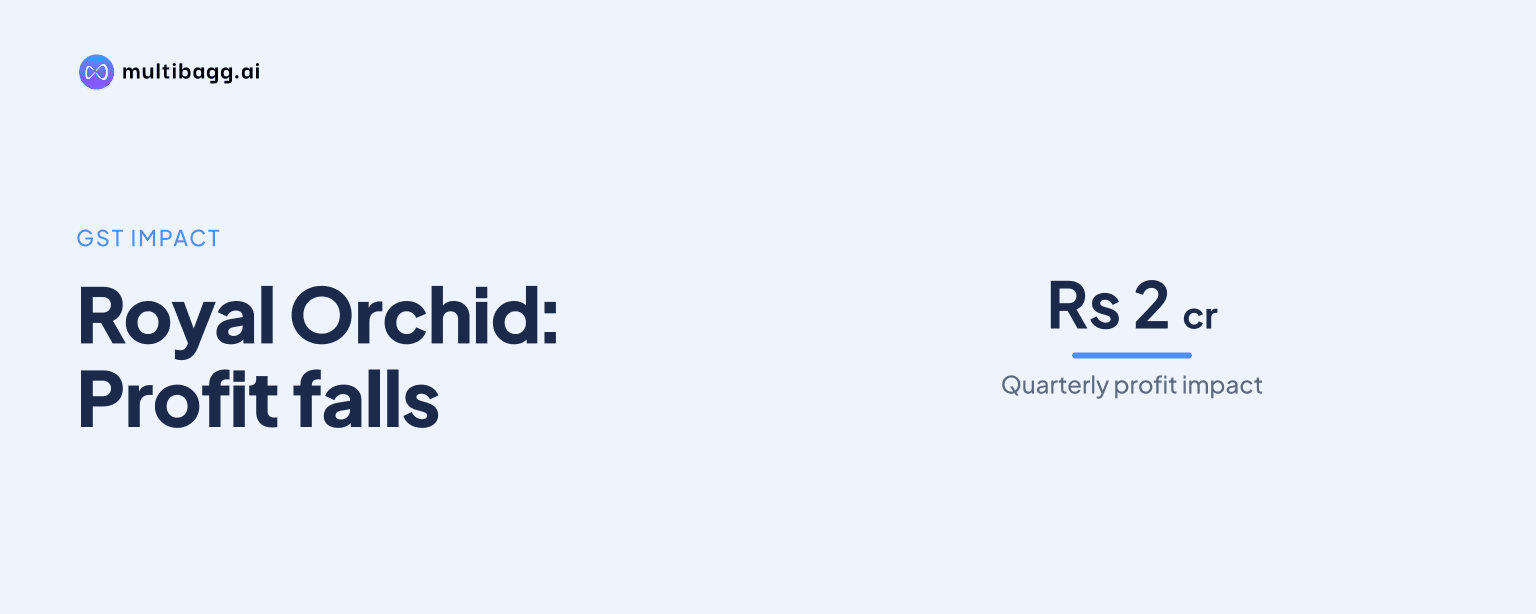
Royal Orchid Hotels said during its Q2 FY27 earnings call that GST input-credit disallowance is reducing quarterly profit by almost Rs 2 crore. Management said the cost stems largely from 18% GST paid on rent in lease and revenue-share contracts, while most of Royal Orchid’s hotels have average daily rates below Rs 7,500.
Know Royal Orchid Hotels inside out
Results, valuation, peers and who's buying, in one view.
How is GST input-credit disallowance affecting Royal Orchid?
Royal Orchid said the disallowance is reducing its profit and loss account by almost Rs 2 crore per quarter. Management said there had been a drastic change in GST rates from September of the prior year, after which the company could not claim input credit in the same way across a large part of its portfolio.
The mechanism described by management is tied to Royal Orchid’s operating structure. The company has hotels under revenue-share and lease models and pays 18% GST on rent to property owners. Because most of its hotels are in the mid-market segment, with average daily rates, or ADRs, below Rs 7,500, management said it cannot claim the related input credit.
Does the GST impact extend to Royal Orchid’s managed hotels?
Yes, Royal Orchid said the GST disallowance also affects its managed-hotel business through its share of hotel-level economics. Management said managed-hotel income has two components: income derived from revenue and income derived from the hotel’s operating margin. When input credit is disallowed at a managed hotel, Royal Orchid said it also receives a lower share of those economics.
The issue is therefore not confined to leased or directly operated hotels. In Q2 FY27, Royal Orchid said managed-hotel profit before tax, or PBT, increased about 11.5% from Q2 FY26. That year-on-year PBT growth occurred despite management’s explanation that GST disallowance can reduce the conversion of hotel operations into the company’s reported earnings.
What other costs are holding back Royal Orchid’s profit?
Royal Orchid attributed part of the gap between business growth and profit growth to ICONIQA’s ramp-up and the pre-opening cost of new hotels. Management said ICONIQA recorded its first quarter of positive earnings before interest, tax, depreciation and amortisation, or EBITDA, in Q2 FY27. The hotel received full licensing only at the end of November in the prior year.
A Vadodara hotel added during Q2 FY27 also created an immediate cost. Management said the property’s pre-opening expense was more than Rs 1 crore, while adding that it expects the hotel to generate revenue over time. That cost was separate from the almost Rs 2 crore quarterly GST impact, but management cited both factors in explaining the near-term pressure on profit.
Got a follow-up? Ask IRIS
Is ICONIQA nearing Royal Orchid’s break-even revenue level?
Royal Orchid said it is working towards quarterly ICONIQA revenue of about Rs 25 crore during the current financial year. An analyst said this was the revenue level at which ICONIQA would no longer have a negative PBT effect, and noted that the property had generated about Rs 21 crore in each of the preceding two quarters. Management described Rs 25 crore as a target rather than a reported result.
Management said ICONIQA generated Rs 23 crore of revenue in Q4 of the preceding year and that its team intended to exceed that figure in the coming Q4. Occupancy was 70% in Q2 FY27 and about 70% in H1 FY27, while management said occupancy in the current quarter was marginally higher at the time of the call.
Can hotel additions improve Royal Orchid’s earnings trajectory?
Royal Orchid expects a larger opening programme to support growth, with about 30 hotels and close to 1,800 keys planned over the next 12 months. Management called the period a step-up year and said growth could be higher than 10% to 15%, while cautioning that opening dates depend on partner development timelines and market conditions. It did not provide a revenue target.
The company also said it has 50 hotels in the pipeline and is expanding its development team. Management described a premiumisation effort across a portfolio of more than 100 hotels in the Rs 5,000 ADR category. It cited Royal Orchid Resort in Bangalore as an example, saying its EBITDA had risen from Rs 80 lakh to Rs 2 crore after investments.
Conclusion
Royal Orchid’s almost Rs 2 crore quarterly GST input-credit disallowance is a disclosed regulatory cost that management says is suppressing earnings across lease, revenue-share and managed-hotel economics. The pressure comes as ICONIQA has reached positive EBITDA and as the company continues to incur start-up spending, including more than Rs 1 crore for the Vadodara hotel’s pre-opening phase.
The next developments to watch are whether government discussions with the hotel industry produce the relief management said it hoped for from January onward, whether ICONIQA reaches its roughly Rs 25 crore quarterly revenue target in the current financial year, and whether the planned 30 hotel openings with close to 1,800 keys occur on schedule.