










ICRA sees path to profitability but gives no timetable
Key highlights
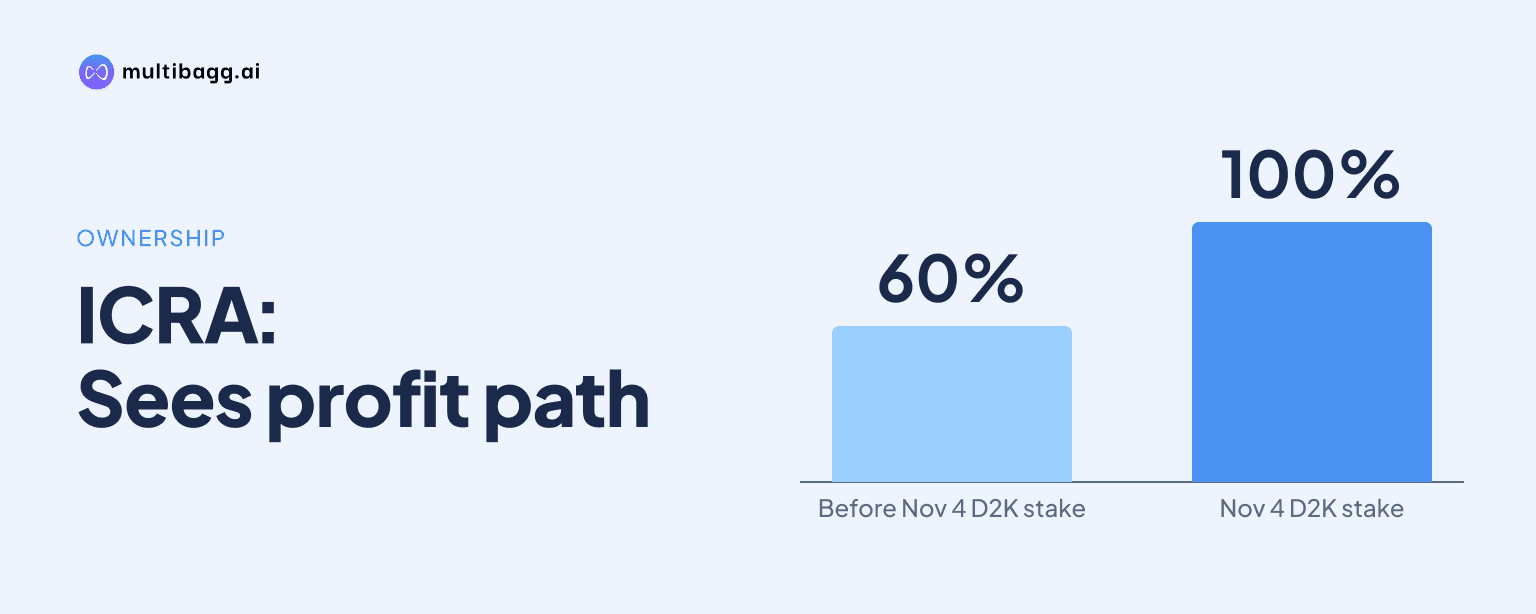
- ICRA said D2K became a 100% subsidiary about four to five months before the November 4, 2026 call.
- ICRA said Risk and Analytics segment profit grew about 35% before depreciation and amortization.
- An analyst estimated D2K and Fintellix had combined FY26 profit-after-tax losses of about Rs 25 crore.
- ICRA held a 60% stake in D2K for three years before gaining full control.
powered by IRIS
ICRA Limited said on November 4, 2026 that D2K and Fintellix have a clear path to sustainable profitability, but it would not state whether either business would turn profitable by 2027-2028. ICRA said D2K became a wholly owned subsidiary only four to five months earlier, enabling planned investment and operational changes.
Know ICRA inside out
Results, valuation, peers and who's buying, in one view.
What did ICRA say about D2K and Fintellix profitability?
ICRA said sustainable profitability and bottom-line accretion are key deliverables for management and the Board across existing operations and acquisitions, including D2K and Fintellix. Ramnath Krishnan said ICRA has a clear internal view of when profitability can be delivered, and that the plan is tracked by management and reviewed by the Board.
The discussion followed an analyst's estimate that D2K and Fintellix together recorded a profit-after-tax loss of about Rs 25 crore in FY26. The analyst also said D2K had been loss-making in each of its three years within ICRA, while Fintellix reported a loss of about Rs 20 crore in the previous year. ICRA did not independently confirm either company-level figure during the call.
ICRA said acquired businesses may require investment in their first couple of years where operations have been underinvested, while accounting treatment can also pressure the bottom line in the initial period. Management cited depreciation and amortization associated with technology investment as one such mechanism, but did not quantify charges or write-offs for D2K or Fintellix.
Why did ICRA not give a turnaround date?
ICRA did not give a turnaround date because management declined to provide guidance on whether D2K or Fintellix would become profitable in 2027-2028 or in any other specified year. Krishnan said there was “absolutely” clear visibility internally, but said ICRA could not share an X-or-Y public timeline.
The call therefore established an internal profitability plan rather than a public forecast. ICRA said the plan is reviewed by the Board, but disclosed no revenue, margin, depreciation, cash-generation or net-profit milestones for either D2K or Fintellix. It also provided no time period against which investors could test the stated path to sustainable profitability.
An analyst asked whether accelerated depreciation from technology investments could end in the current or following year and improve net-profit accretion. ICRA did not quantify the timing or amount of depreciation, amortization or write-offs, instead directing attention to Risk and Analytics segment profit before those charges.
How has full ownership changed ICRA's D2K plan?
ICRA said full ownership has changed its ability to implement D2K's plan because it obtained 100% control only about four to five months before the November 4, 2026 call. ICRA acquired D2K three years earlier with a 60% shareholding, while the business's two sponsors remained invested.
Management said the earlier ownership structure constrained both the pace and extent of changes ICRA could make. D2K had been run predominantly by two individuals over the preceding couple of decades, and Krishnan said it needed significant investment and continues to need investment. ICRA had been reluctant to make those investments before it secured complete control.
ICRA said it now has the flexibility and latitude to make investments at D2K, and that those investments will happen. However, it did not disclose the amount, timing or use of the spending, including whether it will be directed to technology, staffing, product development or sales. The financial effect of the new investment phase therefore remains undisclosed.
Got a follow-up? Ask IRIS
What does the 35% R&A profit growth indicate?
ICRA said Risk and Analytics, or R&A, segment profit grew about 35% before depreciation and amortization, showing higher segment profit before charges that management said largely reflected investment. Venkatesh Viswanathan cited the figure while responding to questions about the reported losses at D2K and Fintellix.
ICRA did not provide absolute R&A revenue or profit, nor did it disclose segment depreciation and amortization in the exchange. The 35% figure consequently indicates a change in profit before those charges, but does not establish the reported net-profit contribution of D2K or Fintellix.
The comparison highlights the distinction made on the call: the R&A segment's profit before depreciation and amortization increased about 35%, while an analyst cited combined FY26 losses of about Rs 25 crore for D2K and Fintellix. ICRA did not break out how much of the segment growth, depreciation or loss came from either acquired business.
How does ICRA assess acquisition profitability?
ICRA said profitability is a key criterion when it assesses existing operations and acquisitions, rather than treating added revenue as sufficient evidence of success. Krishnan said ICRA is not pursuing acquisitions merely to report a purchase or add to top-line revenue; bottom-line accretion is a critical deliverable.
Management also said an acquired company may not become profitable in its acquisition year or the following year because investment and accounting effects can weigh on results. D2K's three-year ownership history, including the first period with only 60% ownership, shows why ICRA has not presented immediate profitability as its stated standard.
ICRA's annual budgets are approved between January and February for the financial year beginning in April and sit within a rolling five-year strategic plan presented to the Board. That planning process provides the framework for targets, but ICRA did not connect it to a separate profitability target, budget or turnaround date for D2K or Fintellix.
Conclusion
ICRA's central message was that D2K and Fintellix are expected to achieve sustainable profitability and that management and the Board oversee that objective. The disclosed evidence was limited to an internal plan, D2K's move to 100% ownership four to five months before the call, and R&A profit growth of about 35% before depreciation and amortization.
The next development to watch is the D2K investment programme that ICRA said can proceed now that it has full control. Management has said the business continues to need investment and has an internal path to profitability, but its refusal to state a public year, including for 2027-2028, leaves delivery timing unresolved.