










ICRA Limited completes integration for AI-led global growth
Key highlights
- ICRA completed the operational integration of D2K and Fintellix by September 2026 after nine months.
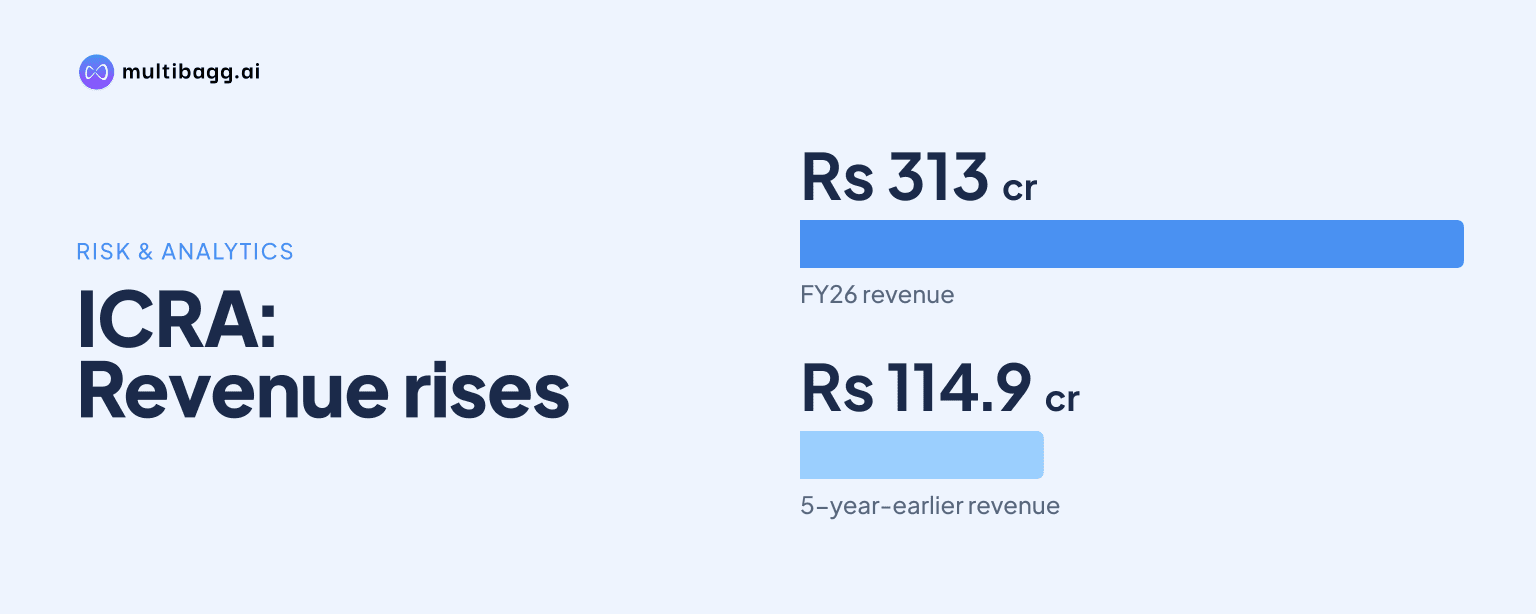
- Risk & Analytics revenue rose to Rs 313 crore in FY26 from Rs 114.9 crore five years earlier.
- Risk & Analytics represented 50% of group revenue at FY26-end, versus roughly one-third five years earlier.
- ICRA identified Europe, the US and the Middle East for organic and inorganic Risk & Analytics expansion.
powered by IRIS
ICRA Limited completed the operational integration of D2K and Fintellix by September 2026 after a nine-month exercise, creating a three-division Risk & Analytics platform. Management plans to use the integrated base for artificial intelligence-enabled products and for organic and inorganic expansion in Europe, the US and the Middle East.
Know ICRA inside out
Results, valuation, peers and who's buying, in one view.
How did ICRA integrate D2K and Fintellix?
ICRA completed the operational integration of D2K and Fintellix at the end of September 2026, following nine months of work after the acquisitions were completed in Q1 of the year. D2K added banking software, software engineering and agile product-development capabilities, while Fintellix contributed risk and regulatory technology, delivery capabilities and a mature operating model.
ICRA now runs the business across legacy legal entities through three divisions, with integrated people, processes and policies, one product roadmap and a unified customer-service organisation. Management said legal-entity simplification remains a further step, and it will update the board and investors as that work progresses.
What businesses make up ICRA's Risk & Analytics platform?
ICRA's Risk & Analytics platform comprises KnowTech, BankTech and CapTech. KnowTech supplies technology-enabled data and analytics services to global enterprises; BankTech provides risk, regulatory and supervisory solutions for banks and lenders; and CapTech offers market data, valuation and investment-intelligence services for capital markets.
KnowTech contributes about 60% of Risk & Analytics revenue, while BankTech and CapTech contribute the remaining 40%, according to management. The intended portfolio shift is to expand BankTech and CapTech without reducing KnowTech, using the three-division structure to organise products and customer coverage rather than the acquired companies' former legal structures.
How has ICRA rebalanced its revenue portfolio?
ICRA increased Risk & Analytics revenue to Rs 313 crore in FY26 from Rs 114.9 crore five years earlier, while group revenue rose to Rs 646.9 crore from Rs 301 crore in FY21. Risk & Analytics therefore represented 50% of group revenue at FY26-end, compared with roughly one-third five years earlier.
The company also reduced concentration in KnowTech, where its anchor customer accounted for about 49% of revenue, down from 80% five years earlier. Management linked that change to the larger contribution from BankTech and CapTech, whose combined share of Risk & Analytics revenue reached about 40%.
Management said the changing mix affects margins because KnowTech had been relatively higher-margin, while BankTech and CapTech have comparatively lower margins. It said the resulting margin compression was anticipated in plans and budgets as it sought a more balanced revenue base rather than reliance on one revenue stream.
Got a follow-up? Ask IRIS
How is ICRA applying AI to Risk & Analytics?
ICRA is investing in technology, software platforms, artificial intelligence and agentic capabilities to make its portfolio more AI-enabled and AI-centric. Management described this as a long-term objective to reshape products and business models while building technology and people capabilities for a more AI-centric market.
The strategy also depends on expanding proprietary data assets alongside the group's financial data analytics, environmental, social and governance, or ESG, and credit expertise. Management said the combination of software, data, models, services and consulting is intended to generate analytical outcomes and decision support for banking, financial-services and capital-markets customers.
ICRA has increased technology spending over the past five or six years after hiring a chief technology officer from outside the group. Management said technology and AI agents are being embedded to improve client experience, productivity and controls, but it did not disclose an investment amount, product-launch date or AI-related revenue target.
Where will ICRA pursue international growth?
ICRA has identified Europe, the US and the Middle East as markets for Risk & Analytics expansion. Management said it will consider both organic and inorganic opportunities in those regions, but did not announce an overseas transaction, an investment amount or a market-entry timetable on November 4, 2026.
The international plan forms part of ICRA's inorganic-growth pillar, under which management assesses opportunities for adjacency, complementarity, scale and current and expected profitability before approaching the board. D2K was described as a smaller deliberate acquisition, while Fintellix was the more significant acquisition used to broaden the risk and regulatory platform.
Near-term growth differs between the divisions. Management said KnowTech, the largest segment, has recorded muted growth, while BankTech sales moderated in H1; however, BankTech's recurring renewals are concentrated in Q1, when management said it recorded significant year-on-year growth, and it typically sees a better run rate in H2.
Conclusion
The September 2026 integration combines D2K's banking-software capabilities and Fintellix's risk-and-regulatory platform with ICRA's existing KnowTech, BankTech and CapTech operations. It supports management's plan to turn Risk & Analytics, which generated Rs 313 crore in FY26 and represented 50% of group revenue, into a broader risk-intelligence provider.
Investors will next watch progress on legal-entity simplification, the H2 BankTech sales run rate and any disclosed moves in Europe, the US or the Middle East. Management has also identified AI-enabled product redesign and additional proprietary data assets as long-term priorities, without providing a quantified revenue target or implementation schedule.