










IFB appliance margin target slips as BOM costs rise 4.3%
Key highlights
- IFB said appliance BOM cost rose about 4.3% of net revenue in Q2 FY27.
- Q2 FY27 revenue rose 14.04% to Rs 1,512 crore, while PBDIT margin fell to 6.01% from 7.73%.
- YTD September 2026 PBDIT was Rs 179.38 crore, with margin down to 5.9% from 6.5%.
- Q2 sales promotion including CSR expense fell to Rs 75 crore from Rs 81 crore.
powered by IRIS
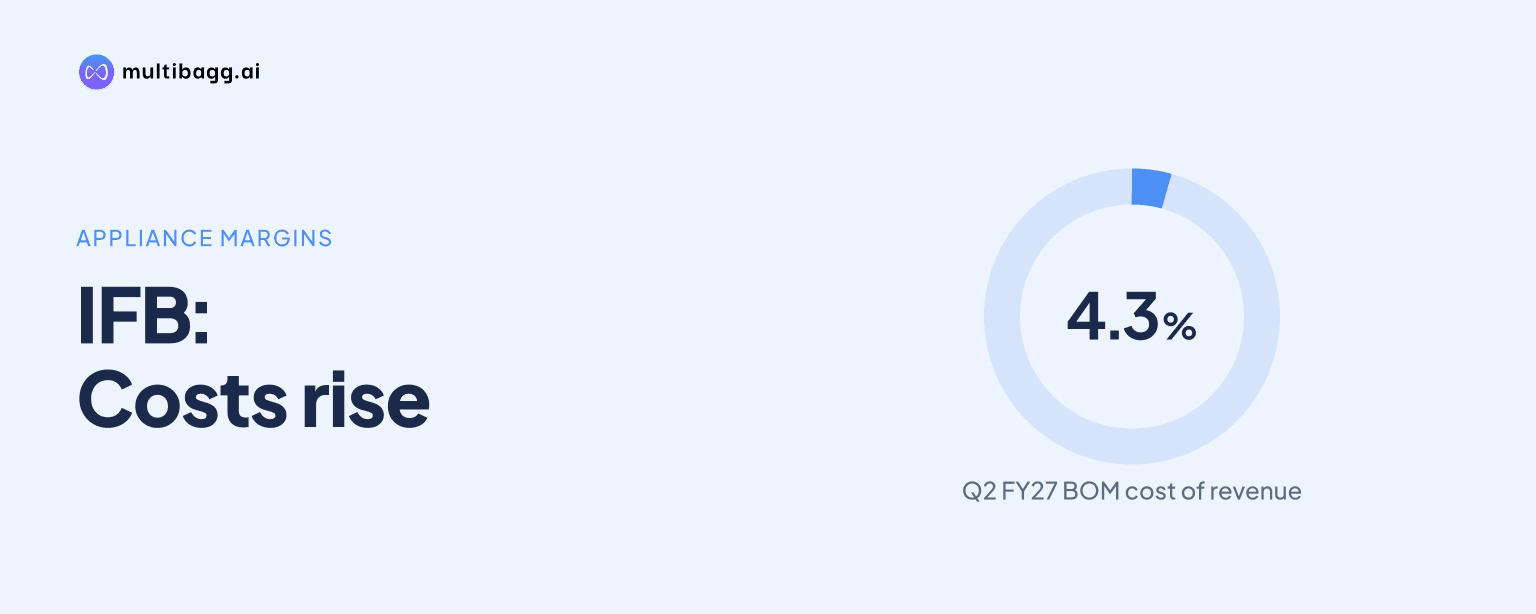
IFB Industries Limited said its appliance division remained below its 10% margin target in Q2 FY27 after bill-of-materials, or BOM, cost rose about 4.3% of net revenue, while price increases did not cover commodity and foreign-exchange inflation; reported profit before depreciation, interest and tax (PBDIT) margin fell to 6.01% from 7.73%.
Know IFB Industries inside out
Results, valuation, peers and who's buying, in one view.
Why has IFB's appliance margin target slipped?
IFB said its 10% appliance margin target is not currently achievable because BOM cost increased by about 4.3% of net revenue despite cost-saving initiatives. Management said that without the cost increase, the division would still have been below 10%, although closer to that level.
The company attributed the increase to commodity inflation and adverse foreign exchange. IFB said its price hikes, and those taken across the industry, have not been sufficient to offset the BOM increase. Management said it is cautious on pricing during festive selling periods because large appliances carry higher ticket prices and customers may defer purchases if products become uncompetitive.
IFB's group results show revenue growth did not translate into higher profitability in Q2 FY27. Revenue increased by Rs 185 crore year on year, but PBDIT declined by Rs 11.58 crore, as material costs rose and office expenditure increased. Staff costs were lower than a year earlier, according to management, but did not offset those pressures.
How did IFB's first-half profitability compare with last year?
IFB's revenue rose 15.34% to Rs 3,042 crore in YTD September 2026, while PBDIT margin declined to 5.9% from 6.5% in YTD September 2025. PBDIT increased by Rs 6.93 crore to Rs 179.38 crore, indicating that first-half revenue growth absorbed part of the higher material-cost burden even as the margin narrowed.
Profit conversion also decreased over the six months. PBT margin was 3.3%, versus 3.9% a year earlier, and PAT margin was 2.5%, versus 2.9%. IFB said material costs remained elevated, staff costs decreased marginally and office expenditure increased during the period.
Lease-related cash-flow movements were separate from the reported profit and loss account. Management said lease-rent principal payments rose to Rs 57.45 crore from Rs 18.99 crore, including Rs 37 crore related to the Gujarat plant, and said the item is reported under financing cash flow rather than in the profit and loss account.
Got a follow-up? Ask IRIS
What is IFB doing to offset appliance cost inflation?
IFB is pursuing cost innovation, selective staffing actions and volume-linked trade incentives while retaining product quality and features. Management said the cost-innovation programme had delivered the savings it had envisaged, but continued commodity and foreign-exchange pressure requires further efficiency measures.
Staff cost declined in Q2 FY27 after IFB left about 100 positions unfilled and selectively replaced employees, including after annual salary increments. Management said other costs continued to rise and did not quantify the savings from these staffing actions or confirm whether they meet an earlier investor-referenced fixed-cost objective of Rs 3 crore to Rs 4 crore a month.
Sales-promotion spending also declined. In Q2 FY27, sales promotion including Counter Sales Representation, or CSR, was Rs 75 crore, down from Rs 81 crore, and represented 4.96% of revenue against 6.13% a year earlier. For YTD September, the corresponding expense fell to Rs 139 crore from Rs 156 crore, or 4.58% of revenue from 5.92%.
IFB said it is not seeking indiscriminate cuts in trade schemes. Instead, payouts are graded when channel partners miss committed volumes, rather than paid in full. The company said the mechanism is intended to ensure incentives produce the agreed sales volumes while it continues to fund displays, visibility and in-store promoters at key outlets.
Can product mix and festive demand help IFB improve margins?
IFB said first-half appliance growth was about 14.2% to 14.5%, below its 20% aspiration but above the 9.8% growth reported for the prior full year. Management said Q2 appliance growth of 10.5% was affected by Diwali falling on 8 November this year rather than 20 October last year, shifting festival-linked demand and schemes into Q3.
Management said market share was maintained or slightly higher in washing machines, refrigerators and air conditioners, while microwave ovens and dishwashers gained share. IFB said front-loading washing machines grew 40%, although it has an 11-kilogram offering rather than a product in the 12-kilogram-and-above segment that management described as a growing part of the category.
The mix plan concentrates on higher-value products and weighted distribution at important retail counters. IFB said it aims for frost-free refrigerators to account for at least one-third of its refrigerator business and is focused in air conditioners on 1.5-ton, five-star and 2-ton models. Management said display quality, promoter coverage and sales per square foot matter more than numerical distribution in appliances.
Conclusion
IFB's Q2 FY27 performance shows that higher sales have not yet restored the margin trajectory management had targeted for appliances. Revenue rose 14.04% in the quarter, but PBDIT margin decreased by 1.72 percentage points as the 4.3% BOM cost increase exceeded the available pricing response, despite lower staff and sales-promotion costs.
The next reported checkpoint is Q3 FY27, which includes the Diwali period that moved from Q2 because the festival fell on 8 November rather than 20 October a year earlier. Investors will be watching whether festive demand, further price actions, graded trade payouts and the higher-value product mix reduce the gap to IFB's appliance margin objective.