










IFB Industries Revenue Rises 15% as Q2 Profit Falls 25%
Key highlights
- IFB Industries reported Q2 FY27 consolidated revenue of ₹1,575.78 crore, up 14.98% year on year.
- Q2 FY27 consolidated operating profit declined 9.1% to ₹90.70 crore.
- Consolidated operating margin fell to 5.8% from 7.3%, a decline of 1.5 percentage points.
- Q2 FY27 consolidated net profit fell 24.51% to ₹38.34 crore.
powered by IRIS
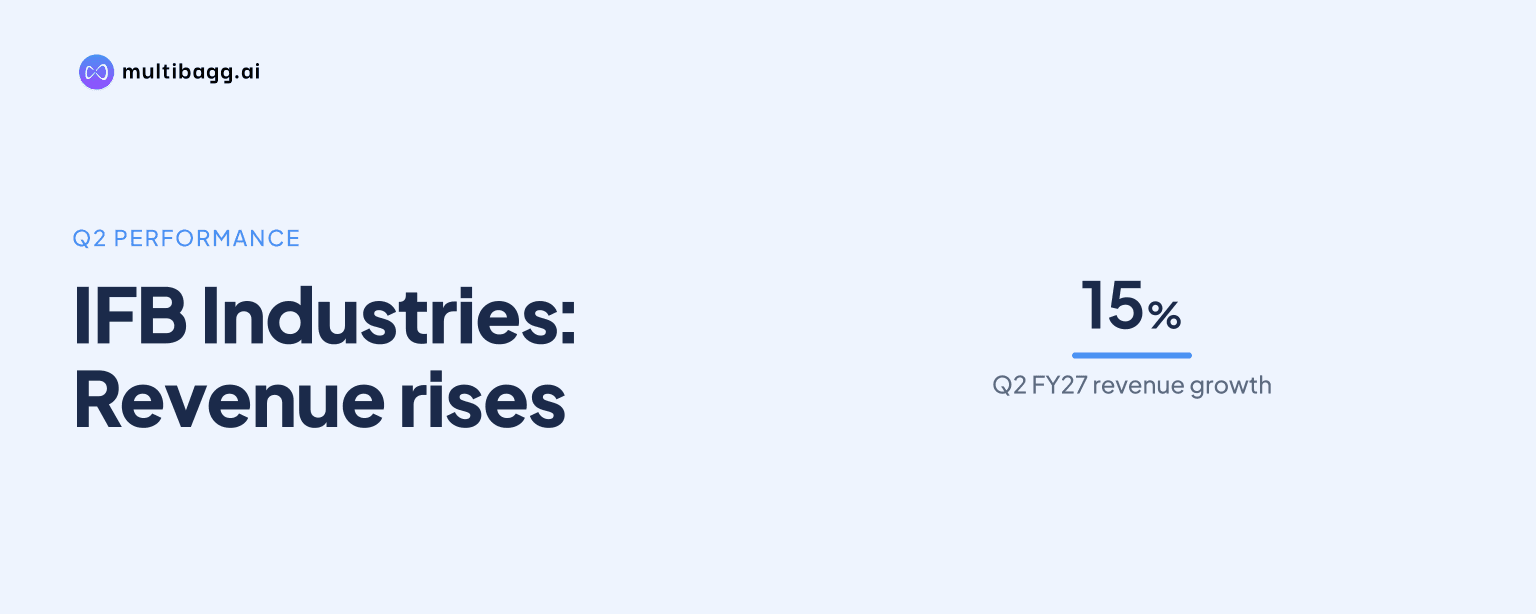
IFB Industries Limited reported consolidated revenue growth of 14.98% to ₹1,575.78 crore in Q2 FY27, but net profit declined 24.51% year on year to ₹38.34 crore. The July-September quarter showed continued sales growth, while operating profitability came under pressure from higher material, commodity and foreign-exchange costs.
Know IFB Industries inside out
Results, valuation, peers and who's buying, in one view.
What did IFB Industries report for Q2 FY27?
IFB Industries reported higher consolidated revenue but lower operating profit and net profit for the quarter ended September 2026. Revenue from operations increased from ₹1,370.43 crore in Q2 FY26 to ₹1,575.78 crore in Q2 FY27. Operating profit declined 9.1% to ₹90.70 crore from ₹99.78 crore, while net profit fell from ₹50.79 crore to ₹38.34 crore.
The contrast between sales and profit is central to the quarterly result. Consolidated operating margin was 5.8%, compared with 7.3% a year earlier, a decline of 1.5 percentage points. This means the company generated more revenue during the quarter but retained a smaller proportion as operating profit.
What happened at the November 5 investor call?
IFB Industries held its Q2 FY27 earnings conference call on November 5, 2026, hosted by Nirmal Bang Institutional Equities, and subsequently disclosed the audio recording under Regulation 30 of the SEBI Listing Obligations and Disclosure Requirements Regulations, 2015. The disclosure provides investors access to the management discussion following the quarterly results.
The call included Sandeep Joseph Abraham, Managing Director and Chief Executive Officer of the Home Appliances Division, Soumitra Goswami, Chief Financial Officer, and senior executives from the home appliances and engineering businesses. The available call material highlighted revenue expansion and the pressure on profitability during the period.
The company also stated that its trading window for designated persons and their immediate relatives would remain closed from October 1, 2026, under the SEBI Prohibition of Insider Trading Regulations, 2015. Such closures are a standard compliance measure around the handling and release of unpublished price-sensitive information.
Got a follow-up? Ask IRIS
Why did margins decline despite higher sales?
Margin pressure reflected higher material and commodity costs as well as an adverse foreign-exchange impact, according to the earnings-call highlights. On the standalone basis cited in the call material, revenue rose 14.04% to ₹1,512 crore, while PBDIT declined to ₹90.92 crore, or 6.01% of revenue, from ₹102.50 crore, or 7.73%, a year earlier.
The call material also showed standalone profit before tax of ₹53.86 crore, compared with ₹68.32 crore in the prior-year quarter. Standalone profit after tax was ₹39.56 crore, down from ₹49.75 crore. These standalone figures should not be directly mixed with the consolidated quarterly figures, as they represent different reporting bases.
For the first half of FY27, standalone revenue was reported at ₹3,042 crore, up 15.34% from ₹2,637 crore in the corresponding period of FY26. The half-year sales trend indicates that demand and business activity supported top-line growth, even as input and currency costs affected profitability.
How do the results affect investors and operations?
For investors, the Q2 numbers present two distinct indicators: revenue growth remained in the mid-teens, while profits and margins moved lower. The 24.51% fall in consolidated net profit was larger than the 9.1% drop in operating profit, underlining the importance of tracking costs and profit conversion alongside revenue growth.
For operations, higher commodity and material expenses can affect the profitability of appliances and engineering products unless offset by pricing, sourcing changes, product mix or efficiency measures. The available material does not disclose a new pricing action, a volume target or a detailed cost-reduction plan. It does, however, identify the management goal of reaching a 10% EBITDA margin.
No share-price movement or market reaction was provided in the source material. Therefore, the disclosed financial data and the management discussion are the direct reference points for assessing the quarter rather than any inferred trading response.
Conclusion
IFB Industries delivered 14.98% consolidated revenue growth in Q2 FY27, but the gain was accompanied by lower operating profit, a 1.5-percentage-point contraction in operating margin and a 24.51% decline in net profit. The quarter demonstrates that stronger sales did not fully offset higher commodity, material and foreign-exchange costs.
The next key issue is whether IFB Industries can improve profitability while sustaining revenue growth and progressing toward its stated 10% EBITDA margin goal. Investors can monitor future quarterly disclosures, management commentary and the company’s subsequent investor-call materials for evidence of changes in costs, margins and execution.