










India Glycols Limited’s integrated chain supports chemicals moat
Key highlights
- IGL says 97% of raw material in its ethanol-to-bio-EO platform is renewable.
- The Kashipur complex has annual capacity of 175,000 metric tonnes for glycols and 70,000 metric tonnes for glycol ethers.
- About 35% of IGL cargo moves through ICD Kashipur, with rail connections of roughly 1,500 kilometres to three export gateways.
- IGL reported FY26 chemicals revenue of Rs 1,164 crore and EBITDA of Rs 169 crore.
powered by IRIS
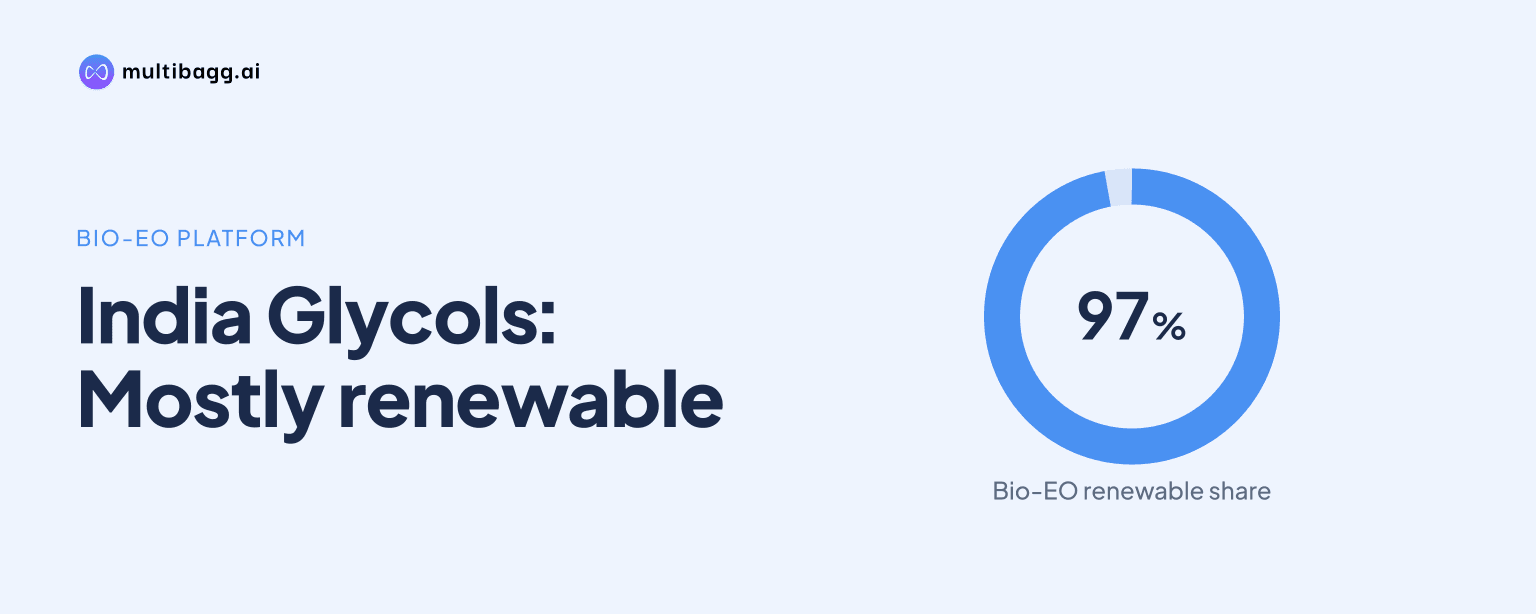
In financial year 2026 (FY26), India Glycols Limited said its 97% renewable ethanol-to-bio-EO chain, 300-acre Kashipur complex and rail-linked export access underpinned its chemicals moat. The chemicals business reported Rs 1,164 crore of revenue and Rs 169 crore of earnings before interest, tax, depreciation and amortisation (EBITDA) in FY26.
Know India Glycols inside out
Results, valuation, peers and who's buying, in one view.
How does IGL's renewable ethanol-to-EO chain work?
IGL converts sugarcane-based renewable ethanol into bio-ethylene and then bio-based ethylene oxide, or bio-EO, before making several product streams. The company says it first produced ethylene oxide from renewable ethanol in 1989, and its platform supplies bio-glycols, glycol ethers and glycol ether esters, performance chemicals, bio-EO for its Clariant joint venture and industrial gases.
The chain uses a common bio-EO backbone rather than separate feedstock systems for each product. IGL says shared feedstock, utilities and logistics at Kashipur allow every product line to draw on the same intermediate, while its 97% renewable raw-material base differentiates the platform from petroleum-derived glycol and solvent routes. CarbonSmart ethanol, produced through LanzaTech technology, is also listed as an input.
The downstream outlets matter because IGL says it can direct output towards the product with the best realisation while retaining one shared cost base. Bio-glycols serve packaging, polyester fibre, coolant and natural-gas dehydration markets, while glycol ethers and esters serve coatings, inks, adhesives and automotive applications. IGL identifies performance chemicals as about 5% of current revenue, making the category a stated mix-shift opportunity.
Why does IGL say its integrated production base matters?
IGL says backward integration gives it control over bio-ethylene and bio-EO rather than requiring purchases of merchant ethylene oxide. Its presentation describes control over cost, quality and supply reliability because feedstock, EO and finished derivatives are produced at one 300-acre Kashipur site. Multiple ethanol sources are intended to let sourcing be adjusted for cost and availability.
The company also monetises streams beyond core derivatives. Process carbon dioxide and air-separation gases are sold as industrial, food-grade and medical gases, while biomass cogeneration and zero-liquid-discharge operations are presented as measures that lower utility cost and carbon footprint. This gives the gases business a role alongside the core chemical platform rather than treating those process streams solely as waste.
Metric tonnes per annum is a measure of annual production capacity. The 175,000-metric-tonnes-per-annum glycols capacity is two-and-a-half times the 70,000-metric-tonnes-per-annum glycol-ethers capacity, showing that glycols remain the larger installed base while the new specialties unit is smaller. IGL also reports 19 derivatisation platforms and 28 application functions for converting its two renewable carbon sources into formulations and end uses.
Got a follow-up? Ask IRIS
How does IGL's Kashipur rail link support exports?
IGL says its Kashipur complex is rail-linked to Mundra, Pipavav and Nhava Sheva, roughly 1,500 kilometres away, reducing the inland distance to export gateways. About 35% of IGL cargo is routed through the inland container depot, or ICD, at Kashipur, and the presentation calls the site one of India’s only chemical plants with a direct rail line to port.
The company says double-stack rail can cost less than road transport, while sealed tank containers reduce dangerous-goods handling risk and produce lower carbon dioxide emissions per tonne-kilometre than road movement. IGL also reports terminal dwell of less than two days as the largest ICD exporter, although the cited logistics benefits are company statements rather than independently quantified savings.
Exports are a material outlet for the production chain. IGL reports that about 45% of sales excluding the joint venture are exported across more than 40 countries, and that 63% of bio-glycols are exported. That contrasts with bio-glycol ethers, of which 89% are sold domestically, creating different geographic exposures within the same integrated site.
What makes IGL's platform difficult to reproduce?
IGL says a new entrant would need renewable feedstock at scale, hazardous-EO process and safety capability, derivative capacity with export logistics, and customer approvals at the same time. Its stated head start includes a 1989 agro-route to ethylene oxide, a Department of Scientific and Industrial Research-recognised research and development centre established in 1993, and about four decades of operating experience.
Customer qualification is another part of IGL’s stated barrier. IGL says approval cycles in coatings, personal care and pharmaceuticals can take multiple years, and it reports more than 100 customers across over 40 countries. Its presentation names BASF, L’Oréal and Clariant among selected customers, but does not disclose sales values, contract lengths or customer concentration for those relationships.
The Clariant-IGL joint venture adds a dedicated downstream channel for bio-EO. Formed in 2021 as a 51:49 venture, it operates under a long-term agreement through which IGL supplies bio-EO and the venture converts it into green performance chemicals for textiles, personal care, pharmaceuticals, crop solutions and construction. IGL presents Clariant’s technology and market reach as complementary to its feedstock and intermediate position.
The chemicals business became separately focused following the group demerger. In FY26, the chemicals operation generated Rs 1,164 crore of revenue and Rs 169 crore of EBITDA, representing 25% of the pre-demerger group’s EBITDA; its 14.5% EBITDA margin was 570 basis points higher across FY24 to FY26. IGL says post-demerger cash flows can be allocated to chemicals capacity fill and specialties, while ethanol supply and Kashipur shared services operate under commercial agreements.
Conclusion
IGL’s stated advantage is the combination of a renewable feedstock route, captive bio-ethylene and bio-EO, derivative capacity and a rail-connected export system. The structure supports several products from a common intermediate, while 175,000 metric tonnes per annum of glycols capacity, 70,000 metric tonnes per annum of glycol-ethers capacity and sales in more than 40 countries show the scale and breadth behind that claim.
The next items to watch are whether IGL shifts more revenue towards performance chemicals, which it places at about 5% of revenue today, and how its product pipeline and technology projects develop over the medium to longer term. Management has identified new products, business development with diverse partners and the 7,500-metric-tonnes-per-annum new specialties unit as parts of its specialty-led growth plan.