










India Glycols Limited demerger leaves chemicals at 25% EBITDA
Key highlights
- IGL retained Rs 169 crore of FY26 EBITDA, equal to 25% of the former group’s Rs 690 crore EBITDA.
- The demerger became effective on 1 September 2026, and the resulting entities were listed on 4 November 2026.
- IGL reported H1 FY27 revenue of Rs 713 crore and EBITDA of Rs 113 crore, up 26% and 25% year on year on a like-for-like basis.
- Sustainable & Performance Chemicals lifted H1 FY27 EBITDA by 40% to Rs 51 crore and margin to 16.3% from 15.0%.
powered by IRIS
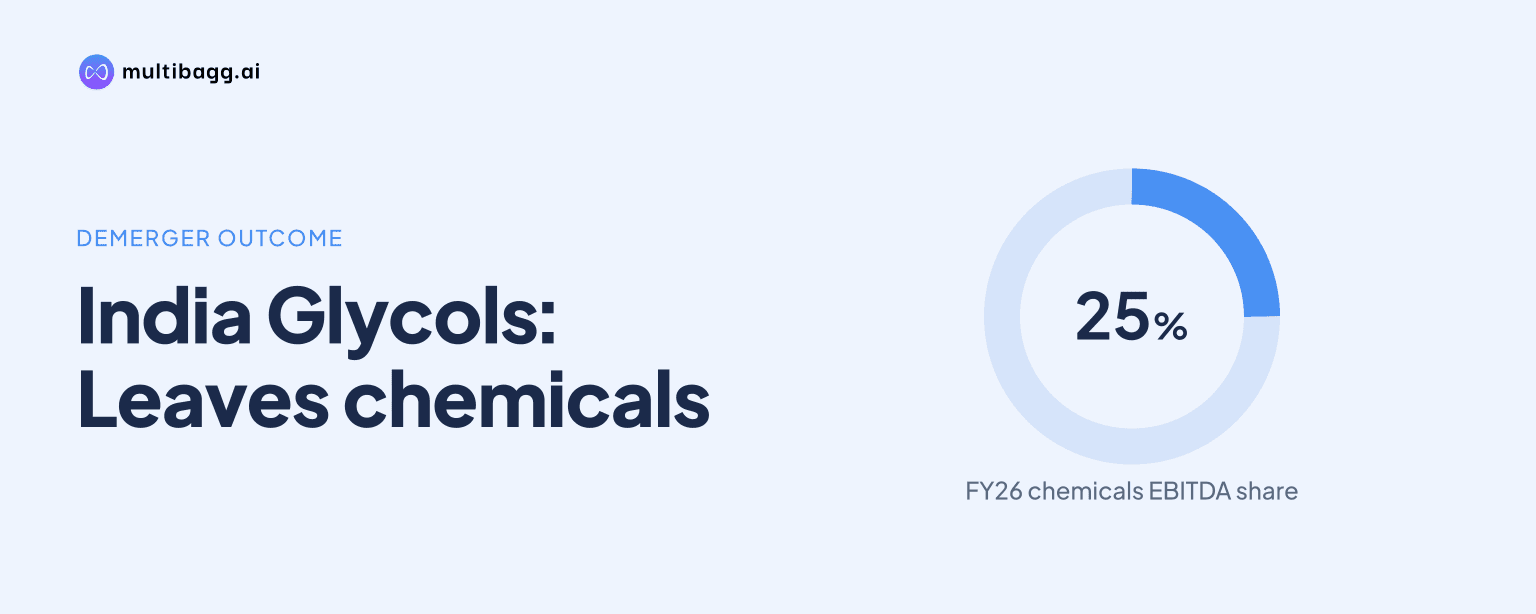
IGL emerged from the 1 September 2026 demerger as a chemicals-focused company retaining Rs 169 crore of financial year 2026 (FY26) earnings before interest, tax, depreciation and amortisation (EBITDA), equal to 25% of the former group’s Rs 690 crore EBITDA. The spirits and biopharma businesses became separately listed companies on 4 November 2026.
Know India Glycols inside out
Results, valuation, peers and who's buying, in one view.
What did IGL retain after the demerger?
IGL retained three chemicals platforms, Bio-based Specialty Materials, Sustainable & Performance Chemicals, and Gases, with FY26 revenue of Rs 1,164 crore and EBITDA of Rs 169 crore. The retained chemicals business reported a 14.5% EBITDA margin and uses sugarcane-derived ethanol to produce ethylene oxide and derivatives at its Kashipur complex.
The businesses transferred out were larger in revenue terms. IGL Spirits Limited, comprising spirits and biofuels, had FY26 revenue of Rs 2,801 crore and EBITDA of Rs 492 crore, while Ennature Biopharma Limited, which comprises nutraceuticals, plant-based active pharmaceutical ingredients and biopolymers, had revenue of Rs 246 crore and EBITDA of Rs 29 crore.
IGL accounted for 25% of former-group EBITDA, compared with 71% for IGL Spirits Limited and 4% for Ennature Biopharma Limited. Under the transaction terms, shareholders received one IGL Spirits Limited share for every IGL share and one Ennature Biopharma Limited share for every three IGL shares.
How does the demerger change IGL’s capital allocation?
IGL’s chemicals cash flows are intended for capacity utilisation and specialty products rather than spirits or biopharma capital expenditure. The presentation identifies sharper business focus, greater value visibility and capital deployment against each business’s own priorities as the stated rationale for the 1 September 2026 separation.
IGL’s roadmap sets an aspiration of Rs 2,000 crore of net revenue and Rs 400 crore of EBITDA within four to five years, compared with FY26 revenue of Rs 1,164 crore and demerger-overview EBITDA of Rs 169 crore. A separate historical-financials measure puts adjusted FY26 EBITDA at Rs 215 crore because it adds IGL’s share of profit from the Clariant joint venture.
Management’s stated growth plan centres on Sustainable & Performance Chemicals and longer-horizon novel carbon technologies. IGL has 175,000 metric tonnes per annum (MTPA) of glycols capacity, 70,000 MTPA of glycol ethers capacity and a 7,500 MTPA new-specialties unit at Kashipur; the presentation says demand and customer approvals, rather than machinery, constrain additional sales.
Got a follow-up? Ask IRIS
How will IGL secure ethanol and shared services?
IGL says ethanol supply and shared Kashipur services will continue through commercial agreements with the separated businesses. The presentation describes this arrangement as continuity at arm’s length, with commercial arrangements for common assets and shared services intended to support a seamless transition after the 2026 demerger.
This mechanism matters because IGL’s chemicals chain runs from renewable ethanol through bio-ethylene and bio-ethylene oxide, or bio-EO, into derivatives. The 300-acre Kashipur complex also contains ethanol fermentation and distillation, spirits bottling and biopolymer activities, while assets, liabilities, contracts and employees transfer to the relevant resulting company.
IGL also has a 51:49 joint venture with Clariant, established in 2021, that converts IGL-supplied bio-EO into green performance chemicals under a long-term supply agreement. The venture serves polymers, textiles, personal care, crop solutions, pharmaceuticals and construction, and its profit share is included in the presentation’s specified EBITDA measures.
What does IGL’s focused chemicals business look like financially?
IGL reported Rs 713 crore of revenue and Rs 113 crore of EBITDA in the first half of FY27 (H1 FY27), increases of 26% and 25% year on year on a like-for-like basis. The H1 FY26 comparison excludes the subsequently demerged spirits and biopharma businesses, and H1 FY27 EBITDA margin was 15.8%.
Bio-based Specialty Materials, including gases, generated Rs 382 crore of H1 FY27 revenue, up 43%, and Rs 62 crore of EBITDA, up 15%. Its margin declined to 16.2% from 20.1% in H1 FY26, while Sustainable & Performance Chemicals recorded Rs 313 crore of revenue, up 29%, and Rs 51 crore of EBITDA, up 40%.
The larger Bio-based Specialty Materials segment delivered faster H1 revenue growth but slower EBITDA growth than Sustainable & Performance Chemicals. In the second quarter of FY27 (Q2 FY27), Sustainable & Performance Chemicals expanded EBITDA margin to 14.2% from 13.0%, or about 124 basis points, while Bio-based Specialty Materials’ margin fell to 14.6% from 18.4% amid cost, freight and export-margin pressures.
Conclusion
The demerger leaves IGL as a smaller listed company by FY26 revenue and EBITDA, but with operations limited to renewable chemicals, performance products and gases. Its Rs 169 crore FY26 EBITDA was one-quarter of the former group total, while the new structure separates the chemicals platform’s operating results, capital allocation and commercial arrangements from the spirits and biopharma businesses.
The next disclosed milestones are management’s aspiration for more than Rs 200 crore of FY27 EBITDA and Rs 400 crore of EBITDA on about Rs 2,000 crore of revenue within four to five years. Progress will depend on specialty-product development, capacity utilisation, customer approvals and the operation of ethanol-supply and Kashipur shared-service agreements, alongside freight, feedstock and export-market conditions.