










India Glycols Limited targets Rs 400 crore EBITDA in 4-5 years
Key highlights
- IGL aims for Rs 400 crore EBITDA and about Rs 2,000 crore net revenue within four to five years.
- IGL lists Rs 200 crore EBITDA for FY27E, after Rs 169 crore for FY26.
- IGL reported Rs 79 crore EBITDA on Rs 720 crore revenue from operations in H1 FY27.
- IGL cites 10% to 12% annual growth for India’s specialty-chemicals market through FY29E.
powered by IRIS
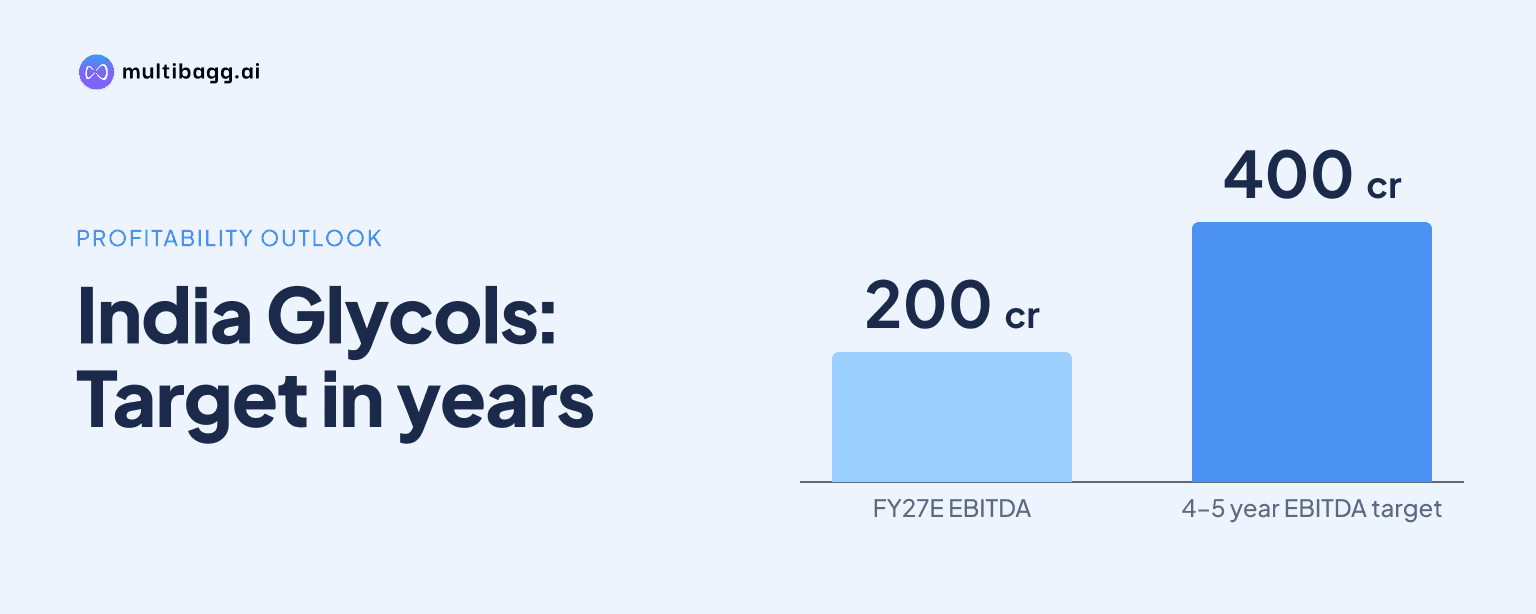
India Glycols Limited is aiming for Rs 400 crore of earnings before interest, tax, depreciation and amortisation (EBITDA) within four to five years, alongside about Rs 2,000 crore of net revenue. The presentation places Rs 200 crore EBITDA in financial year 2027 estimate (FY27E), after listing Rs 169 crore for FY26, and ties the ambition to a specialty-led product mix.
Know India Glycols inside out
Results, valuation, peers and who's buying, in one view.
How does IGL plan to reach Rs 400 crore EBITDA?
IGL plans to pursue Rs 400 crore EBITDA through sustainable specialty materials as a foundation and sustainable and performance chemicals as its growth engine. Its foundation portfolio includes bio-glycols, glycol ethers and esters made through a bio-based ethylene oxide (EO) route, with planned work on cost, differentiation, new markets and applications. Its scaling portfolio includes surfactants, esters, quaternaries, polyglycerols, CarbonSmart chemicals and amines.
The targeted specialty applications span personal care, crop care, coatings, lubricants, textiles, oil and gas. Management says multiple launches, molecule-development programmes and engagements with global customers form its pipeline, while several performance-chemical products are moving from development to commercialisation. The presentation does not disclose product-level sales, volumes or margin milestones supporting the Rs 2,000 crore revenue aspiration.
IGL says extra sales should require very little new capital expenditure because fixed costs are already absorbed and machinery is not the constraint. Management identifies demand and customer approvals as the limiting factors, making the conversion of new molecules into commercial volume central to the four-to-five-year plan. That mechanism differs from a target based solely on price increases in bio-glycols or glycol ethers.
What EBITDA milestones has IGL set?
IGL lists Rs 169 crore EBITDA for FY26, Rs 200 crore for FY27E and Rs 400 crore for the following four to five years. The stated FY27E objective is Rs 31 crore above the FY26 figure, while the medium-term aspiration is twice the FY27E objective and about Rs 231 crore above the FY26 figure.
Management also presents a 10-year vision of 10 times revenue and EBITDA without acquisition. The longer-horizon roadmap includes carbon capture, utilisation and storage, novel catalysis and carbon-dioxide valorisation, where IGL reports laboratory and pilot work plus global collaborations. It assigns no revenue or EBITDA contribution from those novel technologies to the four-to-five-year target.
How do IGL’s reported earnings compare with its targets?
IGL reported Rs 39 crore EBITDA in Q2 FY27, down Rs 1 crore from Rs 40 crore in Q1 FY27, although revenue from operations rose Rs 5 crore to Rs 362 crore. EBITDA margin declined to 10.8% from 11.2%, showing that the sequential revenue increase did not produce higher quarterly operating profit.
For H1 FY27, IGL recorded Rs 79 crore EBITDA on Rs 720 crore of revenue from operations, with an EBITDA margin of 11.0%. The presentation shows Rs 311 crore EBITDA and Rs 2,133 crore revenue for H1 FY26, but says those results included subsequently demerged Spirits & Bio-fuels and Ennature Biopharma businesses. It therefore labels the H1 FY26 figures non-comparable with the demerged IGL business.
Got a follow-up? Ask IRIS
Which demand trends could support IGL’s strategy?
IGL cites a 9.6% compound annual growth rate for global bio-based chemicals between 2024 and 2032, while approximately 90% of chemical feedstock remained fossil-based in 2023. It says its drop-in molecules can serve customers seeking lower-carbon inputs without reformulation, linking its bio-based EO route to customer decarbonisation commitments.
The presentation identifies more than 14,000 companies with sustainability targets and more than 2,750 companies with net-zero commitments. It also states that roughly 40% of global market capitalisation is covered by science-based climate targets. These figures describe the wider demand setting rather than contracted orders or a quantified revenue split for IGL.
In India, IGL cites 10% to 12% annual specialty-chemicals market growth through FY29E, compared with about 6% for Taiwan, about 5% for China and about 3% for Japan. Its disclosed end-market exposure includes industrial processes through gases and glycol ethers, plus agriculture, construction, personal care and automotive applications projected to grow 9% to 12% annually between FY25 and FY29E.
What could delay IGL’s EBITDA plan?
IGL reports that chemicals costs increased 35% to 75%, drums and intermediate bulk containers increased 21% to 54%, and freight was about double in its operating environment. In bio-glycols, it says the price gap with petro-based monoethylene glycol narrowed because petro-based prices rose, while its ethanol and EO costs did not fall; the gap nonetheless remained about 2.5 times.
Performance chemicals faced higher and scarce propylene oxide, lactic acid and phenol, which IGL says squeezed margins and constrained growth. A Gulf import gap and propylene oxide shortage temporarily raised rival glycol ether and acetate prices and brought customers back, but the company says this benefit is fading. These conditions matter because the target relies on portfolio mix and volume growth translating into EBITDA expansion.
Cash and cash equivalents closed at Rs 6 crore in September 2026, compared with Rs 18 crore in September 2025. IGL reported Rs 39 crore of operating cash flow and Rs 95 crore of investing cash outflow for September 2026, producing a Rs 21 crore net decrease in cash and cash equivalents. The presentation does not connect these cash-flow figures to a funding requirement for the Rs 400 crore EBITDA aspiration.
Conclusion
IGL’s plan combines a bio-based foundation of glycols, glycol ethers and esters with a larger role for performance chemicals, differentiated products and value-added exports. The central numerical objective is to progress from the listed Rs 169 crore FY26 EBITDA level and Rs 200 crore FY27E objective to Rs 400 crore, while reaching about Rs 2,000 crore of net revenue within four to five years.
The next disclosed marker is the Rs 200 crore FY27E EBITDA objective, against Rs 79 crore reported in H1 FY27. Investors can watch product commercialisation, customer approvals and specialty-product demand, alongside input costs for propylene oxide, lactic acid, phenol, ethanol, EO and freight. IGL’s novel carbon technologies remain at laboratory and pilot stages, with no stated medium-term financial contribution.