










Indag sees radialisation reach 68-70% by FY30, aiding retreads
Key highlights
- Indag cites truck and bus tyre radialisation rising from about 60% to 68-70% by FY30.
- Indag says retreading can save up to 70% of a new tyre's cost and reduce cost per kilometre to one-third.
- Indag reports 48 kg of CO₂ for the retread process versus 184 kg for a new tyre.
- Indag says its network includes more than 300 dealers, 3,000 retreaders and 15 depots.
powered by IRIS
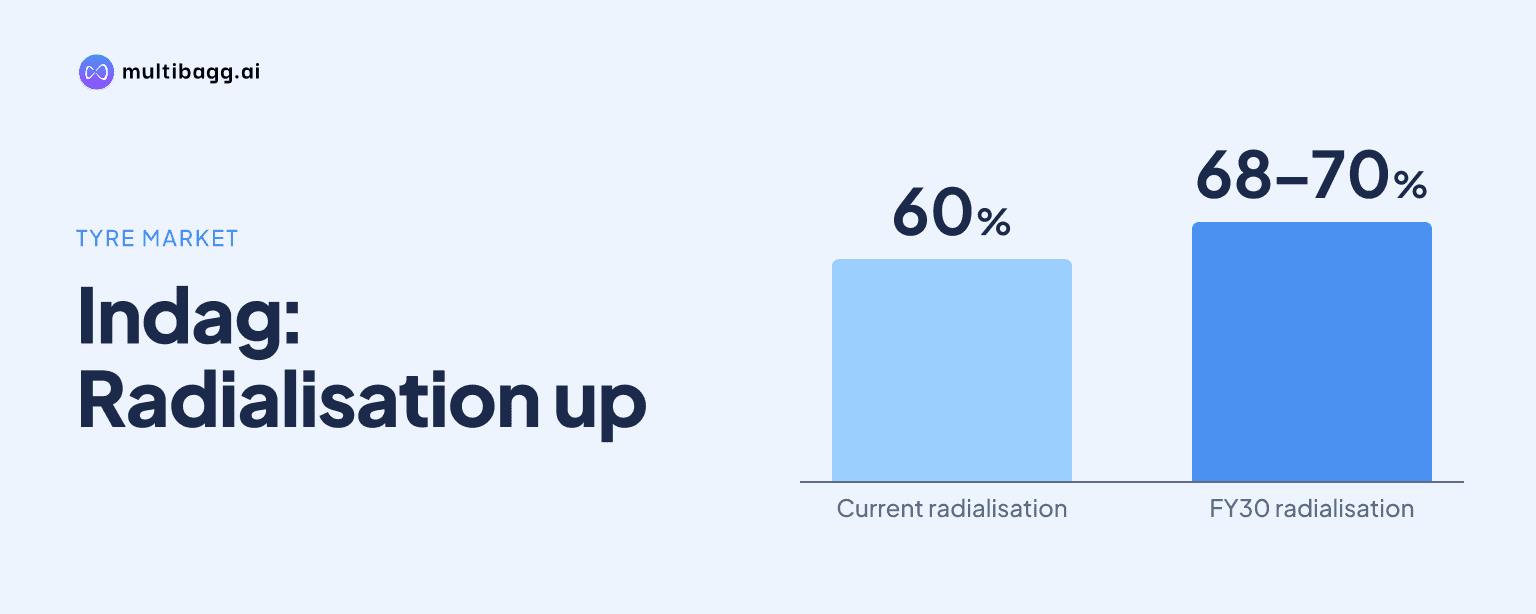
Indag says truck and bus tyre radialisation is expected to reach 68-70% by FY30 from about 60%, expanding the pool of structurally stronger tyres that can support multiple retreads. Its presentation also cites retread-process carbon dioxide emissions of 48 kilograms per tyre, versus 184 kilograms for a new tyre.
Know Indag Rubber inside out
Results, valuation, peers and who's buying, in one view.
Why does Indag expect tyre retreading to grow through FY30?
Indag expects radialisation in the truck and bus tyre segment to rise from about 60% to 68-70% by FY30, citing CRISIL for the current penetration and projection. The company’s core argument is that radial tyres are structurally stronger and support multiple retreads, increasing the number of casings that may be suitable for retreading rather than replacement after their first tread life.
The presentation also identifies road infrastructure as a demand mechanism for the commercial-vehicle segment. It says improved roads can allow more distance to be travelled in less time, support higher-tonnage vehicles with more tyres, reduce downtime and extend tread life. These operational changes do not quantify future retread volumes, but Indag presents them as conditions that can increase the addressable tyre base and improve casing usability.
Regulatory and logistics changes form another part of Indag’s industry thesis. The company cites e-way bills as reducing check-post stopovers, while restrictions on overloading and end-of-tyre-life and labelling norms may formalise the value chain. Indag also says these measures can reduce the role of smaller unorganised participants, though it provides no market-size estimate or timetable for that formalisation.
How much can retreading reduce fleet tyre costs?
Indag says retreading can save up to 70% of the cost of a new tyre, reduce cost per kilometre, or CPKM, to one-third of a new tyre, and provide 70% of a new tyre’s life. These are the presentation’s fleet-owner economics, set against commercial-vehicle price increases of 10-12%, higher fuel costs, rising tolls and increasing competition.
The comparison means that retreading is presented as a way to extend the use of an existing casing rather than buy a replacement tyre immediately. A retread offering 70% of new-tyre life is not equivalent to a new tyre on that measure, but the stated CPKM of one-third is the basis for Indag’s claim that retreading lowers operating cost for fleet owners and operators.
Indag describes retreading as the only considerable forward-looking solution for reducing tyre costs, an opinion presented in its material rather than an independently quantified industry conclusion. The company also says retread safety is tested against the same stringent performance criteria as a new tyre, while its commercial proposition centres on dedicated support intended to reduce fleet CPKM.
Got a follow-up? Ask IRIS
What environmental case does Indag make for retreading?
Indag says a retread tyre has a 48-kilogram carbon dioxide footprint for the retread process, compared with 184 kilograms for a new tyre, a difference of 136 kilograms per tyre. The comparison covers 100 kilograms versus 21 kilograms from raw materials, 20 kilograms versus 8 kilograms from transport, and 64 kilograms versus 19 kilograms from manufacturing.
The company also states that retreading saves more than 57 litres of oil and 44 kilograms of rubber for each tyre, alongside 136 kilograms of carbon dioxide emissions. These figures support its description of retreading as a circular-economy activity, in which an existing tyre casing is reused before downstream pathways such as reclaim, devulcanised rubber, crumb and recovered carbon black are considered.
The 48-kilogram retread figure covers the retread process only, which is an important boundary in Indag’s comparison. The presentation additionally names Extended Producer Responsibility, or EPR, policy as a potential industry driver because it could encourage sustainability and reusability, but it does not specify an EPR target, compliance date or financial effect for Indag.
How does Indag plan to address the expanding retreading market?
Indag says it has a pan-India network of more than 300 dealers, 3,000 retreaders and 15 depots, intended to provide customer proximity and product availability. This distribution structure is paired with more than 50 on-ground personnel, including sales executives, technical engineers and fleet engineers, who provide timely solutions and services for fleet and retreader customers.
The company’s offer covers multiple tyre segments through its product portfolio and includes consultancy on retreading processes, machinery and troubleshooting. Indag says this service model helps retreaders operate efficiently and cost-effectively, while dedicated assistance to fleet owners and operators is designed to lower CPKM. The presentation does not disclose segment-wise revenue, dealer productivity or retreader throughput for this network.
Indag also points to a recently established research and development facility at Nalagarh, Himachal Pradesh, as its product-innovation base. Its marketing activity has included more than 1,000 touchpoints using three-dimensional rendering and modelling of precured tread designs, as well as more than 200 below-the-line activities reaching over 700 owner-drivers. These figures show channel and customer engagement activity, not a disclosed measure of sales conversion.
Conclusion
Indag’s growth case combines greater radial-tyre penetration with stated fleet economics and lower resource use per retread. The presentation positions multiple-retread capability, CPKM of one-third of a new tyre, savings of up to 70% against a new tyre and a 136-kilogram carbon dioxide difference as connected reasons for retreading adoption.
The main disclosed milestone to watch is whether truck and bus radialisation advances toward the 68-70% FY30 range. Indag’s plan also rests on its more than 300 dealers, 3,000 retreaders, 15 depots, more than 50 on-ground personnel and the Nalagarh research and development facility translating product, service and network activity into disclosed operating outcomes.