










Indag Rubber Ltd. Reports Record Q2 Revenue, Margin Declines
Key highlights
- Indag Rubber reported record Q2 FY27 net sales of ₹80.83 crore, up 15.32% quarter-on-quarter.
- Operating profit margin fell to 4.31% in Q2 FY27 from 8.06% in Q1 FY27.
- H1 FY27 net sales were ₹150.92 crore, up 54.71% year-on-year.
- The Board declared an interim FY27 dividend of ₹0.90 per equity share.
powered by IRIS
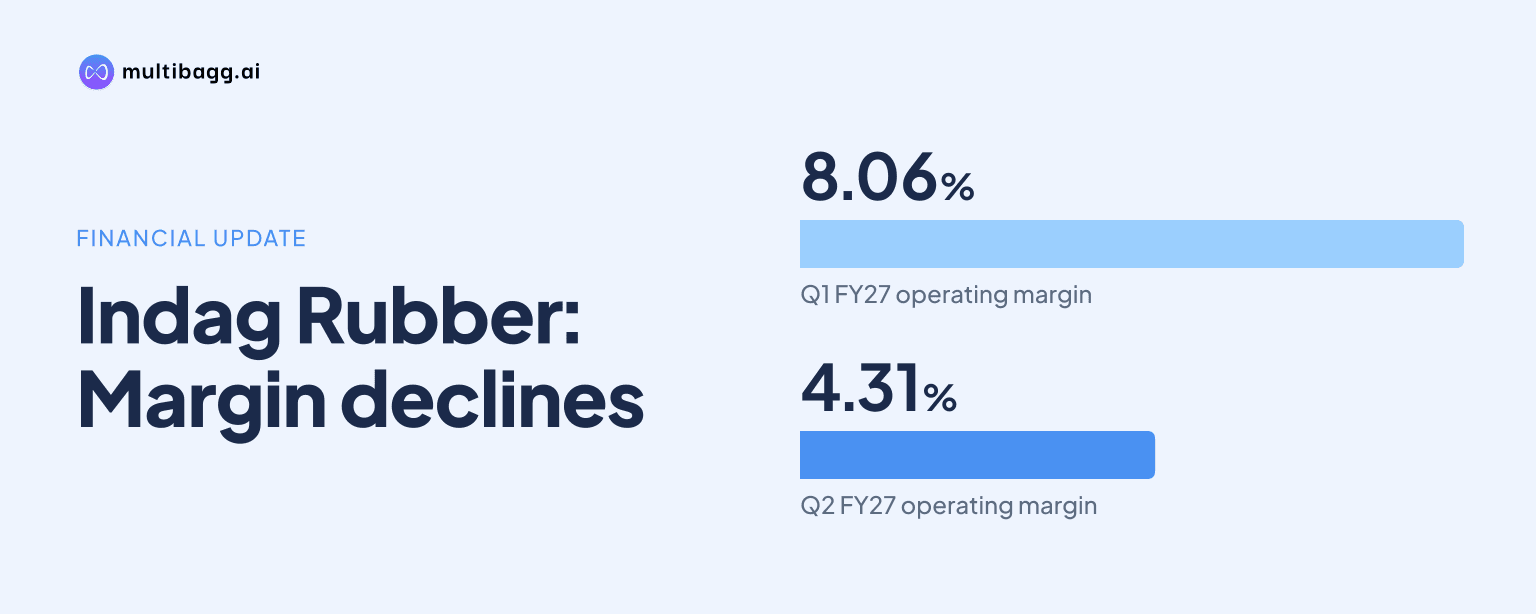
Indag Rubber Ltd. reported record Q2 FY27 net sales of ₹80.83 crore, up 15.32% sequentially, but its operating profit margin fell to 4.31% from 8.06% in Q1 FY27, indicating that costs rose faster than sales during the September 2026 quarter.
Know Indag Rubber inside out
Results, valuation, peers and who's buying, in one view.
What did Indag Rubber report for Q2 FY27?
Indag Rubber reported a mixed second-quarter performance, with net sales reaching ₹80.83 crore in Q2 FY27, described in the supplied material as the company's highest quarterly revenue on record. Sales were 15.32% higher than Q1 FY27 and 53.9% above Q2 FY26, according to the result summary. The Board approved audited standalone and consolidated results for the quarter and six months ended September 30, 2026.
The supplied material reports consolidated net profit of ₹3.17 crore for the quarter, down 37.35% from the preceding quarter. A separate result-summary table cites net profit of ₹3.06 crore. The materials do not explain this difference, so the reported profitability figures should be read in the context of that inconsistency. Both sets of information point to lower sequential profitability despite stronger revenue.
Why did Indag Rubber's margin decline despite sales growth?
Indag Rubber's margin declined because expenditure increased faster than revenue in the quarter. The result summary shows expenditure of ₹79.29 crore, rising 19.4% sequentially, compared with 15.3% growth in revenue. This gap reduced the operating profit margin to about 4.3% in Q2 FY27.
The year-on-year comparison also shows a weaker earnings conversion from sales. Revenue rose 53.9% from the prior-year quarter, while net profit in the result summary increased only 7.0%. Operating profit margin fell from 5.8% in Q2 FY26 to 4.3% in Q2 FY27, while net profit margin declined from 5.2% to 3.7%. These figures indicate that the revenue expansion did not translate proportionately into profit during the quarter.
The supplied material does not identify specific cost heads behind the higher expenditure. It does, however, characterise the result as a margin squeeze, making cost control and the company's ability to improve operating leverage important factors in assessing subsequent results.
Got a follow-up? Ask IRIS
How did Indag Rubber perform in the first half of FY27?
Indag Rubber's first-half performance was stronger than its Q2 trend, with H1 FY27 net sales of ₹150.92 crore, up 54.71% year-on-year. Consolidated net profit for the six months was reported at ₹8.23 crore, an 80.09% year-on-year increase. The supplied material also cites standalone profit after tax of ₹8.35 crore for H1 FY27, compared with ₹5.46 crore in H1 FY26.
Average operating margin for the first half was 6.05%, and the average PAT margin was 5.45%. Both were above the Q2 operating and net-margin levels reported in the result summary. This means the stronger Q1 performance supported the half-year numbers, even as the September quarter showed a clear sequential weakening in margins.
The company had reported Q1 FY27 revenue from operations of ₹57.6 crore, EBITDA of ₹8.2 crore, and PAT of ₹5.1 crore in its investor presentation. Q1 EBITDA margin was stated at 13.6%, and PAT margin at 8.4%. The contrast with Q2 highlights the extent of the quarterly moderation in profitability.
What do the results mean for Indag Rubber investors and operations?
The results show that Indag Rubber has maintained strong sales momentum in its tyre-retreading business, but profitability has become the more important operating issue. The company manufactures precured tread rubber, un-vulcanised rubber strip gum, universal spray cement and envelopes, and offers application-specific tread patterns for the transportation industry. Higher sales therefore indicate continued activity across its operating market, while lower margins point to pressure within the cost structure.
The Board declared an interim dividend of ₹0.90 per equity share for FY27 alongside the approval of the audited results. Statutory auditor Khanna & Annadhanam issued an unmodified opinion on the standalone results. These formal actions confirm completion of the reported financial review, but they do not change the margin trend evident in the Q2 numbers.
The supplied material also describes the stock's classification as “Risky” since February 12, 2025, citing investor scepticism about management's ability to reverse profitability pressure. It compares Indag Rubber with Goodyear India, which was stated to have an ROE of 14.58% and a price-to-book multiple of 2.59 times, compared with Indag Rubber's 1.19 times. This comparison reflects a valuation gap, although it does not by itself establish the reason for that difference.
Conclusion
Indag Rubber delivered its highest reported quarterly net sales in Q2 FY27, but the rise in expenditure outpaced sales growth and compressed operating margin to 4.31%. The stronger H1 revenue and profit figures show that the first half remained ahead of the previous year, while the September-quarter performance brought the sustainability of that improvement into focus.
The next key issue is whether Indag Rubber can address the unresolved margin pressure in the second half of FY27. Investors will also watch for further disclosures on operating costs, quarterly profitability and the implementation of the ₹0.90-per-share interim dividend approved by the Board.