










Indegene Agentic AOR pilot wins a primary-agency mandate
Key highlights
- Indegene said its Agentic AOR pilot completed launch concepting in a few days versus a couple of months for conventional agencies.
- The client initially sought 60% to 70% of traditional-agency output, according to Indegene management.
- Indegene said the pilot resulted in a primary-agency mandate for the molecule.
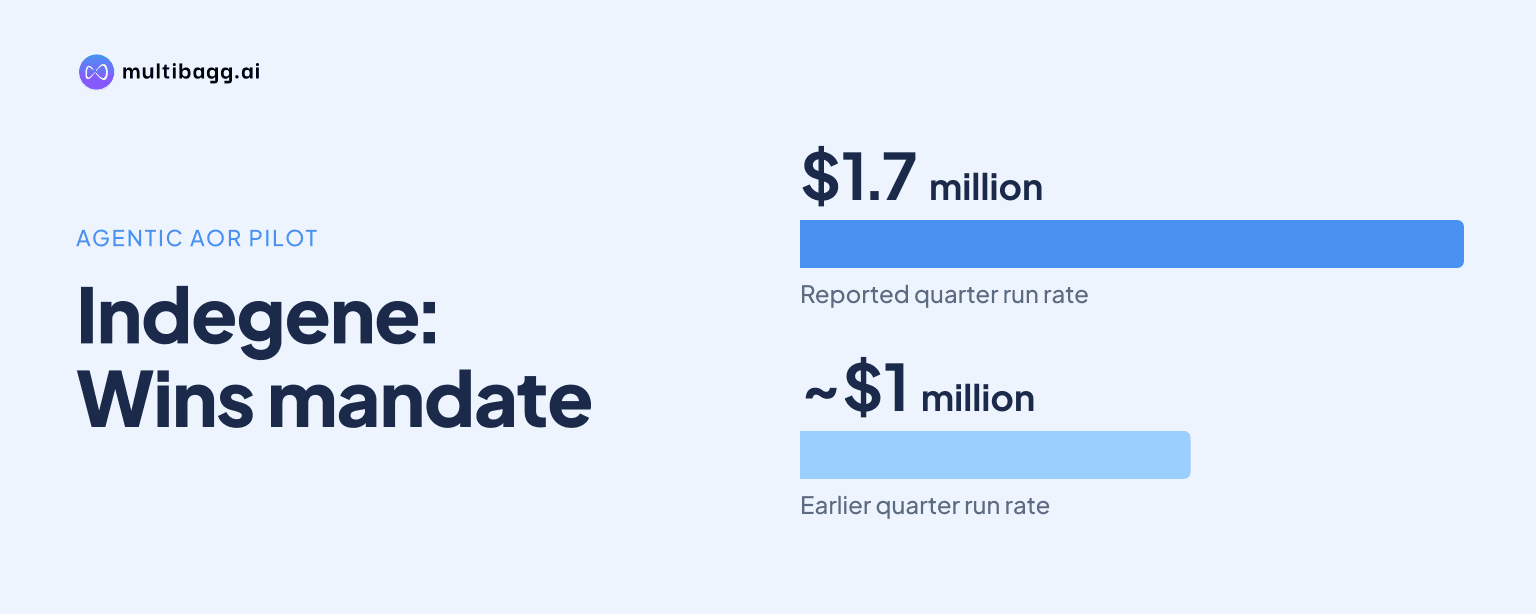
- Tectonic’s quarterly run rate rose from about $1 million to $1.7 million in the reported quarter.
powered by IRIS
Indegene Limited said its Agentic AOR pilot completed drug-launch positioning, physician segmentation, scientific messaging and creative work in a few days rather than the couple of months management said agencies typically require, leading the client to appoint Indegene as primary agency for the molecule. Management said the client had initially sought only 60% to 70% of conventional-agency output.
Know Indegene inside out
Results, valuation, peers and who's buying, in one view.
What did Indegene’s Agentic AOR pilot achieve?
Indegene said the pilot won a primary-agency assignment after conducting launch concepting for a customer’s new molecule through workshops lasting a few days. Agency of record, or AOR, describes the agency relationship for the molecule. Management said the scope included deciding how to launch the molecule, its market positioning, the physician segments to target, scientific messages and creative work.
The client ran the Indegene pilot alongside its existing agency rather than replacing that agency at the outset. Management said the customer indicated it would be satisfied if Indegene produced 60% to 70% of what agencies normally delivered. After a couple of days, management said the client viewed the output as better than what an agency would produce in a three-day workshop.
The comparison was not limited to speed. Indegene said the exercise incorporated the molecule’s clinical data, its claims, competing molecules and the therapeutic landscape before generating recommendations. Management described the outputs as scientific messages, creative material and physician profiles, positioning the assignment as launch strategy and content work rather than a simple generative-artificial-intelligence writing task.
How did Indegene’s workflow differ from a conventional agency process?
Indegene said its agentic approach compressed work that conventional agencies typically complete over a couple of months into a few days of workshops. Management described the conventional process as expensive and iterative, involving large agency teams. In contrast, the client and Indegene first had to prepare a specified set of inputs for the workshop-based process.
The workflow was designed to assess commercial and medical inputs together. Management said it considered clinical evidence, claims and competitor activity in a therapeutic area before determining physician profiles, messages and creative direction. That mechanism matters because the company said pharmaceutical launch decisions require the perspectives of marketers, creative professionals and medical directors, not only a general-purpose technology model.
Management said the pilot formed over the past six months, during which its teams had been holding similar workshops and discussions with multiple clients. It also cautioned that adoption will take time because the method changes how pharmaceutical companies conduct commercial work. The primary-agency mandate is therefore evidence from one client conversion, not a disclosed timetable for broad industry adoption.
Why did the client appoint Indegene as primary agency?
Indegene said the client asked it to handle a range of work for the molecule after seeing the pilot, resulting in its appointment as primary agency. Management did not disclose the contract value, revenue contribution, molecule name or client identity. It said the assignment expanded after the customer reviewed the outputs generated during the workshops.
The client relationship may extend beyond the molecule-level mandate. Management said next-level meetings had been arranged to consider working with the customer at a broader enterprise level using the same approach. Those meetings are a disclosed plan, not a signed enterprise-wide engagement, and management gave no target date or financial estimate for any potential expansion.
The outcome differs from Indegene’s Tectonic engagements at its largest client, where management said contracted scope continued to grow but revenue ramped more gradually. Management attributed that divergence to change-management dynamics between central teams seeking greater centralisation and local geography and therapeutic-area teams accustomed to decentralised working. It said those Tectonic engagements were not progressing on a linear path.
Got a follow-up? Ask IRIS
What supports Indegene’s agentic commercial model?
Indegene said the work shown in three days rested on two to three years of development. Management said experts from its own operations and acquired agencies developed internal knowledge-engineering graphs using Cortex, then embedded them in specialised workflows, agents, checks and balances. It described that development as requiring detailed understanding of pharmaceutical commercial and medical decision-making.
Management said frontier artificial-intelligence models were not a threat to this model because technology providers require partners for the last-mile redesign of workflows and skill sets. Indegene has set up a dedicated partnerships team in the United States and India and said it was working with multiple technology companies, including frontier-model providers. This is management’s assessment of its role in the technology ecosystem.
The company also said it is combining Invisage and Tandem into an Audience Intelligence capability and integrating that data with industry-specific platforms, contextualised workflows and artificial intelligence. Management identified acquisitions including CultHealth, MJL, Cake and BioPharm as components of its move upstream in pharmaceutical commercialisation. It expects the distinctions among Agentic AOR, Tectonic and production to diminish over time within one integrated content model.
How is Indegene turning the model into contracts?
Indegene said most of its wins in the current quarter were output- or outcome-based contracts, except for one, rather than full-time-equivalent, or FTE, contracts. Management said it was seeking to convert pure FTE arrangements into hybrid contracts combining outcome-based and FTE elements as renewal cycles arise. It did not estimate an eventual ceiling for outcome-aligned revenue.
Management said some FTE roles would remain necessary even as artificial-intelligence-enabled workflows scale. It identified omnichannel orchestrators, brand liaisons, brand managers and regulatory experts in different global markets as roles that would oversee work delivered at scale. The company said it could not reliably quantify how much AI-enabled work could grow, but expected the outcome-based share to trend upward.
Tectonic is part of that broader commercial model rather than a stand-alone business unit, management said. Its quarterly run rate rose from about $1 million to $1.7 million in the reported quarter, while contracted business looking ahead had crossed more than $2 million a quarter. Management said it was increasingly winning combinations of Agentic AOR, Tectonic and other services, making individual offering boundaries less distinct.
Indegene said demand for Tectonic was currently concentrated in the United States and large European markets including Spain, Germany and the United Kingdom. In the broader business, Enterprise Commercial represented about 71% of revenue, compared with Enterprise Medical at 25% and Others at 4%. Management said Commercial could outpace Medical over the next few quarters as current-quarter deal wins were more weighted toward Commercial.
Conclusion
Indegene’s disclosed evidence of AI commercialisation is a pilot-to-mandate conversion: launch concepting that management said normally takes agencies a couple of months was completed in a few days and became a primary-agency role for a molecule. The company links that result to two to three years of knowledge-graph, workflow and control development, while treating Agentic AOR, Tectonic and production as connected elements of a wider commercial model.
What to watch next is whether the planned enterprise-level discussions with the pilot client become a broader assignment and whether output- and outcome-based wins continue to replace or supplement FTE contracts at renewal. Management also said Tectonic contracts had exceeded $2 million a quarter looking ahead, while its largest-client ramp remained gradual because of centralisation-related change management.