










Chambal Says Brownfield Projects Likely to Lead India's Urea Policy
Key highlights
- Chambal said the urea-capacity review is in its final stages and an outcome should come very soon.
- Chambal said the policy’s 12%-16% return range is normative, not an ex-post cap.
- Gadepan-III has stated capacity of 12.7 lakh metric tonnes and produced 3.68 lakh tonnes in the period discussed.
- Chambal received about Rs 1,300 crore against receivables in October.
powered by IRIS
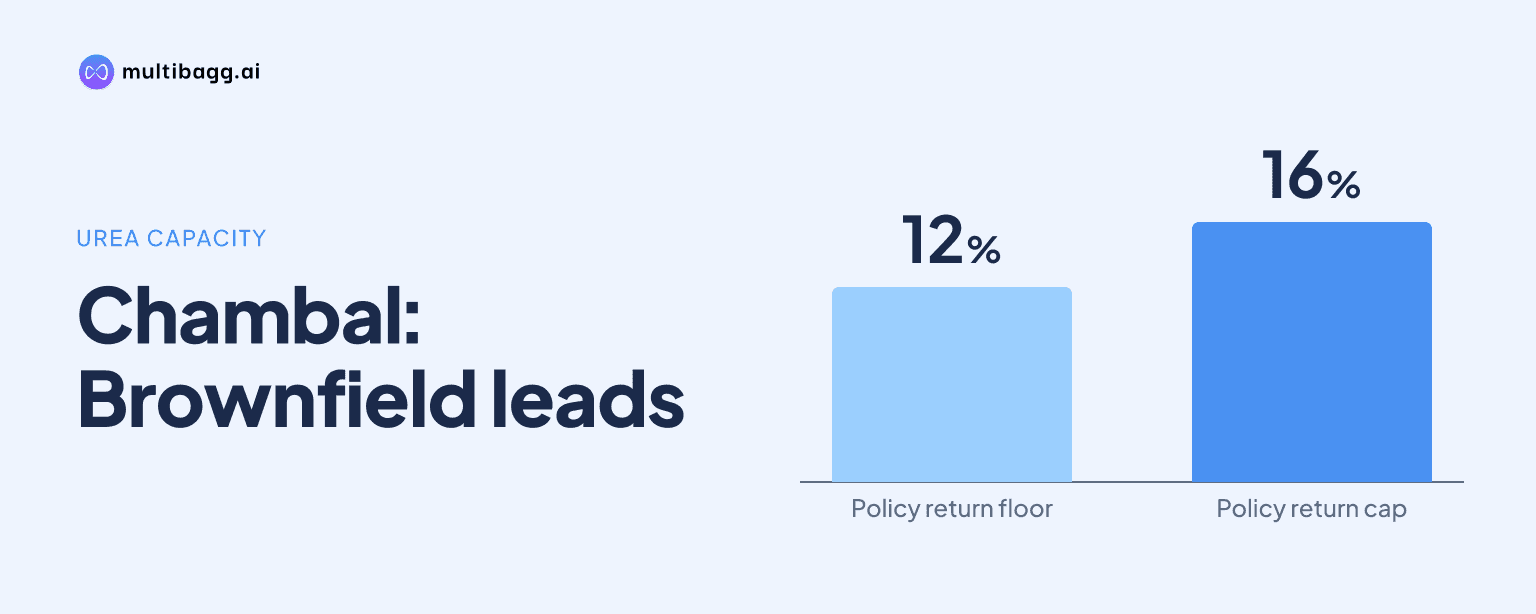
Chambal Fertilisers and Chemicals Limited said the government’s review of new urea-capacity applications was in its final stages, with brownfield projects likely to rank first because existing infrastructure can accelerate execution; it also said the policy’s 12%-16% return range is normative rather than an ex-post ceiling.
Know Chambal Fertilisers & Chemicals inside out
Results, valuation, peers and who's buying, in one view.
When does Chambal expect India to decide on urea capacity?
Chambal expects the government’s decision on new urea plants to come very soon because management understands that the evaluation is in its final stages. It said authorities had completed several rounds of deliberations covering the required national capacity, the preferred project type, the ability of proponents to deliver quickly and the locations where capacity is needed.
Management did not say how many applications would be selected or disclose a timetable beyond its expectation of a near-term outcome. An analyst referred to roughly seven to eight applications, but Chambal said it could not predict the government’s decision because several considerations, including capacity distribution and technology, remain relevant.
The review of new plants is separate from the policy treatment of Chambal’s existing Gadepan-III unit. Management said the current policy benefit expires at the end of November and a new policy begins on 1 December, while a white paper on the issue was circulating among government departments.
Chambal said it remains in discussions with the government on Gadepan-III, but had no visibility on the final outcome or its earnings before interest, tax, depreciation and amortisation impact. The company said it would disclose the result once it had information, rather than estimate an effect before the 1 December policy transition.
Why does Chambal expect brownfield urea projects to rank first?
Chambal expects brownfield proposals to receive the highest priority because they have existing infrastructure and can be completed in the shortest possible time. Management described its view of the likely selection order as brownfield first and greenfield next, while making clear this was not a government announcement.
Greenfield projects may still be needed because the government wants to spread urea production capacity across India, according to management. Chambal also said alternative technologies, including coal gasification, were being considered, although it did not know how the government would rank those options against conventional brownfield and greenfield projects.
Gadepan-III illustrates the existing operating base behind Chambal’s emphasis on available infrastructure. The unit has stated capacity of 12.7 lakh metric tonnes, and management expected production of more than 9 lakh tonnes by the end of November at the then-current operating trend.
Gadepan-III recorded the highest production and sales among Chambal’s three urea units in the period discussed on the call. Its 3.68 lakh tonnes of output exceeded Gadepan-I’s 2.89 lakh tonnes by 0.79 lakh tonnes and Gadepan-II’s 2.56 lakh tonnes by 1.12 lakh tonnes, although these results do not establish approval criteria for a new project.
Got a follow-up? Ask IRIS
Does Chambal say the 12%-16% range caps project returns?
No, Chambal said the 12%-16% range is the government’s normative estimate of the return that a urea project could earn, not a cap to be imposed after construction. Management said the government would not examine each completed project’s actual costs and restrict returns to the stated range ex post facto.
Chambal said a developer’s realised return could differ from the normative range through financing structure, tax benefits, plant efficiency and production volumes. Management said the government would have considered assumptions such as brownfield capital costs and debt-equity structure when it designed the policy framework.
The policy also seeks to address foreign-currency exposure during construction, according to Chambal. Management said the first four years refer to project implementation rather than the first four years of operations, noting that a urea plant can take three to five years to build.
Chambal said the government would use an average dollar rate over the first four implementation years to set fixed charges, because projects have a significant dollar component. Management referred to fixed-charge figures of US$133 or US$151, depending on the applicable case, but did not say which figure would apply to a specific project.
What could policy uncertainty mean for Chambal's current urea business?
Policy uncertainty could affect Chambal’s Gadepan-III earnings after the end-November expiry, but management did not quantify the potential impact. It said the government would seek to reduce the applicable support where possible, while Chambal had made what it considered a logical case for its preferred treatment.
Management said Gadepan-III was then operating at US$155 per tonne, while cautioning that expenses sit below that figure. It declined to validate an analyst’s suggested range for the unit’s policy impact, saying it could not second-guess the government before the new policy starts on 1 December.
Higher gas costs were also increasing operating expenses. Chambal said gas cost was about US$20.2 on a net calorific value basis in Quarter 2 and had risen to about US$24.5 currently, while power and fuel explained an estimated 85%-90% of the increase in other expenses.
Management said other expenses had risen from a previous run rate of about Rs 1,100 crore to Rs 1,150 crore to about Rs 1,650 crore. Anuj Jain said power and fuel costs accounted for more than Rs 500 crore of the increase, and Chambal said the run rate would not decline unless those costs normalised.
Subsidy receivables remain another cash-flow variable while input costs are elevated. Chambal put urea escalation receivables at about Rs 1,150 crore, pending point-of-sale clearances at about Rs 1,000 crore, pending point-of-sale amounts for phosphatic and potassic fertilisers at about Rs 500 crore, and seasonal diammonium phosphate calculations at about Rs 350 crore to Rs 360 crore.
Chambal said it received about Rs 1,300 crore against receivables in October. Management added that if urea prices remained elevated near the US$24 gas-cost level and plants continued to operate at full rates, subsidy receivables could rise further unless the government processed price escalation quickly.
Conclusion
Chambal’s assessment points to a policy decision that could favour faster-to-build brownfield urea projects, while leaving room for greenfield plants where regional capacity distribution requires them. Its clarification on the 12%-16% range matters because management describes that figure as a normative policy assumption, not an individual-project return ceiling after construction.
The next events to watch are the government’s announcement on new urea applications and the treatment of Gadepan-III when the current benefit expires at the end of November and the new policy starts on 1 December. Chambal’s operating outlook will also depend on whether gas costs stay near US$24.5 on a net calorific value basis and on the pace of subsidy collections after Rs 1,300 crore was received in October.