










Chambal to Hold Global Rights for 10 TERI Farm Products
Key highlights
- Chambal will have exclusive global commercial rights for 10 TERI products with jointly owned intellectual property.
- Five Chambal-TERI products are planned for FY 2028-2029, with registration data generation initiated through ICAR and universities.
- The other five jointly developed products are planned for FY 2030 and FY 2031.
- Chambal’s crop protection, speciality nutrients and seeds segment reported Q2 FY 2027 revenue of Rs 325 crore and EBIT of Rs 87 crore.
powered by IRIS
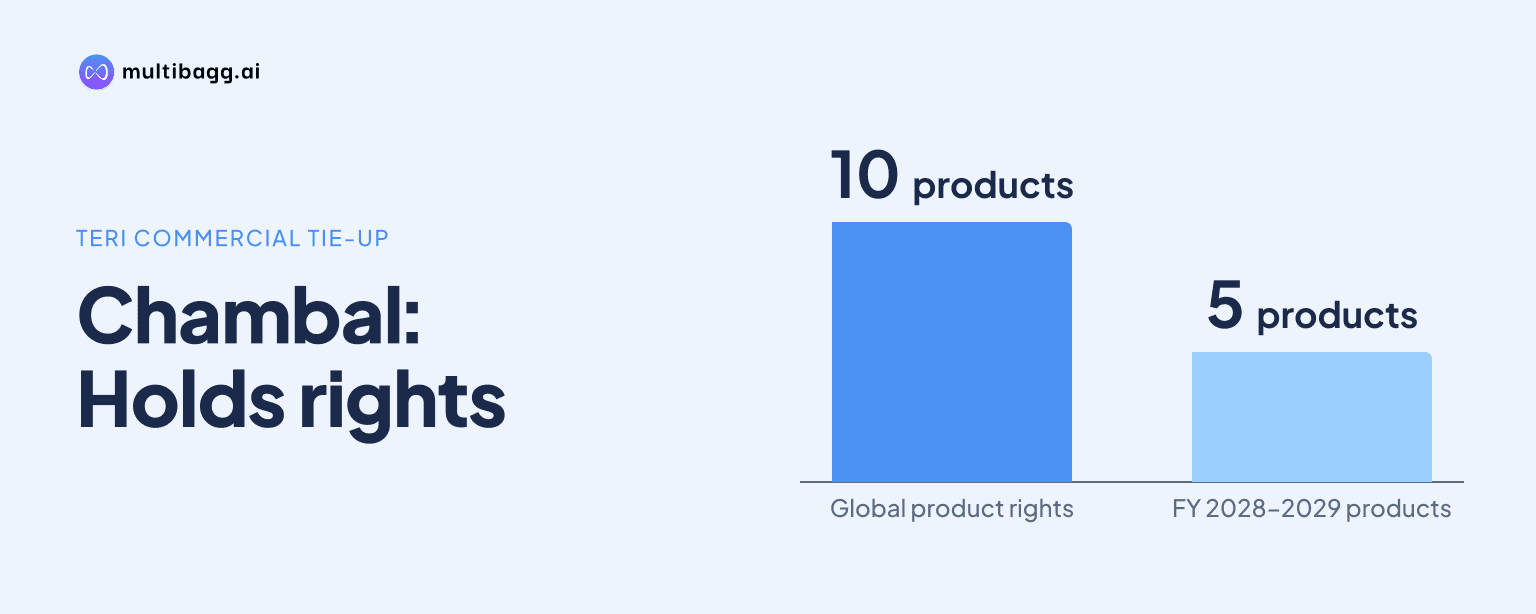
Chambal Fertilisers and Chemicals Limited said on November 4, 2026 that it will hold exclusive global commercial rights for 10 farm products whose intellectual property will be jointly owned with TERI, with five planned for launch in FY 2028-2029. Registration data generation for the first five has started through ICAR and universities.
Know Chambal Fertilisers & Chemicals inside out
Results, valuation, peers and who's buying, in one view.
What does Chambal’s TERI partnership include?
Chambal’s TERI partnership includes joint research and development of 10 next-generation agricultural products, jointly owned intellectual property and exclusive global commercial rights for Chambal. The companies have established the CFCL-TERI Centre of Excellence for Advanced and Sustainable Agriculture Solutions to conduct the research and development work behind the planned product pipeline.
The arrangement moves beyond the product launches Chambal has already made in FY 2027 because the 10 TERI-linked products are planned under a joint intellectual-property structure. Management did not disclose the individual product names, product categories, commercial terms, development cost, sales targets, pricing or the duration of Chambal’s exclusive global rights during the November 4 earnings call.
The programme sits alongside Chambal’s Crop Protection Chemicals, Speciality Nutrients and seeds business, which reported Q2 FY 2027 revenue of Rs 325 crore. That was down from Rs 374 crore in the corresponding quarter a year earlier, while segment earnings before interest and tax, or EBIT, stood at Rs 87 crore and the EBIT margin was 26.76%.
When will Chambal launch the TERI products?
Chambal plans to launch five of the 10 TERI products in FY 2028-2029 and the other five in FY 2030 and 2031. Management said registration data generation for the first five products has been initiated through the Indian Council of Agricultural Research, or ICAR, and universities, identifying the current development step before the first launch window.
The disclosed schedule places the first TERI launches after FY 2027, the financial year under discussion on the call. Chambal did not provide dates for completion of data generation, regulatory approvals, commercial availability in individual countries or a split of the later five products between FY 2030 and FY 2031.
Chambal had already launched 13 products in the first half of FY 2027, against 14 products planned for the full year. It also introduced new-age herbicide, fungicide and insecticide products in Q2, but the TERI programme has a longer timetable because its first five products are planned for FY 2028-2029 rather than FY 2027.
Which crop markets will Chambal target with TERI products?
Chambal said the TERI products will use its market capabilities in horticulture, spices, cereals, sugarcane and cotton. Management did not specify how many of the 10 products will target each crop group, nor did it identify active ingredients, biological formulations or the registration category of any individual product.
These crop markets align with Chambal’s stated focus on crop protection chemicals, speciality nutrients, seeds and biologicals rather than its larger urea and complex-fertiliser businesses. In Q2 FY 2027, urea revenue rose to Rs 4,629 crore from Rs 3,317 crore a year earlier, while complex-fertiliser revenue fell to Rs 1,978 crore from Rs 2,721 crore.
The crop protection, speciality nutrients and seeds segment was smaller than the urea and complex-fertiliser segments, but reported Q2 EBIT of Rs 87 crore against Rs 668 crore for urea and Rs 78 crore for complex fertilisers. The respective EBIT margins were 26.76%, 14.44% and 3.97%, showing that the TERI pipeline is being developed within a segment with a different revenue base and margin profile from Chambal’s fertiliser operations.
Management also said its biologicals business continued to grow in volume and revenue, without providing standalone figures. Chambal launched Uttam Aris Gold in Q1 FY 2027 and Uttam Fertilis in Q2 FY 2027 with Nutrien, whereas the TERI products remain at the research, data-generation and planned-launch stages.
Got a follow-up? Ask IRIS
What could affect Chambal’s TERI launch schedule?
Registration progress and agricultural conditions are the disclosed factors relevant to Chambal’s path toward the FY 2028-2029 to FY 2031 launch schedule. The company has begun registration data generation through ICAR and universities for the first five products, but management gave no forecast for approval timing or confirmation that these products will reach commercial launch on the stated dates.
Weather conditions affected the agricultural backdrop in Q2 FY 2027, when India recorded a 12% rainfall deficit during June to September, according to management. Chambal said delayed and uneven rainfall affected crop planting and application windows in some regions, although it had not suffered materially in volumes at that point.
Chambal’s farmer-engagement network may provide a route for demonstrating new products, though management did not directly link these activities to the TERI portfolio. During Q2, the company held more than 2,800 farmer meetings and crop seminars, conducted 3,600 crop-protection-chemical demonstrations and analysed more than 38,000 soil samples.
Input prices and nutrient-based subsidy decisions affect Chambal’s fertiliser operations more directly than its crop protection and speciality-nutrient business. Management said price pressure in Q2 was absorbed by traded fertilisers, while crop protection and speciality nutrients were not influenced by nutrient-based subsidy decisions and were instead more dependent on cropping patterns.
How does the TERI programme fit Chambal’s wider growth plans?
The TERI programme adds a multi-year product-development route while Chambal continues to build its existing agricultural portfolio. Management said the company’s biologicals business was growing in both volume and revenue, and it reported 4.27 crore views across Facebook, YouTube and Instagram as part of its farmer outreach during Q2 FY 2027.
The longer-dated product pipeline comes as Chambal reported Q2 standalone revenue from operations of Rs 7,000 crore, up 9% from Rs 6,413 crore a year earlier. Standalone profit after tax rose 6% to Rs 635 crore, while the crop protection, speciality nutrients and seeds segment’s Rs 325 crore revenue was lower than the prior-year quarter’s Rs 374 crore.
Management also said it is undertaking preparatory activities for a potential fourth urea plant under the National Investment Policy for Urea-2026. Any investment decision for that plant remains subject to government approvals, project economics and board approval, making it separate from the disclosed TERI product-launch programme.
Conclusion
Chambal has set out a defined technology-commercialisation plan with TERI: the partners will jointly own intellectual property for 10 agricultural products, while Chambal will have exclusive global commercial rights. The plan extends the company’s crop-input development pipeline beyond the 13 products it launched in the first half of FY 2027, but management has not quantified product-level revenue, investment or profit contribution.
The next disclosed milestone is progress in registration data generation for the first five products through ICAR and universities ahead of their planned FY 2028-2029 launches. Management’s future updates on the five products planned for FY 2030 and FY 2031, and on the crop protection, speciality nutrients and seeds segment after its Q2 revenue decline to Rs 325 crore, will indicate how the pipeline develops.