










Chambal says IMACID restarted at lower capacity in Q2-FY27
Key highlights
- Chambal said sulphur shortages and higher prices caused a prolonged IMACID shutdown in Q2-FY27.
- IMACID resumed at lower capacity in Q2-FY27 because of higher input costs.
- Chambal’s Q2-FY27 urea sales increased to Rs 4,629.2 crore from Rs 3,317.4 crore year on year.
- Complex-fertiliser EBIT declined to Rs 78.5 crore in Q2-FY27 from Rs 124.2 crore a year earlier.
powered by IRIS
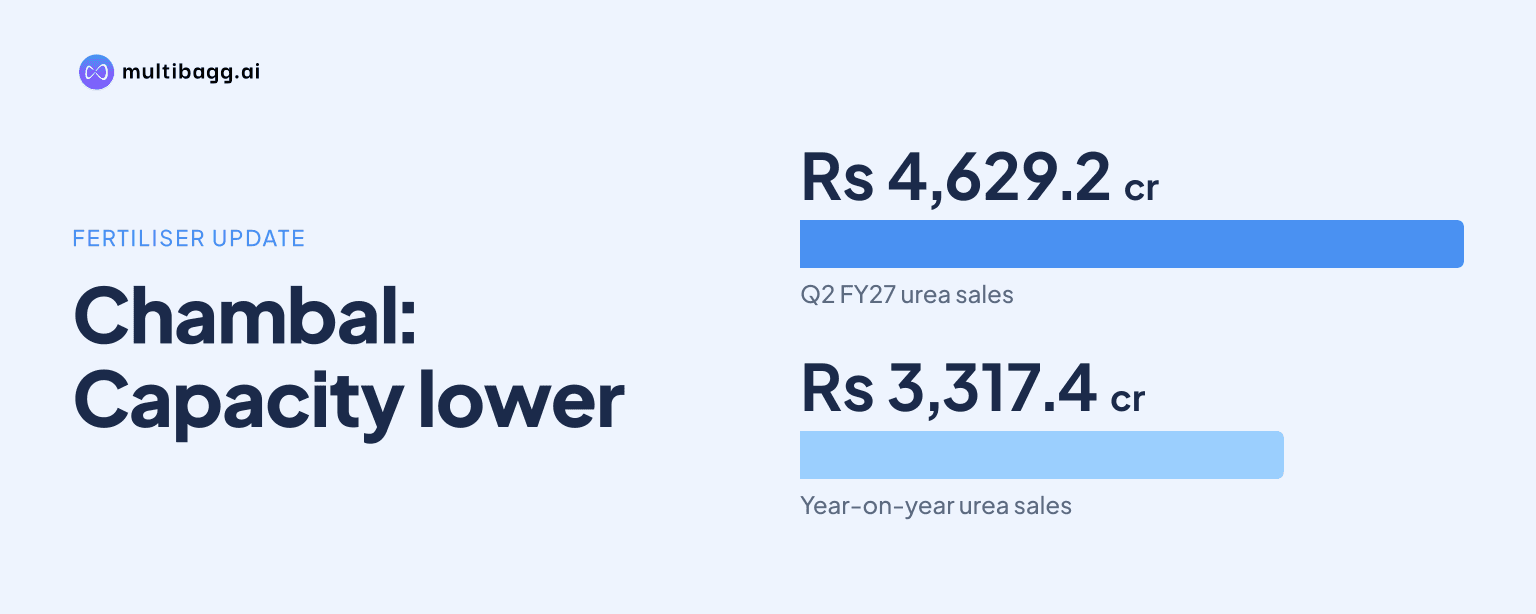
Chambal Fertilisers and Chemicals Limited said IMACID resumed production at lower capacity in Q2-FY27 after sulphur shortages and higher prices caused a prolonged shutdown. The company identified continued higher input costs as the reason for the reduced-capacity restart, but did not disclose IMACID revenue, profit, loss, capacity utilisation or production volume.
Know Chambal Fertilisers & Chemicals inside out
Results, valuation, peers and who's buying, in one view.
What caused IMACID to shut down in Q2-FY27?
Chambal said sulphur shortages and higher sulphur prices caused a prolonged shutdown at IMACID in Q2-FY27. The Q2-FY27 operational update identifies sulphur availability and cost as the direct operating constraints, without providing the shutdown duration, sulphur volumes unavailable or the increase in sulphur prices.
IMACID was discussed within Chambal’s bulk-fertiliser update for Q2-FY27, when the company also said it had sourced phosphatic and potassic, or P&K, fertilisers in time for the Rabi season. Chambal said it maintained muriate of potash, or MOP, and nitrogen-phosphorus-potassium, or NPK, fertiliser volumes, indicating that the IMACID interruption was reported alongside continued procurement activity in other fertiliser categories.
The presentation does not state the volume of phosphoric acid affected by the shutdown or the period in which sulphur availability became constrained. It also does not give IMACID’s pre-shutdown operating rate, sulphur inventory policy or any quantified cost effect on Chambal’s Q2-FY27 segment results.
Has IMACID returned to full production capacity?
No, Chambal said IMACID resumed production at a lower capacity because input costs remained higher in Q2-FY27. The disclosure distinguishes a production restart from a return to normal operations, but does not state the capacity achieved after the restart or the capacity level before the shutdown.
Chambal provides no timetable for IMACID to return to full capacity and no sulphur-sourcing target in the supplied material. The company also does not disclose whether the lower run rate resulted from a deliberate production decision, restricted raw-material availability, or a combination of both higher sulphur costs and supply limitations.
The limited disclosure means the operational event can be measured only by its stated mechanism: a sulphur shortage and higher prices led to shutdown, followed by lower-capacity production. It does not support a quantified claim that IMACID swung to a loss or that it reduced Chambal’s consolidated profit by a specified amount in Q2-FY27.
How did Chambal’s fertiliser segments change in Q2-FY27?
Chambal’s urea sales and earnings before interest and tax, or EBIT, rose year on year in Q2-FY27, while complex-fertiliser sales and EBIT declined. Urea sales increased to Rs 4,629.2 crore from Rs 3,317.4 crore in Q2-FY26, and EBIT increased to Rs 668.5 crore from Rs 552.6 crore.
Urea production reached 9.13 lakh metric tonnes in Q2-FY27, compared with 8.81 lakh metric tonnes in Q2-FY26, while urea sales volume declined to 8.90 lakh metric tonnes from 9.09 lakh metric tonnes. This shows that the increase in urea sales value and EBIT occurred despite sales volume being 0.19 lakh metric tonnes below the prior-year quarter.
Complex-fertiliser sales fell to Rs 1,978.2 crore in Q2-FY27 from Rs 2,721.3 crore a year earlier, while EBIT fell to Rs 78.5 crore from Rs 124.2 crore. These segment figures provide operating context for the quarter, but Chambal does not provide a financial bridge linking the IMACID shutdown to the complex-fertiliser change.
Got a follow-up? Ask IRIS
What happened to Chambal’s complex-fertiliser volumes?
Chambal’s di-ammonium phosphate and triple superphosphate, or DAP/TSP, volume declined sharply in Q2-FY27, while MOP volume increased and NPK volume was broadly lower. DAP/TSP sales were 0.71 lakh metric tonnes, compared with 2.32 lakh metric tonnes in Q2-FY26, a decline of 1.61 lakh metric tonnes.
MOP sales increased to 0.63 lakh metric tonnes in Q2-FY27 from 0.52 lakh metric tonnes a year earlier. NPK sales declined to 1.70 lakh metric tonnes from 1.66 lakh metric tonnes, while remaining above the 0.15 lakh metric tonnes reported for MOP in Q1-FY27.
For the first half, DAP/TSP volume was 0.96 lakh metric tonnes in H1-FY27, down from 3.45 lakh metric tonnes in H1-FY26. In contrast, MOP volume increased to 0.76 lakh metric tonnes from 0.67 lakh metric tonnes, and NPK volume declined to 4.13 lakh metric tonnes from 4.59 lakh metric tonnes.
What does Chambal disclose about IMACID’s financial effect?
Chambal does not disclose IMACID’s revenue, profit, loss, equity-accounted contribution or impairment charge in the supplied Q2-FY27 presentation. The material therefore supports reporting the prolonged shutdown and lower-capacity restart, but not the premise that IMACID recorded a loss or swung from profit to loss.
The H1-FY27 segment data show a mixed operating result across Chambal’s fertiliser businesses. Urea sales increased to Rs 7,489.2 crore from Rs 6,425.9 crore in H1-FY26 and urea EBIT increased to Rs 1,100.3 crore from Rs 1,013.9 crore.
Complex-fertiliser sales declined to Rs 3,714.9 crore in H1-FY27 from Rs 4,852.1 crore in H1-FY26, but its EBIT increased to Rs 317.2 crore from Rs 267.1 crore. This difference between lower sales and higher half-year EBIT underscores why the presentation’s data cannot establish a direct financial effect from IMACID’s Q2-FY27 disruption.
How did Chambal’s other agricultural businesses perform in Q2-FY27?
Chambal said seeds revenue grew 32% year on year and seeds margin improved 69% year on year in Q2-FY27. The company also said crop protection chemicals, or CPC, and speciality nutrients, or SN, maintained performance despite adverse agro-climatic conditions in some territories.
Chambal introduced four new-age CPC products in Q2-FY27 across herbicide, fungicide and insecticide categories. The launches were Croparmo, containing tebuconazole and trifloxystrobin; Duo Strike, containing dinotefuran and pymetrozine; Novel, containing bentazone; and Karbo, containing hexaconazole and pyraclostrobin.
The company also introduced Uttam Fertilis, a biostimulant, in Q2-FY27 after launching Uttam Aris Gold in Q1-FY27. Chambal reported continuous volume and revenue growth in biologicals, but did not disclose product-level sales, margins or volumes for the four CPC launches or the biostimulant products.
Conclusion
Chambal’s stated IMACID development in Q2-FY27 was operational rather than quantified financially: sulphur shortages and higher prices caused a prolonged shutdown, and higher input costs limited the subsequent restart to lower capacity. Elsewhere, urea sales rose to Rs 4,629.2 crore and EBIT rose to Rs 668.5 crore, while complex-fertiliser sales and EBIT declined to Rs 1,978.2 crore and Rs 78.5 crore respectively.
The next disclosure to watch is whether Chambal reports improved sulphur availability, lower input costs or a higher IMACID operating rate after Q2-FY27. Management did not provide a date for full-capacity production, a sulphur procurement target or IMACID financial figures, leaving the duration and earnings effect of the constraint unresolved.