










Chambal TAN plant reaches 80%-85% utilisation in weak market
Key highlights
- Chambal said its TAN plant reached almost 80%-85% capacity utilisation after Q2 FY 2027 commissioning.
- The TAN segment generated Rs 67 crore of Q2 FY 2027 revenue and Rs 12 crore of EBIT at a 17.97% margin.
- Chambal produced about 16,000 tonnes of WNA and 9,500 tonnes of ANS and HDAN combined in its first 40 days.
- Management said the Rs 1,500 crore TAN project should carry about Rs 70 crore of annual depreciation and no interest cost.
powered by IRIS
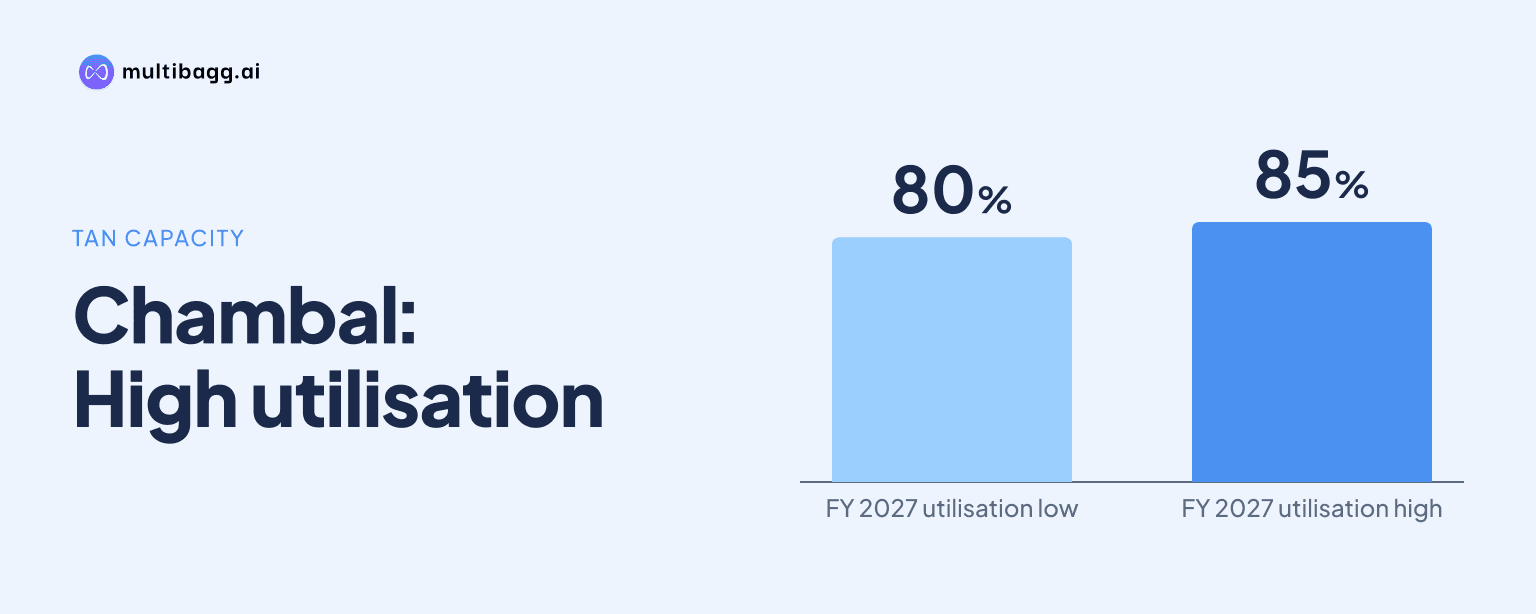
Chambal Fertilisers and Chemicals Limited said its Technical Ammonium Nitrate plant reached almost 80%-85% capacity utilisation after starting commercial production in Q2 FY 2027, despite low demand and competitive pricing at entry. The new segment generated Rs 67 crore of revenue and Rs 12 crore of earnings before interest and tax, or EBIT, at a 17.97% margin.
Know Chambal Fertilisers & Chemicals inside out
Results, valuation, peers and who's buying, in one view.
How quickly has Chambal’s TAN plant ramped up?
Chambal said ammonium nitrate solution, or ANS, and high-density ammonium nitrate, or HDAN, were operating at almost 80%-85% of capacity when it spoke to investors after Q2 FY 2027. Management separately described overall project utilisation as having crossed 83%-84%, with the remaining capacity to be added as demand grows and logistics reach additional Indian markets.
The Technical Ammonium Nitrate, or TAN, project began commercial production during Q2 FY 2027. In its first 40 days, Chambal produced about 16,000 tonnes of weak nitric acid, or WNA, and about 9,500 tonnes of ANS and HDAN combined. Management said WNA and ANS were operating at optimum levels, while HDAN continued to be ramped up, and explosives manufacturers had accepted the product quality.
Management said the plant’s fixed costs were low and that depreciation was its principal major cost, as the project had no interest expense from borrowings. That cost structure is relevant because the Rs 12 crore of TAN EBIT was earned during an initial 40-day operating period, rather than during a full quarter at a mature production level.
What did Chambal’s TAN business earn in Q2 FY 2027?
Chambal’s TAN segment recorded Rs 67 crore of revenue and Rs 12 crore of EBIT in Q2 FY 2027, resulting in a 17.97% EBIT margin. The contribution was smaller than the company’s established fertiliser segments because the TAN plant had only begun commercial production during the quarter.
The TAN margin was achieved in what management described as an unfavourable entry market. Managing Director Abhay Baijal said Chambal entered when demand was low and competitive pricing pressure was high. Vivek Misra said the company was establishing supply chains and working on transport efficiencies, while management expected margins to improve in coming quarters without giving a numerical sustainable-margin target.
Chambal’s wider Q2 FY 2027 standalone result provides context for the early TAN contribution. Revenue from operations rose 9% year on year to Rs 7,000 crore from Rs 6,413 crore, while earnings before interest, tax, depreciation and amortisation, or EBITDA, were Rs 901 crore at a 12.87% margin. Profit after tax rose 6% to Rs 635 crore.
Why does Chambal expect TAN margins to improve?
Chambal expects TAN pricing power and margins to improve in the third and fourth quarters as seasonal demand increases, according to management. Misra said TAN prices are market-driven and influenced by imported material as well as domestic producers, meaning the company did not state a fixed price or margin outcome.
Management linked its expectation to both seasonal demand and the supply-demand balance. India had been importing roughly 4 lakh tonnes of ammonium nitrate, but Chambal expects import volumes to decline as domestic capacities are added. It also cited demand generation of roughly 2.5 lakh to 3 lakh tonnes every two to three years and estimated market demand growth at roughly 6%.
Chambal also said reduced coal imports during the year could add to ammonium nitrate demand. Management’s view was that producers should have sufficient market opportunity to place available volumes, but this remains conditional on demand growth, import availability and domestic competition. The company’s stated mechanism for filling the remaining capacity is wider market access supported by improved logistics.
Got a follow-up? Ask IRIS
What investment and costs does the TAN project add?
Chambal said the TAN project was closed at Rs 1,500 crore, although the capitalisation process was not yet complete. Management estimated annual depreciation of about Rs 70 crore once the plant is fully operational and said no borrowing had been used for the project.
The absence of project interest cost differentiates TAN from a debt-funded expansion, according to management’s explanation. Baijal said that, after depreciation and taxation, much of TAN EBITDA could translate into profit after tax because fixed costs were low. The actual conversion will still depend on production, prices and operating conditions as the facility moves beyond its first 40 days.
Other segments faced different Q2 FY 2027 conditions. Urea revenue increased to Rs 4,629 crore from Rs 3,317 crore a year earlier, while complex fertiliser revenue declined to Rs 1,978 crore from Rs 2,721 crore. Management said traded nutrient-based subsidy fertilisers faced pricing pressure, while urea operated at capacity with efficiency gains.
What should investors watch in Chambal’s TAN ramp-up?
Chambal’s immediate TAN test is whether it can lift utilisation beyond the current 80%-85% range by adding markets and improving logistics. Management said the balance of capacity would be ramped only as demand develops and the distribution network is positioned to serve more areas of India.
Seasonal pricing through the third and fourth quarters is the other disclosed factor. Management expects stronger demand to improve pricing power and margins, after starting in a low-demand period with competitive pressure. The company did not set a TAN volume, revenue or margin target for FY 2028.
At the consolidated level, Chambal reported Q2 FY 2027 revenue of Rs 7,000 crore, up 9% year on year, and EBITDA of Rs 900 crore at a 12.87% margin. Against those figures, TAN revenue of Rs 67 crore remains a small part of the business, but its utilisation has progressed rapidly following commissioning.
Conclusion
Chambal has moved its TAN project from Q2 FY 2027 commissioning to almost 80%-85% utilisation, with Rs 67 crore of revenue and Rs 12 crore of EBIT in the initial operating period. The launch occurred during weak demand and price competition, while urea revenue rose by Rs 1,312 crore year on year and complex fertiliser revenue fell by Rs 743 crore.
The next measure is whether Chambal can place the remaining TAN capacity through wider markets and logistics while third- and fourth-quarter seasonal demand supports prices. Management also expects imports, previously around 4 lakh tonnes, to decline as domestic capacity expands, but it has not provided a numerical TAN margin or revenue target.