










Chambal TAN business records 18% EBIT margin in Q2-FY27
Key highlights
- Chambal reported Rs 66.9 crore of TAN revenue and Rs 12 crore of EBIT in Q2-FY27.
- Chambal's TAN EBIT margin was 18% in Q2-FY27.
- Commercial TAN production started on 20 August 2026.
- TAN sales volumes including trial production were 24,985 MT of WNA, 16,269 MT of ANS Melt and 554 MT of HDAN.
powered by IRIS
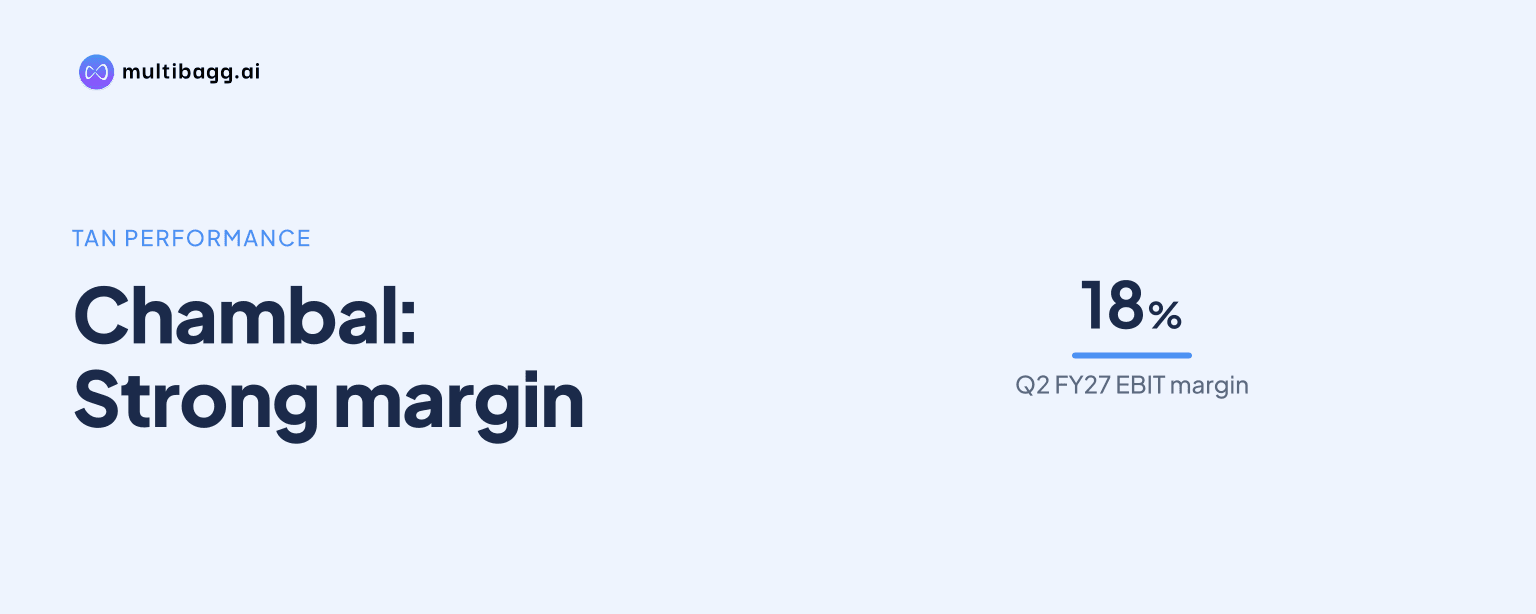
Chambal Fertilisers and Chemicals Limited recorded an 18% earnings before interest and tax (EBIT) margin in its Technical Ammonium Nitrate (TAN) business in Q2-FY27, with Rs 12 crore of EBIT on Rs 66.9 crore of revenue. Commercial production began on 20 August 2026, while Weak Nitric Acid and ANS Melt were at optimum levels and HDAN was still catching up.
Know Chambal Fertilisers & Chemicals inside out
Results, valuation, peers and who's buying, in one view.
What did Chambal's TAN business report in Q2-FY27?
Chambal reported Rs 66.9 crore of TAN revenue, Rs 23.3 crore of contribution and Rs 12 crore of EBIT for Q2-FY27. The reported EBIT margin was 18%, providing a separate view of the new industrial-chemicals business within the presentation. Chambal did not provide a corresponding Q2-FY26 or Q1-FY27 TAN result on the disclosed page.
The difference between TAN contribution of Rs 23.3 crore and EBIT of Rs 12 crore was Rs 11.3 crore in Q2-FY27. Chambal did not break down that difference into individual operating-cost categories, nor did it disclose product-specific revenue or EBIT for Weak Nitric Acid, ANS Melt or HDAN. The 18% figure is therefore a business-level measure rather than a disclosed margin for each TAN product.
How far had Chambal's three TAN products ramped up?
Chambal said Weak Nitric Acid, or WNA, and ANS Melt were running at optimum levels in Q2-FY27, whereas HDAN was catching up to the optimum level. Sales volumes, including the trial period, were 24,985 metric tonnes for WNA, 16,269 metric tonnes for ANS Melt and 554 metric tonnes for HDAN. These figures identify an uneven ramp across the three products following the 20 August 2026 commercial-production start.
HDAN's disclosed volume of 554 metric tonnes was substantially below the 24,985 metric tonnes of WNA and 16,269 metric tonnes of ANS Melt. Chambal's wording links this gap to HDAN still catching up, but the presentation does not disclose a target date, installed capacity, utilisation percentage or expected sales volume for HDAN. It also says product quality was well accepted by explosive manufacturers, without quantifying customers, contracts or repeat orders.
When did Chambal begin commercial TAN production?
Chambal began commercial TAN production on 20 August 2026. That date places the Q2-FY27 result within the early commercial phase of the operation, although the presentation does not state how many production days fell within the quarter or separate post-launch revenue from trial-period revenue. The sales-volume line expressly includes the trial period.
Before commercial production, Chambal reported Rs 80.3 crore of revenue and Rs 28.9 crore of contribution during the trial run. The company states that trial-period contribution was decapitalized. This accounting treatment matters when comparing the trial-run contribution with the Q2-FY27 contribution of Rs 23.3 crore, because the presentation supplies no trial-run EBIT, trial-period duration or comparable margin.
The disclosed trial revenue of Rs 80.3 crore was Rs 13.4 crore higher than Q2-FY27 TAN revenue of Rs 66.9 crore, while trial contribution of Rs 28.9 crore was Rs 5.6 crore above the Q2 figure. Chambal presented these as separate trial-run and Q2-FY27 disclosures, but did not state the trial period's dates or whether any trial activity overlapped with Q2-FY27. The figures are therefore not a like-for-like quarterly comparison.
Got a follow-up? Ask IRIS
How does TAN compare with Chambal's other Q2-FY27 businesses?
Chambal presented TAN separately from its established operating segments, which included urea, complex fertilisers, and crop protection chemicals, speciality nutrients and seeds. In Q2-FY27, urea sales were Rs 4,629.2 crore and EBIT was Rs 668.5 crore, compared with complex-fertiliser sales of Rs 1,978.2 crore and EBIT of Rs 78.5 crore. TAN's Rs 66.9 crore revenue and Rs 12 crore EBIT were smaller than either fertiliser segment on the disclosed quarterly data.
The quarter-to-quarter movement in the established segments was mixed. Urea sales increased from Rs 2,860 crore in Q1-FY27 to Rs 4,629.2 crore in Q2-FY27, and urea EBIT rose from Rs 431.8 crore to Rs 668.5 crore. Complex-fertiliser sales increased from Rs 1,736.7 crore to Rs 1,978.2 crore, but EBIT declined from Rs 238.7 crore to Rs 78.5 crore. TAN has no disclosed Q1-FY27 comparator, so its 18% EBIT margin cannot be assessed against a prior TAN quarter from this presentation.
At the consolidated level, Chambal reported Q2-FY27 operating income of Rs 6,999.5 crore, up 9% year on year, operating EBITDA of Rs 900.9 crore, up 7%, and net profit of Rs 631.9 crore, down 3%. The separate TAN disclosure offers detail on a business that began commercial production during the quarter, but it does not quantify TAN's contribution to the consolidated year-on-year changes or reconcile TAN EBIT to consolidated operating EBITDA.
Conclusion
Chambal's Q2-FY27 TAN disclosure establishes a reported starting point of Rs 66.9 crore revenue, Rs 12 crore EBIT and an 18% EBIT margin after commercial production started on 20 August 2026. The operational picture was not uniform: WNA volume was 24,985 metric tonnes and ANS Melt volume was 16,269 metric tonnes, while HDAN volume was 554 metric tonnes and still ramping.
The next disclosed operational issue to watch is whether HDAN reaches the optimum level that Chambal says WNA and ANS Melt had already achieved in Q2-FY27. The presentation does not provide an HDAN target date, capacity figure or future TAN revenue guidance, leaving subsequent quarterly volumes, revenue and EBIT as the measures of further progress.