










Indegene BioPharm integration nears maximum earnout payment
Key highlights
- Indegene completed BioPharm’s finance, human resources, information technology and legal transition by the end of February, one month ahead of plan.
- Indegene expanded BioPharm’s go-to-market team to 9 people from 3 by reinvesting annual integration savings.
- The second earnout tranche requires BioPharm revenue growth of more than 15% in calendar 2026 over calendar 2025.
- Tandem increased Indegene’s physician profiles to more than 3.6 million from 1.8 million.
powered by IRIS
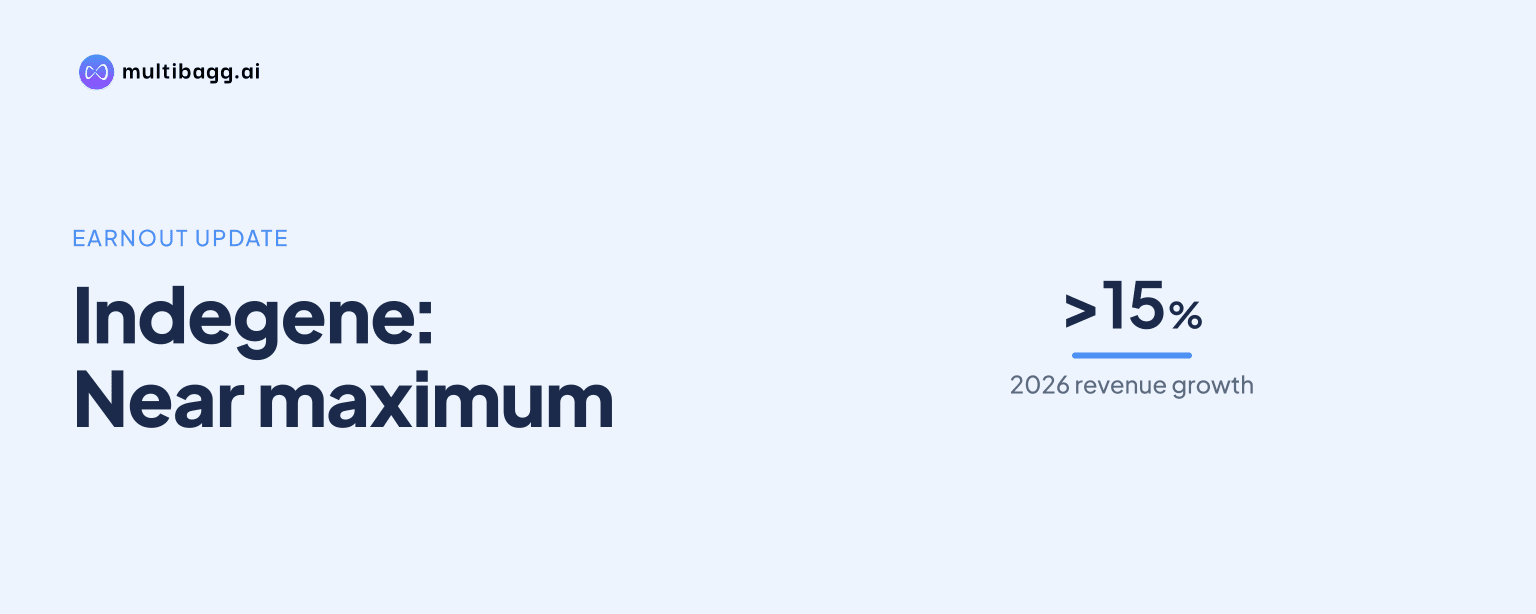
Indegene Limited completed BioPharm’s operational integration by the end of February, one month ahead of plan, and management expects calendar 2026 revenue growth above 15% to take the second earnout payment close to its maximum. Indegene also retained the acquired team and reinvested annual cost savings in expanding BioPharm’s go-to-market team to nine people from three.
Know Indegene inside out
Results, valuation, peers and who's buying, in one view.
When did Indegene complete the BioPharm integration?
Indegene completed BioPharm’s planned finance, human resources, information technology and legal transition by the end of February, ahead of its end-March target. The work also closed the seller’s transition-services arrangements, and management said client engagements continued without disruption during the changeover.
The completion date came before BioPharm’s first anniversary within Indegene on October 1. Management said it had achieved strong retention of the acquired U.S. team, which it had described at the time of the transaction as difficult to hire, and that the team was now fully part of Indegene.
The early completion is an operating milestone rather than a separate measure of BioPharm revenue. Management’s stated commercial objective is to combine BioPharm’s data-driven omnichannel and brand-activation capabilities with Indegene’s customer relationships, technology and delivery resources.
How did Indegene use BioPharm’s integration savings?
Indegene realised annual cost savings from the integration and reinvested them in growth, most visibly by expanding BioPharm’s go-to-market team to nine people from three. That threefold increase in commercial staffing reflects management’s view that BioPharm had previously received limited support because it had been operated mainly for margins.
Management said Indegene’s sales engine, technology, data and management teams could help unlock growth in the acquired business. It did not disclose a stand-alone BioPharm revenue figure for the second quarter of financial year 2027, so the effect of the larger commercial team cannot yet be separated from group performance.
The wider business context was a second-quarter revenue increase of 39.5% year on year and 5.6% sequentially to Rs 1,122.3 crore. Indegene said its top 20 accounts grew 6.7% sequentially in rupee terms, showing growth across larger customer relationships while it continued to invest in sales and delivery capacity.
The reinvestment decision means the reported savings are not presented as a direct addition to group profitability. Second-quarter earnings before interest, tax, depreciation and amortisation, or EBITDA, were Rs 187.3 crore, equal to a 16.7% margin, after the period absorbed an annual wage increase that management said reduced margin by about 150 basis points.
Will BioPharm’s growth trigger the earnout payment?
Management expects BioPharm’s calendar 2026 revenue growth to exceed 15% over calendar 2025, the condition for the second earnout tranche, and said the resulting payment should be close to the maximum. The company also said it had already provided for the entire earnout amount in its balance sheet.
The disclosed test applies to full-year calendar 2026 revenue rather than the completion of the February integration milestone. Indegene did not provide BioPharm’s quarterly revenue run rate or the value of the payment, so management’s near-maximum expectation remains dependent on the acquired business sustaining its current revenue trajectory through 2026.
Management linked its confidence to the combination of integration progress and commercial expansion. The enlarged nine-person go-to-market team is intended to provide more selling capacity, while BioPharm capabilities are being included in existing and new enterprise omnichannel engagements rather than being marketed only as a stand-alone service.
The group’s balance sheet provides context for the accounting provision. Cash and investments stood at Rs 1,389.6 crore at the end of the second quarter, while net days sales outstanding, excluding unearned and unbilled revenue, rose by two days sequentially to 69 days.
Got a follow-up? Ask IRIS
How is BioPharm changing Indegene’s data and omnichannel offering?
Indegene is incorporating BioPharm’s data and targeting capabilities into existing and new enterprise omnichannel engagements, including some of its largest pipeline pursuits. Management said the acquisition’s larger contribution is increasingly in how Indegene competes for broader client mandates rather than in a separately reported revenue line.
Tandem, a BioPharm capability, brought more than 20 years of proprietary data on physician responses to promotions, covering more than 300 million exposure events and 15 million engagements. The data increased Indegene’s physician profiles to more than 3.6 million from 1.8 million, with deeper coverage in oncology, rare diseases and ophthalmology.
Indegene has combined Tandem and Invisage in its Audience Intelligence platform, part of the Indegene Data Universe beneath its Cortex artificial-intelligence stack. Management said the platform has already supported Agentic Agency of Record, or Agentic AOR, research using synthetic key opinion leaders, reducing work it said could take traditional agencies months to a matter of days.
The company is also extending its GenAI-enabled Tectonic model across markets. Tectonic’s quarterly run rate rose to about 1.7 million from about 1 million, while contracted business exceeded 2 million per quarter looking ahead; management cautioned that rollout with its largest customer has been gradual even as the contracted scope expanded.
BioPharm’s capabilities therefore sit within a wider Enterprise Commercial strategy. That segment contributed about 71% of second-quarter revenue, compared with 25% from Enterprise Medical and 4% from Others, giving the omnichannel and data offering its largest reported revenue base.
Conclusion
BioPharm’s first year within Indegene has produced an integration completed one month ahead of schedule, retention of the acquired team and a larger go-to-market function. The combination of nine commercial staff, physician data covering more than 300 million promotional exposure events and deployment in enterprise omnichannel work shows that management is directing the acquisition toward sales capacity and broader client solutions.
The next item to watch is BioPharm’s calendar 2026 revenue growth against the more-than-15% earnout threshold, which management says could result in a near-maximum payment. At group level, management continues to target quarterly EBITDA margin above 19% by the fourth quarter of financial year 2027, following the reported 16.7% second-quarter margin and its plan for productivity, workforce transformation and operating leverage to aid the following two quarters.