










Campus expects Rs 125 crore GST credits unlocked in 12-18 months
Key highlights
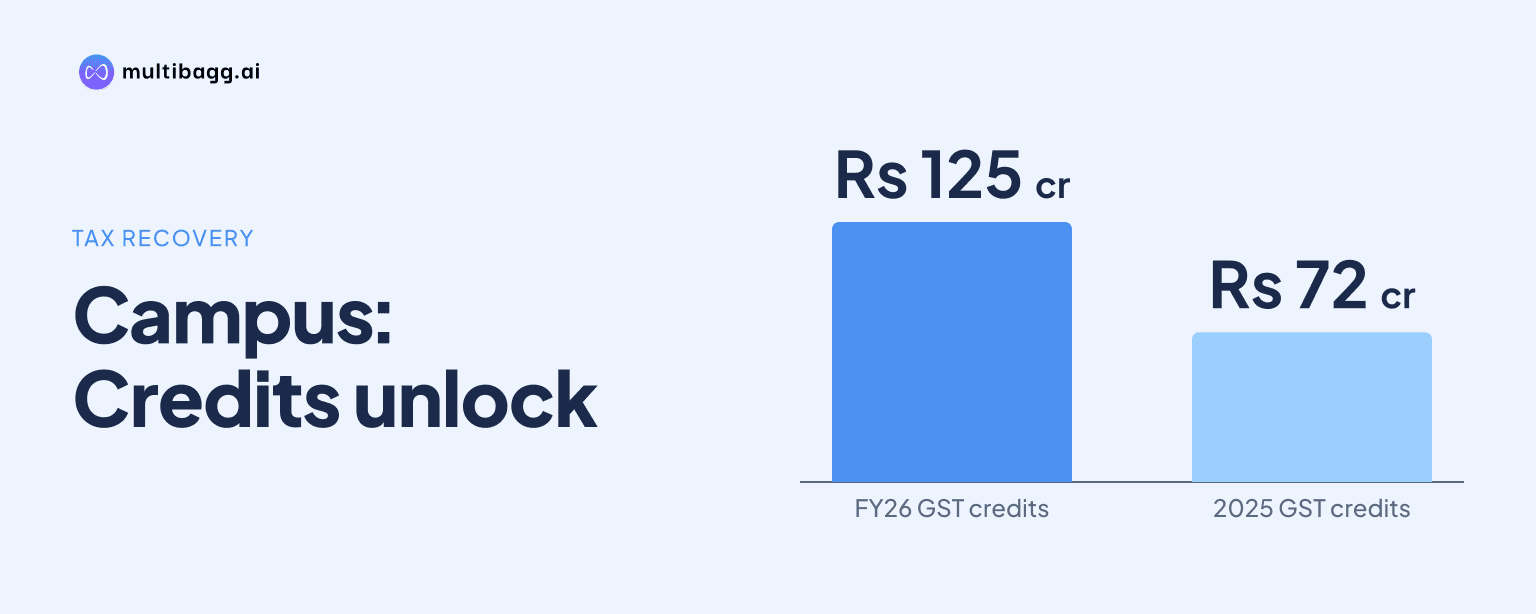
- Campus reported Rs 125 crore of GST input credits in FY26, compared with Rs 72 crore in 2025.
- Management expects the Rs 125 crore GST-credit balance to be unlocked over 12 to 18 months.
- Campus expects to claim roughly Rs 25 crore of refunds from Himachal Pradesh and Uttarakhand in that month or the following month.
- Campus said it carries more than Rs 600 crore of inventory and pays about 15% GST on average when buying material.
powered by IRIS
Campus Activewear expects to unlock Rs 125 crore of accumulated goods and services tax, or GST, input credits over 12 to 18 months, following post-season inventory reduction and a GST rule change affecting services refunds. Campus said it plans roughly Rs 25 crore of claims in Himachal Pradesh and Uttarakhand in that month or the following month.
Know Campus Activewear inside out
Results, valuation, peers and who's buying, in one view.
What is behind Campus’s Rs 125 crore GST credit balance?
Campus said the Rs 125 crore shown under balances with government authorities in FY26 was largely GST input credit recorded on its balance sheet. The amount had risen from Rs 72 crore in 2025, a Rs 53 crore increase. Management linked the accumulation to the company’s tax structure, rather than to a single refund claim or a new operating expense.
Nikhil Aggarwal said most of Campus’s portfolio is taxed at a 5% output GST rate, while the company incurs input taxes on materials and services. Campus also spends heavily on advertising and promotion, or A&P, according to management, creating service-side GST credits that previously could not be offset against the lower-taxed output portfolio.
The inventory position is another contributor. Neeraj Gupta said Campus was carrying more than Rs 600 crore of inventory on its books and pays about 15% GST, on average, when buying material. Management therefore expects the input-credit balance to move with inventory levels, although it said the balance will not fall to zero because the business will always need inventory.
How will Campus recover the GST input credits?
Campus plans to recover GST credits through refunds and through the release of input tax tied up in inventory. Rakesh Thakur said the company was claiming refunds from Himachal Pradesh, or HP, and Uttarakhand, or UK, and expected to submit claims of roughly Rs 25 crore in that month or the following month.
That initial Rs 25 crore claim would leave about Rs 100 crore, management said. Of this remaining balance, Rs 40 crore relates to Haryana and the rest is spread across other states. The state split shows that Campus’s recovery plan is not dependent on a single jurisdiction, although the transcript does not specify separate refund dates for Haryana or the other states.
Management also cited a GST Council amendment that, in its description, allows refunds related to services. Aggarwal said Campus had accumulated credits because service inputs could not previously be used under the earlier rule. Management’s view is that the changed mechanism means there should be no further accumulation from this source and that the existing balance should only decline.
The reduction in inventory is the other recovery channel. Thakur said inventory was slightly elevated and that the associated credit should reduce as stock is unlocked over the next couple of quarters. Management expects a larger movement after March, following the seasonal period, when inventory is expected to come down significantly.
Got a follow-up? Ask IRIS
When does Campus expect the Rs 125 crore balance to decline?
Campus expects the overall Rs 125 crore amount to take 12 to 18 months to unlock. Thakur said the process would begin more meaningfully after March, once seasonal inventory is reduced, and would then take additional time rather than producing an immediate full release.
Aggarwal gave a more phased description of the plan. He said a large portion should come down after March as inventory falls post-season, followed by a steady reduction over the next six months. This commentary is a management plan and timing expectation, not a reported completion of refunds or a guarantee that the full balance will be realised by a specific date.
The transcript distinguishes between the stock-linked part of the credit and the services-related part. Campus said monthly accumulation of Rs 2 crore to Rs 3 crore was no longer expected after the rule change described by management. That matters because the balance can decline only if new credits do not keep building at a comparable pace.
What could change the pace of Campus’s credit release?
Campus’s own inventory cycle is central to the timing. Management said the largest early reduction should occur after March, but it also said the company would continue carrying inventory for the business. Gupta’s reference to more than Rs 600 crore of inventory means some ongoing input-credit balance is structurally associated with the operating model.
The refund process also involves multiple states. Management identified HP and UK for claims of about Rs 25 crore, Haryana for Rs 40 crore of the residual Rs 100 crore, and other states for the rest. The transcript does not disclose the processing time, approval status or any final refund order for those claims, so the 12-to-18-month window remains management’s estimate.
The company’s broader seasonal trading pattern supports its expectation of a post-March inventory release. In the same call, management said trade-channel growth had not been driven by aggressive inventory build-up and was in line with standard inventory practices. That statement addresses channel inventory, while the credit discussion concerns Campus’s own books, but both comments point to management’s focus on controlling stock rather than adding it aggressively.
Campus is also pursuing higher-priced categories including ELAN, performance footwear and apparel, but management did not quantify any direct GST-credit effect from those launches. The relevant disclosed mechanism remains the mismatch between the 5% output tax rate on most of the portfolio, input taxes on purchases and services, and the inventory level held through the season.
Conclusion
Campus’s stated plan is to turn a Rs 125 crore balance-sheet asset into refunds and lower accumulated input credit over 12 to 18 months. The Rs 53 crore increase from Rs 72 crore in 2025 reflects the tax-rate mismatch and service-input credits described by management, while the expected reduction depends on both the services refund treatment and lower post-season inventory.
The next items to watch are Campus’s roughly Rs 25 crore refund claims in HP and UK, the inventory position after March, and whether the Rs 2 crore to Rs 3 crore monthly accumulation stops as management expects. Investors can also watch for updates on the Rs 40 crore Haryana component and the remaining credits across other states.