










India's currency in circulation grew 13.5% to ₹43.46 trillion
Key highlights
- India's currency in circulation reached ₹43.46 trillion on October 15, 2026, up 13.5% year-on-year.
- Currency in circulation growth was the highest in five years, according to the RBI's State of the Economy report.
- Reserve money stood at ₹53.24 trillion on October 15, up 10.3% year-on-year.
- Broad money supply growth accelerated to 16.9% year-on-year as of September 30, 2026.
powered by IRIS
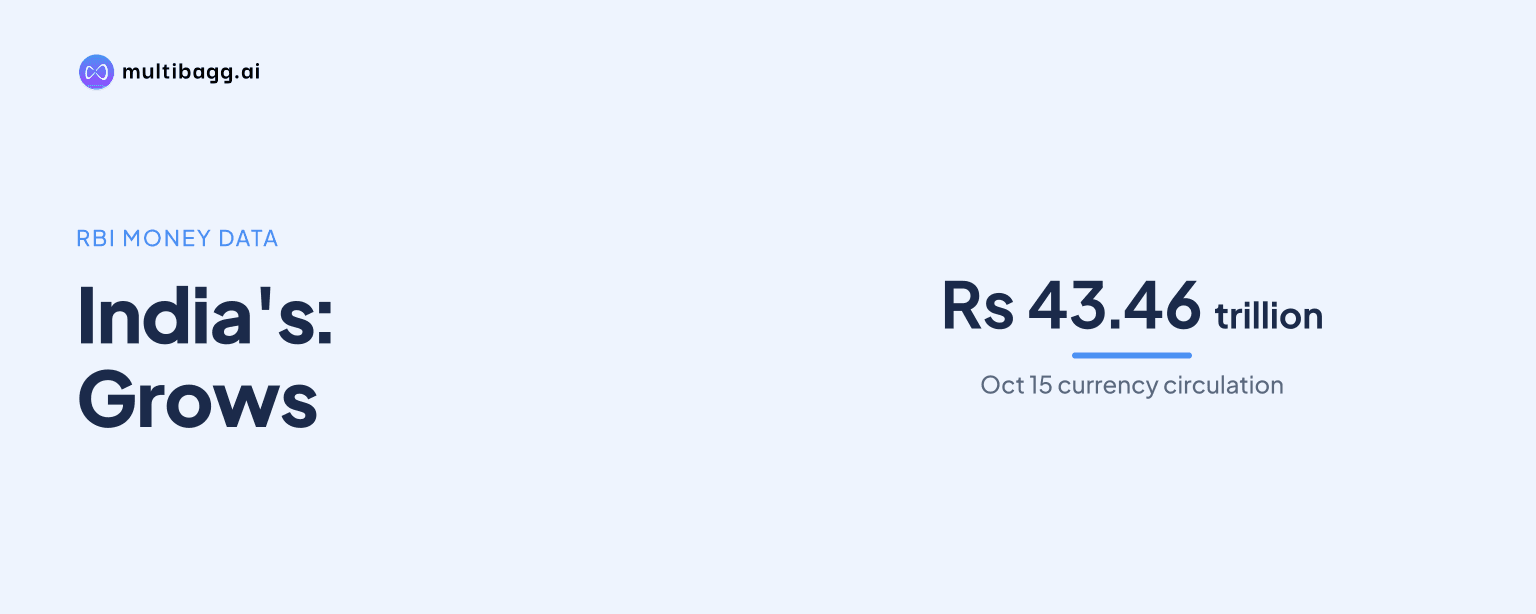
India's currency in circulation (CiC) rose 13.5% year-on-year to ₹43.46 trillion on October 15, 2026, marking its highest growth print in five years as FCNR(B) deposits and Reserve Bank of India liquidity measures supported reserve money expansion.
Why is India's currency in circulation rising?
CiC is rising at its fastest pace in five years, with the latest reported value reaching ₹43.46 trillion on October 15 and growth of 13.5% year-on-year. The Reserve Bank of India's State of the Economy report said the expansion in currency circulation contributed to robust reserve money growth, with FCNR(B) deposits identified as a key driver.
CiC includes notes in circulation, rupee coins and small coins. It measures the value of physical cash held across the economy, including cash used for transactions as well as cash held by households and businesses. The reported 13.5% growth followed 13.3% growth in the fortnight ended September 30, indicating that the pace remained elevated into October.
What is driving CiC and reserve money growth?
FCNR(B) deposits and RBI liquidity measures are cited as the main factors behind the recent strength in CiC and reserve money. The RBI report linked the five-year high in currency growth to deposits under the Foreign Currency Non-Resident (Bank) scheme, while noting robust expansion in reserve money after adjusting for the first-round effect of cash reserve ratio changes.
Reserve money includes CiC, banks' deposits with the RBI and other deposits with the RBI. On an adjusted basis, reserve money growth was 12.1% year-on-year at September-end, compared with 12.2% at August-end. The unadjusted measure was reported at ₹53.24 trillion on October 15, up 10.3% from a year earlier.
Earlier data also showed how CRR changes affected the composition of reserve money. In the fiscal year discussed in the SBI Research report, reserve money growth slowed to 5.8% because a CRR cut reduced the bankers' deposits with the RBI component by ₹1.86 lakh crore. That distinction matters when comparing headline reserve money growth across periods.
Why is cash growing while UPI payments remain large?
CiC is growing even as digital payment volumes remain substantial, showing that UPI adoption has not eliminated demand for physical cash. One month of UPI transaction value was about ₹28 lakh crore, or roughly 70% of the economy's total currency stock, according to the reported SBI Research estimates.
The data point to two parallel trends rather than a direct replacement of cash by digital payments. Social media discussion has described this as a cash paradox: cash demand continues to expand at double-digit rates even as the share of individual transactions conducted digitally declines. RBI Deputy Governor Shirish Chandra Murmu said this combination makes future demand for currency production and distribution harder to predict.
Earlier in 2026, CiC growth was reported at 12.5% year-on-year as of July 31, marginally above 12.4% at June-end. At that point, adjusted reserve money growth was 12.6% and broad money growth was 14.7%, also indicating that cash expansion was occurring alongside wider liquidity growth.
Got a follow-up? Ask IRIS
How fast is India's broad money supply growing?
Broad money supply is growing faster than nominal GDP in the reported data, with M3 expanding 16.9% year-on-year as of September 30, 2026. M3 principally includes currency and bank deposits, making it a broader measure than CiC alone.
For 2025-26, M3 growth was reported at 15.3%, up from around 9.3% in 2024-25, while nominal GDP growth was stated to be below 9% in the later year. Another compilation placed M3 at around 91% of GDP in March and around 93% by September, using projected GDP. Annual M3 growth was also reported at 16% on October 15.
The figures differ by reporting date and measure, but all indicate a faster pace of monetary expansion during 2026. Separate data cited M3 growth of 6.7% in the first five months of the year compared with the same period a year earlier, described as the strongest growth rate in seven years.
What do the latest cash and money supply figures show?
The latest figures show that cash, reserve money and broad money have all expanded strongly, while digital payments continue to handle large transaction values. CiC reached ₹43.46 trillion by October 15, and its 13.5% annual growth rate was the most rapid in five years.
The comparison also highlights that physical currency has continued to rise despite UPI's scale. Currency held by the public had risen 8.2% since March in one reported comparison, against a 4.1% increase in term deposits. The available data do not establish a single reason for all cash demand, but they show that cash remains an expanding part of India's monetary system.
Conclusion
India's currency in circulation has entered a period of faster growth, led by a 13.5% year-on-year increase to ₹43.46 trillion in mid-October. FCNR(B) deposits, RBI liquidity conditions and broader monetary expansion have coincided with this rise, while UPI transaction values remain large relative to the stock of cash.
Investors will watch subsequent RBI data on CiC, adjusted reserve money and M3 to see whether the elevated pace continues. The next key unresolved issue is whether FCNR(B)-linked flows and liquidity measures sustain the current trend, particularly as cash demand and digital payment adoption continue to move together.