










India Job Market Faces Pressure as Manufacturing PMI Slips to 54.7
Key highlights
- India's manufacturing PMI eased to 54.7 in October from 55.1 in September.
- Qualcomm's reported November layoffs could affect an estimated 3% to 6% of its workforce in India.
- Noida's operational apparel units reportedly fell from 2,400 to 1,800 in six months.
- CTI estimated Rs 11,000 crore of Delhi trade disruption on November 1 and said around 20 lakh people lost a day's income.
powered by IRIS
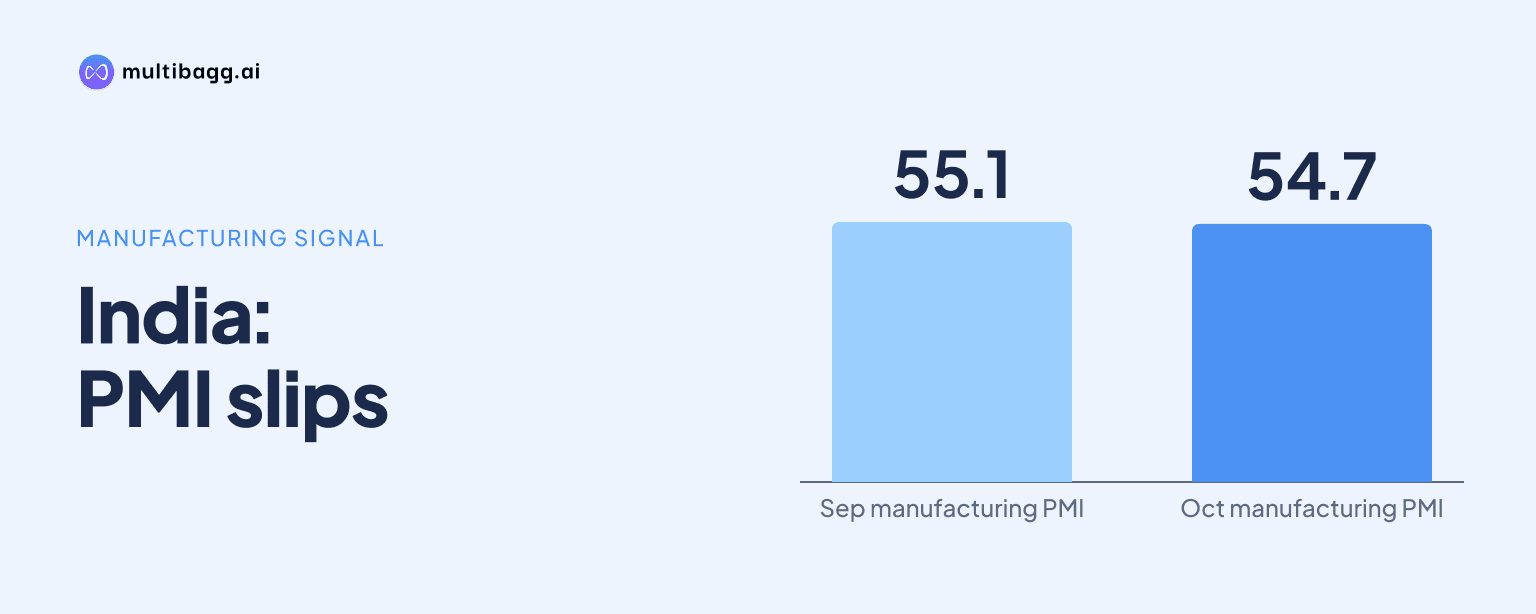
India's job market faces pressure from a slowdown in manufacturing momentum, reported technology layoffs and stress in labour-intensive industries, with the manufacturing Purchasing Managers' Index falling to 54.7 in October from 55.1 in September. The index remained above its long-run average, but hiring was subdued as domestic demand softened.
What is putting pressure on India's job market?
India's job market is facing several separate pressures, ranging from weaker orders in apparel and diamonds to potential technology-sector layoffs and disruptions to daily-wage work. The available reports do not establish one economy-wide job-loss total, but they point to uneven conditions across formal manufacturing, export-oriented businesses and informal work.
Qualcomm is expected to carry out further layoffs in November, according to a memo from chief executive Cristiano Amon cited in the discussion. The expected reduction is estimated at 3% to 6% of its workforce in India and similar proportions globally. Qualcomm has not disclosed the scale of the planned cuts or the number of roles involved, and it did not respond to queries cited in the report.
Why did manufacturing PMI fall to 54.7 in October?
India's manufacturing Purchasing Managers' Index fell because domestic-demand growth softened, although export orders expanded at their fastest pace in six months. S&P Global's survey, released on November 2 and cited by the Deccan Herald, put the October PMI at 54.7, down from 55.1 in September.
A reading above 50 indicates expansion, so the survey still showed manufacturing growth rather than contraction. However, output and new-order growth slowed month on month. Companies continued to add jobs and build inventories, but the pace of hiring was subdued, while business confidence fell from September and remained below its long-run average.
Which industries are reporting job-related stress?
India's job market is seeing reported strain in technology, apparel and diamond manufacturing, although the nature of the pressure differs by industry. Qualcomm is responding to challenges in consumer electronics while shifting its focus towards data centres and artificial intelligence technologies as part of a broader diversification effort.
In Noida's apparel industry, the number of operational units reportedly fell from 2,400 to 1,800 in six months as orders declined. Unpredictable US tariffs have created uncertainty around negotiations and production timelines. In Surat, diamond manufacturers extended Diwali shutdowns, with roughly 300 small businesses reported to have closed.
Got a follow-up? Ask IRIS
How did the Delhi rally affect workers and businesses?
India's job market was also affected by a one-day disruption in Delhi, where the Chamber of Trade and Industry estimated an economic loss of Rs 11,000 crore from the November 1 mega rally at Ramlila Maidan. The figure is CTI's assessment of business activity in affected sectors, rather than an official measure of lost output.
CTI said about 2.5 lakh shops remained shut. It estimated losses of Rs 8,800 crore in retail and wholesale trade, Rs 1,500 crore in transport and logistics, and around Rs 500 crore in hospitality, hotels, restaurants and tourism. The body also put the informal-sector and daily-wage impact at Rs 200 crore, estimating that around 20 lakh people lost a day's income.
What does the available evidence say about employment conditions?
India's job market data in these reports shows continued manufacturing expansion but less forceful hiring, alongside concentrated stress in specific industries and locations. This distinction matters because the PMI survey found firms were still adding jobs, while the other reports describe potential layoffs, operational closures and lost daily earnings.
The reports also show a divide between export demand and domestic demand. Export orders strengthened in manufacturing, but domestic demand softened. For workers, the immediate effect can vary widely: a potential corporate restructuring affects salaried technology roles, while a market closure or factory shutdown can quickly reduce the income of workers paid daily or through small businesses.
Conclusion
The combined picture is of a job market under pressure rather than a confirmed broad-based employment contraction. Manufacturing stayed in expansion territory at 54.7, but slower domestic demand, subdued hiring and lower business confidence coincided with reported layoffs, apparel-unit reductions, diamond-business closures and a major one-day disruption to Delhi trade.
The next signals to watch are Qualcomm's disclosure, if any, on the scale and timing of its November cuts; whether Noida apparel orders recover amid tariff uncertainty; and whether manufacturing demand and hiring improve in the next PMI survey. The direction of domestic orders and business confidence will be particularly important for judging whether the October slowdown is temporary or more persistent.