










NSE India Data Tools Extend AI Paper-Trading Workflows
Key highlights
- The cited NSE bhavcopy server offers end-of-day data for 3,500-plus listed equities across five years.
- The discussion describes intraday NSE data as near real time with a one-to-three-minute delay.
- PaperTrade-India is described as simulating realistic fees, T+1 settlement and live prices for NSE and BSE.
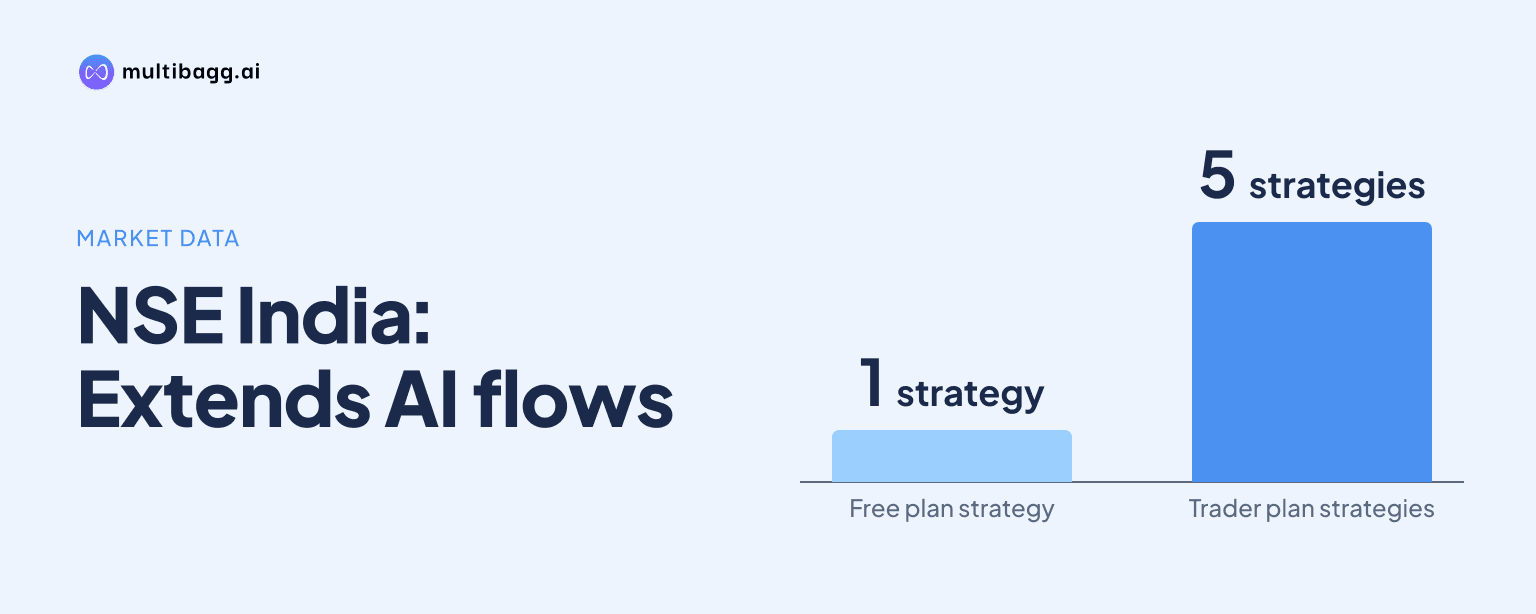
- INDfolio AI says its free plan includes one paper strategy, while its Trader plan includes five.
powered by IRIS
NSE India discussions show a growing set of AI-connected data and simulated-trading tools, with one NSE bhavcopy server offering end-of-day data for more than 3,500 listed equities over five years. The shared examples combine market-data access, plain-English analysis, backtesting and paper-trading workflows, while differing substantially in data timing and execution features.
What data access is being discussed for NSE?
The discussion centres on an nse-bhavcopy server that presents end-of-day data for 3,500-plus listed equities over the past five years. Users can connect compatible AI applications and ask questions in plain English rather than download files, work through spreadsheets or write code.
The cited connection uses the URL https://mcp.nseindia.in/bhavcopy/cm/mcp and is described as an MCP, or Model Context Protocol, connection. MCP is presented as a standard way for AI applications to connect with outside data sources. The material separately says intraday data is near real time but delayed by one to three minutes, an important distinction from end-of-day data.
How are AI tools using NSE data?
AI tools discussed around NSE are designed to turn natural-language requests into market-data queries, screens or strategy rules. Examples include asking how a company performed during the year, ranking an index, analysing technical setups and generating a trading plan with entry, stop, target and position sizing.
Some projects describe automated scans across an NSE index, six technical setups for each stock and backtests using that stock's prior-year history. Other tools list functions including option chains, implied volatility, FII and DII flows, financial ratios, filings, IPO information and portfolio features. These are claims made by the listed tools, not a common capability guaranteed across every service.
The posts also refer to AI systems that create explicit and editable strategy rules from a plain-English description. That matters because an understandable rule set can be reviewed before it is backtested or used in simulated trading. However, the context does not provide comparable performance results for these systems or evidence that an AI-generated trade plan will be profitable.
Got a follow-up? Ask IRIS
What does NSE paper trading aim to simulate?
NSE paper-trading products aim to simulate the practical conditions between a strategy backtest and a live order. The examples describe virtual capital, live market prices, Indian trading costs, T+1 settlement, market hours, lot sizes, intraday square-off and execution or fill logic.
One open-source project, PaperTrade-India, is described as a production-grade simulated broker for NSE and BSE with realistic fees, T+1 settlement, live prices and an Alpaca-style API. Another project, SnakeTrader, is described as running live paper trades in Indian equities with Rs 2 lakh of fake-money accounts using real NSE prices and real costs.
INDfolio AI says its paper-trading system covers NSE equity, futures, options and indices, and uses the same execution engine, fill logic and risk checks that it uses for live deployment. It also says its free plan includes one paper strategy, its Trader plan includes five and its Pro plan has unlimited strategies. These product descriptions indicate how providers seek to reduce the gap between testing and deployment, but they do not remove market risk.
What limits should users consider before deployment?
Users should distinguish between an exchange-data connection, a third-party analytics tool, a simulated broker and a broker order-routing system. The social-media material groups these technologies together, but they serve different roles: data retrieval, research, strategy testing, paper execution and live execution.
Timing is another limitation. A stated one-to-three-minute delay for intraday data may be relevant to strategies that depend on very short-term price moves. Similarly, paper-trading systems can model costs and settlement, but the discussion does not establish that every simulated fill will match a live-market outcome.
Broker integration also has conditions. The material says Zerodha's hosted Kite MCP leaves out trading tools and that order placement requires a self-hosted Kite MCP with the user's own Kite Connect key. INDfolio AI says a strategy can be deployed with one click once a broker is connected and refers to seven SEBI-registered brokers, while other projects mention Zerodha Kite, Kotak Neo, Angel One SmartAPI or Groww MCP. A retail user would need to verify the relevant connection, permissions and risk controls before relying on any workflow.
Conclusion
The discussion around NSE shows that AI market-data access and paper-trading infrastructure are becoming more connected. End-of-day coverage for more than 3,500 equities, delayed intraday feeds, natural-language queries and simulated execution features can make market research and strategy rehearsal more accessible, but they are not interchangeable services.
The next point to watch is how individual platforms document their data timing, charges, fill assumptions and broker permissions before a paper strategy is moved to live orders. The disclosed plans range from a single free paper strategy to unlimited strategies on paid tiers, while live deployment depends on connecting a supported broker and, in some cases, supplying the user's own API credentials.