










Reliance Power Limited remains near ₹18 after 62% annual decline
Key highlights
- Reliance Power traded at ₹18.28 on 3 November 2026, down 1.56% for the session.
- Reliance Power touched an intraday low of ₹16.18 on 23 October after seven consecutive losing sessions.
- Reliance Power fell 12.03% in the week ended 23 October, while the Sensex declined 3.75%.
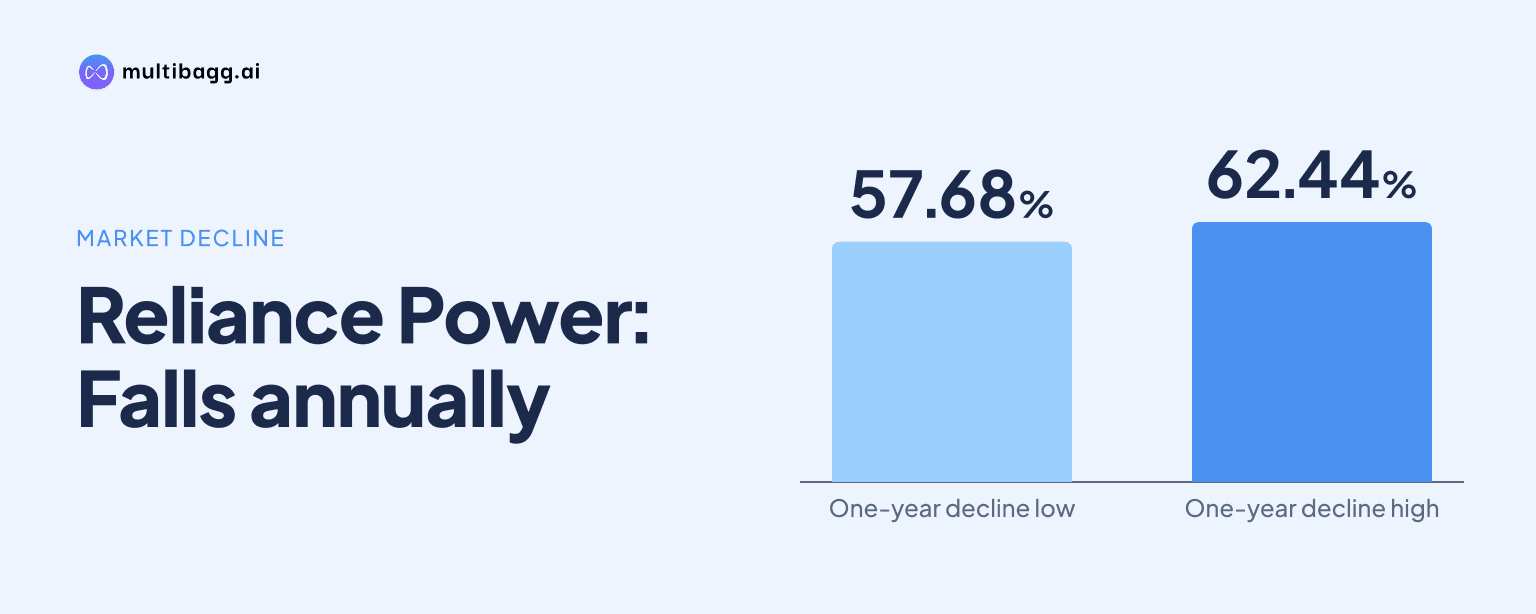
- Reliance Power's reported one-year decline ranged from 57.68% to 62.44% across supplied market snapshots.
powered by IRIS
Reliance Power Limited traded at ₹18.28 on 3 November 2026, remaining near the lower end of its reported 52-week range after a reported 62.44% fall over one year and an October sell-off that pushed the share to an intraday low of ₹16.18. The stock had recovered from that low but remained under sustained pressure.
Why is Reliance Power trading near ₹18?
Reliance Power is trading near ₹18 because the stock has suffered a sharp decline across short, medium and annual periods, despite intermittent rebounds. The latest supplied market snapshot put the share at ₹18.28 on 3 November, down ₹0.29, or 1.56%, from the previous close. Its intraday range during that session was ₹18.10 to ₹18.85.
The share was also quoted at ₹18.57 in another 3 November market update, with a year-on-year fall of 60.00%. A separate data snapshot showed a 62.44% annualised decline, while the latest performance table showed a 57.68% one-year loss. These figures differ by source snapshot, but all point to a fall of roughly three-fifths over the year.
What happened during Reliance Power's October sell-off?
Reliance Power's October sell-off included seven consecutive losing sessions that culminated in a fresh 52-week intraday low of ₹16.18 on 23 October. The stock closed at ₹16.45 that day and was down 12.03% for the week from 19 to 23 October, compared with a 3.75% decline in the Sensex over the same week.
The sequence of lower levels was pronounced. The supplied discussion cited ₹18.30 on 19 October, ₹17.50 on 21 October and ₹16.85 on 22 October before the 23 October low. Another account described the seven-session decline as 19.1%, while a separate calculation put the seven-day loss at 17.07%. Both descriptions show the scale of the late-October pressure.
Trading activity rose during the decline. One report cited 1.19 crore shares traded on 21 October, while another recorded 70,43,362 shares on 23 October, valued at about ₹11.77 crore. Higher volume by itself does not establish the reason for a price move, but it indicates elevated activity while the stock was falling.
What do Reliance Power's recent market signals show?
Reliance Power's recent market signals show persistent weak momentum, with the supplied context stating that the stock traded below its 5-day, 20-day, 50-day, 100-day and 200-day moving averages. The same discussion referred to heavy volumes and a strong sell rating from MarketsMOJO during the October decline.
The stock's position within its 52-week range also underlines the weakness. It was near the reported low of ₹15.98 and far below reported highs of ₹46.58 and ₹47.68 in separate market snapshots. Short-term recoveries from the October low have therefore occurred against a backdrop of a much larger annual decline, rather than reversing the broader price trend described in the supplied data.
Got a follow-up? Ask IRIS
How did market and regulatory developments coincide with the fall?
Reliance Power's weakness in October coincided with a reported Enforcement Directorate asset seizure worth ₹2,032.81 crore in a FEMA investigation. On 15 October, the shares reportedly fell 4.69% to ₹18.90 from ₹19.83 as the news added to market pressure.
The broader market comparison was notably different on that date. The supplied context said the Sensex rose 620.05 points, or 1.1%, to 73,585.85, while Reliance Power remained under pressure. It also stated that the Sensex was 3.12% above its 52-week low, compared with a 57.05% annual decline for Reliance Power in that snapshot. This contrast shows that the stock's fall was substantially sharper than the cited broad-market movement.
What should traders take from the Reliance Power decline?
Reliance Power's recent price action illustrates the risk of treating a rebound from a 52-week low as confirmation that a downtrend has ended. The stock moved back toward ₹18 after reaching ₹16.18 intraday, but it remained down 7.56% over one month, 22.20% over three months and 35.36% over six months in the latest supplied return data.
The social-media discussion also highlighted the broader risk in equity futures and options trading: 9 out of 10 individual traders in the segment incurred net losses, with loss-making traders recording an average net trading loss close to ₹50,000. It further said transaction costs added 28% of net trading losses for loss makers. These are market-wide figures, not figures specific to Reliance Power, but they are relevant when volatile shares attract short-term trading interest.
Conclusion
Reliance Power has remained close to ₹18 after an October period marked by consecutive declines, fresh 52-week lows and elevated trading activity. While the exact one-year return differs across the supplied data snapshots, the shared finding is clear: the share has lost roughly three-fifths of its value over the year and continues to trade near the bottom of its reported 52-week range.
Investors will next watch whether Reliance Power can sustain a move away from the ₹15.98 to ₹16.18 low area, and whether selling pressure eases after the seven-session October decline. The disclosed FEMA investigation and the reported asset seizure of ₹2,032.81 crore remain an unresolved development to monitor alongside future price and volume trends.